







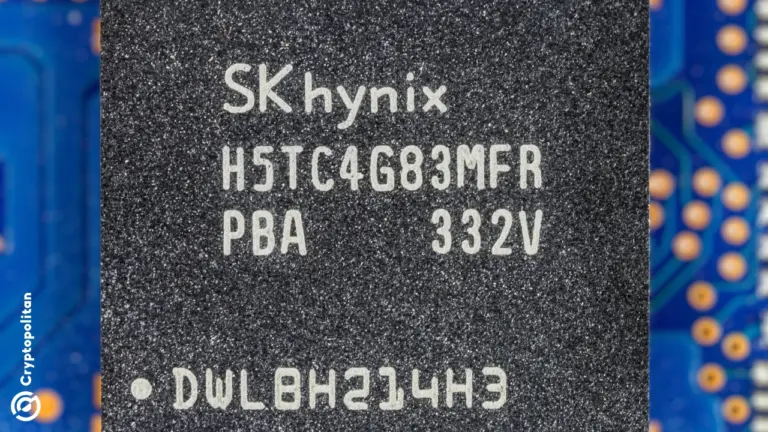
- SK Hynix expects memory demand to outrun supply through 2030.
- Long-term deals with 14 major customers cover more than 50% of its 2027 and 2028 production capacity.
- Third-quarter revenue hit a record 104.6155 trillion won, the first time it topped 100 trillion won.
SK Hynix told investors on Wednesday memory demand will exceed supply through 2030.
The Korean chipmaker reported record results for the third quarter and plans to return about 100 trillion won to shareholders this year alongside the forecast.
HBM and DRAM chips are sold out until 2029
SK Hynix believes that the crunch is a supply problem. Leading edge processes continue to get more arduous and new fabs take years to build so output can’t keep up through 2030.
The company said during its earnings call that it has sold out of its HBM and DRAM chips until 2029. HBM demand is double what SK Hynix can supply, it said.
Short-term demand comes from AI for enterprises and consumers. Further out, physical AI like autonomous driving and robotics takes over.
The chipmaker has long-term deals with 14 large customers including leading global cloud services providers. The volume locked in so far constitutes more than half of total production capacity for 2027 and 2028.
Most contracts are for five years. Prices are within a range agreed with each client as market conditions shift.
Quarterly revenue tops 100 trillion won for the first time
The company said in its results that revenue for the quarter reached 104.6155 trillion won, topping 100 trillion won for the first time.
Operating profit was 83.3338 trillion won with 80% margin. Net profit was 39.7756 trillion won.

Revenue jumped 32% from 79.3187 trillion won in the second quarter. Operating profit rose 38% from 60.5426 trillion won.
DDR5 sales for servers led the DRAM sales, and HBM4 shipments got off to a strong start. SK Hynix plans to operate its M15X plant at full capacity by year’s end in a bid to increase HBM4 output and expects HBM4 to surpass HBM3E in shipments and revenue in the fourth quarter.
Cash and cash equivalents climbed to 114.5 trillion won. Net cash was 98.7 trillion won.
The plan to return 100 trillion won blends cash dividends of 30 trillion won or more and buybacks and cancellations of 60 trillion won or more. That includes the buyback announced in August, which was completed last week, for 40 trillion won.
The dividend for the third quarter is 20,000 won a share. Half of that is a special dividend paid out of the gains on the company’s stake in Kioxia.
SK Hynix CEO Kwak Noh-Jung also explained why SK Hynix dropped an IPO of its US flash-memory unit Solidigm, a reversal Cryptopolitan reported on October 23. Kwak blamed market volatility and a slide in chip stocks for halting the IPO and a pre-IPO fundraising review.
“The IPO was intended to raise external capital for the expansion of Solidigm’s production facilities,” Kwak said. The company “concluded that proceeding at this time would not be the best way to achieve the originally anticipated outcome,” he added.
Don’t just read crypto news. Understand it. Subscribe to our newsletter. It's free.
FAQs
How long does SK Hynix expect the memory shortage to last?
SK Hynix expects demand to outstrip supply through 2030, because leading-edge processes keep getting harder and new fabs take years to build.
How much did SK Hynix earn in the third quarter of 2026?
Revenue was 104.6155 trillion won and operating profit 83.3338 trillion won, both quarterly records.
Why did SK Hynix cancel the Solidigm IPO?
CEO Kwak Noh-Jung said proceeding now would not achieve what the IPO aimed for, which was outside capital to expand Solidigm's production.
Disclaimer. The information provided is not trading advice. Cryptopolitan.com holds no liability for any investments made based on the information provided on this page. We strongly recommend independent research and/or consultation with a qualified professional before making any investment decisions.

Randa Moses
Randa Moses is an editor and reporter at Cryptopolitan covering tech, AI, robotics, crypto, scams, and hacks. She has worked in the crypto space since 2017. She held roles at Forward Protocol, AmaZix, and Cryptosomniac. Randa holds a degree in Electrical and Electronics Engineering from the University of Bradford.









