





Sharplink doubles down on DeFi with Galaxy Digital despite $686M Q1 loss

- Despite taking losses, Sharplink now holds nearly 873K ETH, worth about $1.7B, and maintains its position as the world’s second-largest corporate Ether holder.
- SharpLink and Galaxy Digital are launching a $125M onchain yield fund targeting higher-return DeFi lending and trading strategies.
- The expansion into DeFi followed April 2026, a record-bad month for crypto hacks.
Sharplink Inc., the world’s second-largest corporate holder of Ether (ETH), has reported a net loss of $685.6 million for the first quarter of 2026 in its financial and operating results on Monday, May 11.
The company, which holds 872,984 ETH worth approximately $1.7 billion as of May 4, has also unveiled plans to launch the Galaxy Sharplink Onchain Yield Fund in partnership with Galaxy Digital.
The private vehicle will be seeded with $100 million from Sharplink’s staked Ethereum treasury and $25 million from Galaxy Digital, the New York crypto and asset management firm founded by billionaire Mike Novogratz. Both companies are focusing on the decentralized finance (DeFi) lending and trading sector that just endured its worst month of hacking on record.
Galaxy will serve as the sole investment manager, overseeing protocol selection, position sizing, and risk controls.
Galaxy has been actively deploying capital on-chain since 2020. In June 2025, it closed a $175 million venture fund targeting early-stage investments in DeFi, stablecoins, and blockchain infrastructure.
Why is staking no longer enough for Sharplink?
Sharplink’s first-quarter results show why the company is reaching further down the yield curve. Its revenue jumped to $12.1 million in the three months to March 31, from $0.7 million a year earlier. This rise was driven almost entirely by the actively managed ETH treasury strategy it launched in June 2025.
The company held 872,984 ETH as of May 4, worth roughly $1.7 billion, and has generated 18,800 ETH in staking rewards since inception. Although Strategic ETH Reserve reports the firm’s current holdings at around 863, 020.
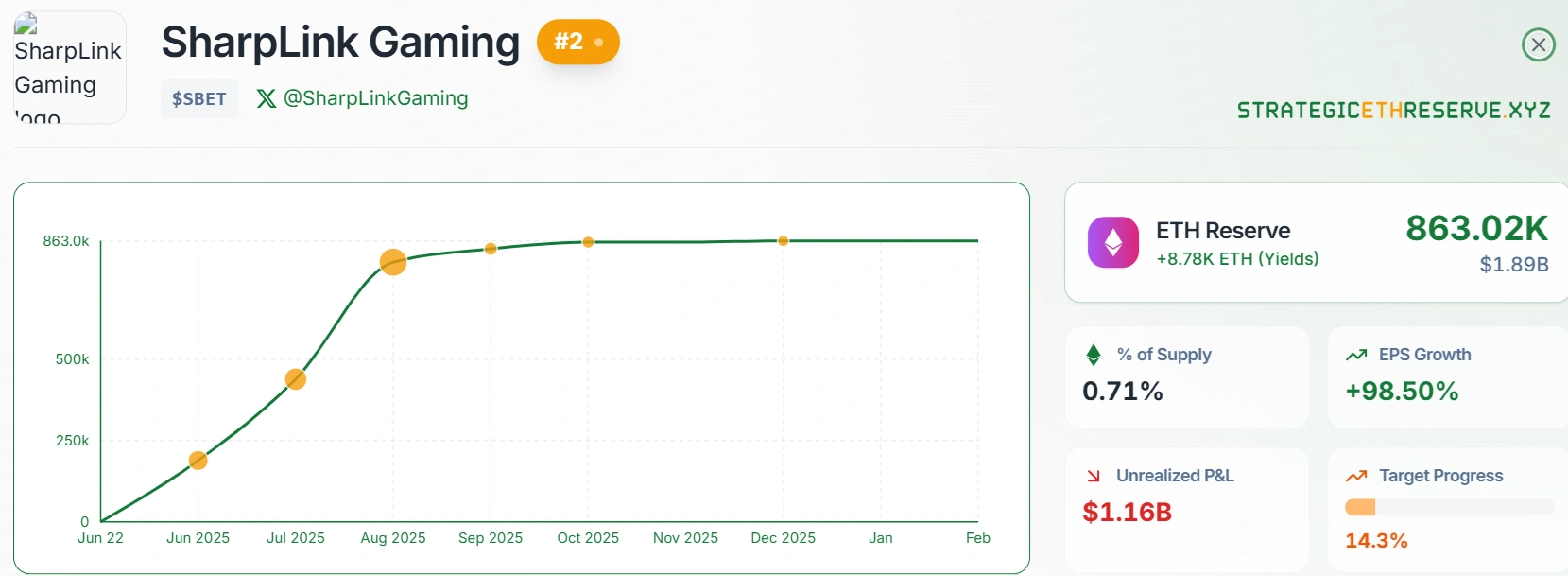
Native Ethereum staking now yields only 2.5 to 3.5% a year, and Sharplink’s market-to-net asset value (mNAV) reportedly sits at 0.79, meaning that the market is pricing the company’s stock below the value of the ETH on its balance sheet.
The Galaxy fund is a direct response. Lending and liquidity provision in DeFi can produce annual returns of 10% or more, with correspondingly higher risk.
How big is the Q1 loss, and what does it actually mean?
Sharplink reported a net loss of $685.6 million for the quarter, up from $1 million a year earlier. The bulk of that, a $506.7 million unrealized loss on ETH and a $191.7 million impairment on liquid staking tokens, is non-cash, reflecting US GAAP fair-value treatment of crypto assets after a first-quarter decline in ETH prices.
However, none of them reduces the number of tokens Sharplink holds.
By the metric the company prefers, ETH per share, Sharplink has more than doubled its position since June 2025, rising from 2.0 to 4.02. Cash and equivalents fell to $16.9 million from $28.5 million at the end of 2025. Its selling, general, and administrative expenses went up to $9.9 million as the firm internalized most of its asset management platform.
“During the quarter, we deployed our ETH capital with discipline, internalized the majority of our asset management platform, and have moved beyond foundational staking into a broader set of on-chain opportunities,” chief executive Joseph Chalom, formerly head of BlackRock’s digital assets strategy, said in a statement.
Is this the right time to push deeper into DeFi?
The fund arrives at one of the worst stretches in DeFi’s short history. On April 1, North Korea-linked attackers stole $285 million from Drift Protocol, Solana’s largest decentralized derivatives exchange, through a months-long social engineering operation.
April 2026 recorded the highest number of crypto hacking incidents of any single month ever, with TRM Labs attributing 76% of 2026 losses through April to North Korean-linked operations.
Chalom is not discouraged by the recent turmoil, as he stated, “The really interesting thing is, out of any financial crisis, whether in traditional finance, DeFi, or other sectors, you end up raising the standards for the next wave of entrants and the next deployments and allocations,” he said.
For him, the protocols that place a high premium on security will survive, and those are the ones they are going to support and invest in.
The smartest crypto minds already read our newsletter. Want in? Join them.
Disclaimer. The information provided is not trading advice. Cryptopolitan.com holds no liability for any investments made based on the information provided on this page. We strongly recommend independent research and/or consultation with a qualified professional before making any investment decisions.

Hannah Collymore
Hannah is a writer and editor with nearly a decade of blog writing and event reporting experience in the crypto space. At Cryptopolitan, Hannah contributes to the news page, reporting and analyzing the latest developments in DeFi, RWA, crypto regulation, AI and frontier tech industries. She graduated from Arcadia university with a degree in Business Administration.









