






Fed Chair Powell’s tone and yield curve to steer market reaction to Fed rate cut

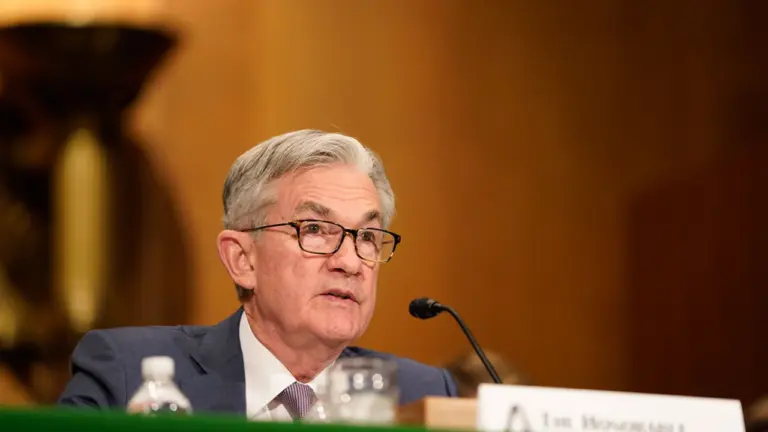
Chair Powell presents the Monetary Policy Report on February 12, 2020. Photo by Federal Reserve
- The Federal Reserve is expected to deliver the first rate cut since 2024, with market pricing in a 25 basis point reduction.
- Investors are watching Powell’s tone, updated dot plot, and Treasury yield curve for signs of future monetary policy direction.
- Mortgage rates, consumer spending, and small-cap stocks all hinge on whether easing sparks growth or stirs inflation risks.
The Federal Reserve’s big decision is coming on Wednesday, when Chair Jerome Powell will confirm if the US central bank has made its first interest rate cut since 2024. Futures markets have already priced in a 25 basis point reduction, which would bring the federal funds target range to between 4.00% and 4.25%.
In the last four decades, the stock market index S&P 500 has witnessed upticks in eight of ten cycles after the central bank eased borrowing rates, averaging nearly 11% over the next year.
Looking at the present times, when the current administration is talking about a resilient GDP and financial conditions, added to steady earnings from large-cap companies, America could be in for another “soft landing” period.
Small-cap stocks to gain on rate cuts, inflation still a problem
BMO chief strategist Brian Belski believes a reduction in borrowing rates is good for risk assets, like small-cap stocks. Despite lagging behind larger peers, small-caps are cheap, with the S&P Small Cap 600 carrying a forward price-to-earnings ratio of 15.5, versus 22.7 for the S&P 500.
Belski sees this discount as an opportunity for smaller companies to benefit from easing credit conditions. However, he insisted that the US central bank has a “dual mandate to respect inflation and job market data.”
According to data from TradingEconomics, inflation grew to a 40-year high in 2022, but has now cooled to 2.9% as of August, still above US policymakers’ 2% target.
Some economists have compared current times to 2007, when rate cuts failed to prevent a recession and caused inflationary pressures. Consumer price inflation is still at 3.3%, but wholesale prices are higher than citizens would like.
A report from the Yale Budget Lab earlier this month found that core goods prices were 1.9% above pre-2025 trends as of June. The study pointed to the increase in US tariffs on trade partners, which have increased costs for everyday items such as window coverings, appliances, and electronics.
Spending data: US is currently a two-tier economy
According to McDonald’s Chief Executive Chris Kempczinski, wealthier households are spending more comfortably, but middle- and lower-income groups are inclined to keep funds in their pockets.
“Particularly, with middle and lower-income consumers, they’re feeling under a lot of pressure right now,” Kempczinski said. He described the current climate as a “two-tier economy,” where higher-income Americans maintain their lifestyles while the rest cut back.
On the housing front, mortgage rates have already responded to expectations of Fed easing, with the average 30-year fixed rate falling to an 11-month low of 6.35% last week. Markets have already priced in three 25-basis-point cuts this year and three more by the end of 2026.
“This means that the markets have high expectations for the Fed’s upcoming rate cuts, and the market could very well be disappointed by a slower Fed pace,” Danielle Hale, Chief Economist at Realtor.com, surmised.
A contentious decision could also move mortgage rates in the opposite direction. If Fed policymakers deliver a split vote or issue guidance that falls short of market assumptions, rates could go upwards.
US mortgage rates plunged to a two-year low ahead of expected cuts in September last year, but corrected once investors realized the easing cycle would not continue onwards to the incoming fiscal year.
Don’t just read crypto news. Understand it. Subscribe to our newsletter. It's free.
Disclaimer. The information provided is not trading advice. Cryptopolitan.com holds no liability for any investments made based on the information provided on this page. We strongly recommend independent research and/or consultation with a qualified professional before making any investment decisions.

Florence Muchai
Florence has been covering for the past 6 years crypto, gaming, tech, and AI news. Her Computer Studies at Meru University of Science and Technology and Disaster Management and International Diplomacy at MMUST amply equip her with language, observation and technical skills. Florence has worked at VAP Group and as an editor for several crypto media houses.









