





Neuralink wins FDA nod for first US pivotal BCI trial as China pulls ahead


-
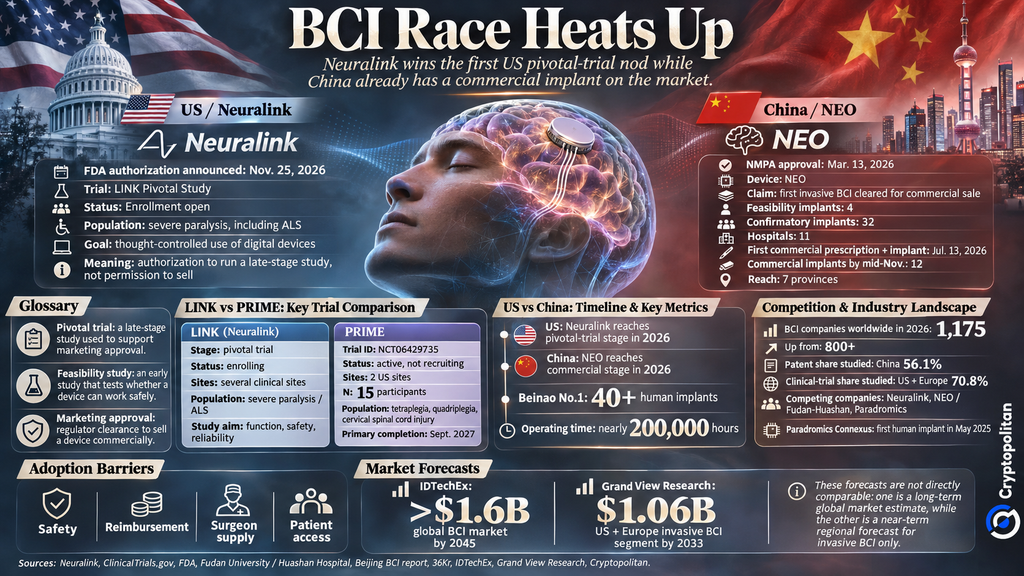
Neuralink has received FDA authorization to launch its LINK pivotal study, evaluating digital-device control in people with severe paralysis caused by ALS.
-
China has already authorized a commercially available implantable BCI designed to help patients regain hand function.
-
Long-term safety, clinical effectiveness, insurance coverage and surgical capacity remain significant barriers to widespread adoption.
Elon Musk’s Neuralink announced on November 25 that it received authorization from the US Food and Drug Administration (FDA) to launch its LINK study. It is the first US pivotal trial of an implantable brain-computer interface (BCI), a technology that allows people to control external devices using brain signals.
A pivotal trial is a late-stage study that collects data to back up the marketing approval, or permission from the authorities to sell a medical device. The FDA authorization allows Neuralink to carry out the study but does not give permission for sales of the product yet.
While Neuralink is approaching the commercialization of its brain implant, China is already way ahead. The country has authorized a competing device for commercial use in March.
What the LINK study will measure
LINK will be assessing the ability of people suffering from severe paralysis caused by amyotrophic lateral sclerosis (ALS), a condition that damages the nerves responsible for controlling muscle movement, to use digital devices through their thoughts.
Researchers will assess how well participants perform everyday tasks independently. They will also monitor the implant’s safety and reliability across several clinical sites.
Enrollment is now open. LINK builds on feasibility studies, or early-stage studies that assess a device’s safety and how well it works.
Neuralink says more than 30 participants in the United States, Canada and the United Kingdom have spent thousands of hours using its implants to study, communicate with family and perform other tasks.
Neuralink’s earlier trial stops recruiting
Neuralink has closed enrollment for its first clinical trial in the US, known as PRIME, and switched to recruiting for LINK. According to a recent update from PRIME’s clinical trial registry (NCT06429735) on November 24, it has revised the expected primary completion date of the trial from June 2026 to September 2027.
PRIME has an estimated enrollment of 15 participants across two US clinical sites. The trial involves adults aged 22 to 75 with paralysis affecting all four limbs or injuries to the spinal cord in the neck.
The longer timeline shows how long it would take for researchers to find out if brain implants can be used over a long period of time.
China already crossed the line Neuralink is approaching
On March 13, 2026, the National Medical Products Administration of China gave the green light to NEO, a brain implant that enables patients to wield objects once more.
Fudan University touts NEO as the world’s first implantable BCI approved to sell as a Class III medical device, a regulatory category for medical devices of high risk.
Four patients were implanted with NEO implants during feasibility testing, according to 36Kr. An additional 32 patients underwent NEO implantation in a subsequent clinical trial across 11 hospitals before regulatory approval.
Four months after receiving regulatory permission, Huashan Hospital carried out its first-ever commercial implantation, on July 13. Reports say that as of mid-November, 12 commercial implantations had been performed across seven provinces in China.
The president of Huashan Hospital and the leader of NEO’s clinical trial, Mao Ying, said on March 17:
“Every step of exploration today is paving the way for accessible rehabilitation technologies tomorrow, making them truly available, affordable and effective for more patients.”
The numbers behind the race
The BCI industry is getting crowded. According to a November 24 Beijing conference report, the number of BCI companies worldwide rose from more than 800 to 1,175 in 2026.
NEO is not China’s only success in human trials. More than 40 human implantations of the country’s Beinao No.1 system have clocked up nearly 200,000 hours of operation.
China’s strength lies in patent activity. Researchers Gaku Fujiwara and Chikako Saotome examined 4,216 patent applications for a May 2026 study and found that 56.1% came from China. However, the US and Europe accounted for 70.8% of the 195 clinical trials they reviewed.
Among Neuralink’s US competitors is Saudi-backed Paradromics, which temporarily implanted its Connexus device in a human in May 2025. By September 2026, the company reported that its implant had enabled real-time speech.
What has to happen before a market exists
Market researchers see commercial potential in brain-computer interfaces. IDTechEx expects the global BCI market to exceed $1.6 billion by 2045. Grand View Research projects a $1.06 billion market for invasive BCIs in the US and Europe by 2033.
The two forecasts measure different markets over different periods. IDTechEx covers both implantable and non-implantable devices worldwide, while Grand View Research focuses on invasive devices in two regions.
Reaching those market projections will take more than regulatory approval. Companies must demonstrate that their implants are safe for long-term use. Patients will also need insurance coverage, access to trained surgeons and hospitals equipped to provide treatment.
Don’t just read crypto news. Understand it. Subscribe to our newsletter. It's free.
FAQs
What is Neuralink's LINK Pivotal Study?
t is a late-stage US trial, approved by the FDA, that will test whether people with severe paralysis from ALS can control digital devices through thought, while assessing daily independence and the system's long-term safety across multiple sites.
Has any brain-computer interface been approved for commercial use?
Yes. China's National Medical Products Administration approved NEO, an implant for restoring hand grasping, on March 13, 2026, described by Huashan Hospital as the first invasive BCI device cleared for marketing, with 12 commercial implants across 7 provinces reported by mid-November.
How many people have received Neuralink implants so far?
Neuralink says more than 30 participants have been implanted across its feasibility studies in the United States, Canada, and the United Kingdom, collectively logging thousands of hours of real-world use.

Micah Abiodun
Micah Abiodun makes good use of his Environmental Engineering and Management (MSc) at Tallinn University of Technology (TalTech) to polish content and price prediction news at Cryptopolitan. Now on his 7th year in the crypto media space, he covers major cryptos, altcoins, DeFi, stablecoins, macro trends, and emerging tech.