






Michigan Senate candidate El-Sayed targets buybacks as trend grows across crypto

- Michigan Senate candidate Abdul El-Sayed called for a ban on corporate stock buybacks after GM announced a $20 billion repurchase.
- Token buybacks, recently blessed by the SEC, would be untouched by that ban.
- Bitcoin treasury firms like Strategy would fall squarely under the ban he wants ahead of the November 3 vote.
Michigan Senate candidate Abdul El-Sayed says stock buybacks should be illegal.
His comment, which came days after General Motors unveiled a $20 billion repurchase, does not broadly affect crypto buybacks. Buybacks in the crypto sector run on two separate tracks, and only one of them will be affected by the ban El-Sayed is calling for.
Should buybacks be illegal?
Abdul El-Sayed, the Democrat in Michigan’s November 3 Senate race, wrote on X on Wednesday that “stock buybacks should be illegal,” accusing GM executives of paying themselves and shareholders instead of funding workers and new products.
Prior to his post, General Motors (GM) announced a $20 billion buyback plan that the United Auto Workers (UAW) called the largest buyback in U.S. automaker history.
El-Sayed’s Republican opponent Mike Rogers, a former U.S. House member, also went after the company, saying it chose to “put profits over people.”
The UAW, which has endorsed El-Sayed, called the move “legalized mass looting” in a statement from President Shawn Fain, who noted that CEO Mary Barra earned $48 million in 2025.
GM has said that its “first priority is investing in our business and our employees.” The company cited more than $100 billion reinvested since 2020.
GM has reportedly repurchased about $29.5 billion in stock since 2023, with Barra calling the shares undervalued.
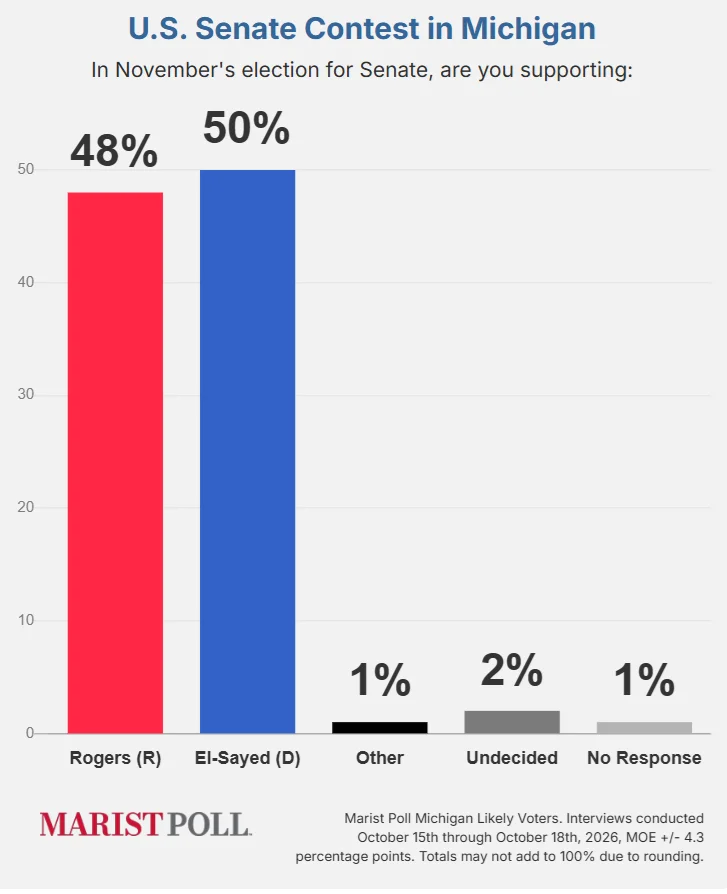
A Marist poll taken October 15 to 18 put El-Sayed at 50% and Rogers at 48% among likely voters.
Will token buybacks become more common?
Strategy Inc., the Bitcoin treasury company formerly called MicroStrategy, now holds 848,517 BTC and does traditional corporate buybacks.
An 8-K filing with the SEC covering October 19 shows the board raised the limit on its digital credit securities repurchase program from $2.0 billion to $3.0 billion, leaving $1.16 billion available. In the week ending October 18, the company bought back 1,938,780 shares of its Series A Perpetual Stretch Preferred Stock (STRC) for $193.1 million.
Strategy also has a separate $1.0 billion authorization for buying back its MSTR common stock, which is still open.
El-Sayed’s target, spelled out in his post about GM, is public companies buying back their own shares. Strategy’s STRC and MSTR repurchases are exactly that, which means a ban on corporate buybacks would affect them.
Crypto projects, on the other hand, are increasingly using a different method of buybacks called “token buybacks.” Under this method, a protocol takes money it earns from trading and uses it to buy its own token on the open market, often destroying (burning) the tokens afterward.
This practice recently got clearer regulatory backing after the SEC’s Division of Corporation Finance said in an updated FAQ that announcing a buyback for an already working crypto network doesn’t turn the token into a security.
For example, Hyperliquid’s Assistance Fund automatically buys and burns HYPE tokens using 99% of eligible trading fees. Cryptopolitan recently reported that the Hyperliquid Policy Center asked the SEC to include the buyback guidance directly into its proposed Regulation Crypto Assets.
Meanwhile, token buybacks have reached a record $638 million.
Don’t just read crypto news. Understand it. Subscribe to our newsletter. It's free.
FAQs
What did Abdul El-Sayed say about stock buybacks?
El-Sayed, the Democratic Senate candidate in Michigan, wrote on X that "stock buybacks should be illegal," accusing GM of rewarding shareholders over workers after the automaker announced a $20 billion repurchase.
Did the SEC approve crypto token buybacks?
In a September 25 FAQ update, the SEC's Division of Corporation Finance said announcing a buyback for an already functioning crypto network does not by itself turn the token into a security.
How does Strategy's buyback differ from a token buyback?
Strategy repurchases its own shares, including a $193.1 million buy of STRC preferred stock in the week ending October 18 and a raised $3.0 billion credit-securities program, which is a corporate buyback, whereas token buybacks involve a protocol retiring its own token using trading fees.
Disclaimer. The information provided is not trading advice. Cryptopolitan.com holds no liability for any investments made based on the information provided on this page. We strongly recommend independent research and/or consultation with a qualified professional before making any investment decisions.

Hannah Collymore
Hannah is a writer and editor with nearly a decade of blog writing and event reporting experience in the crypto space. At Cryptopolitan, Hannah contributes to the news page, reporting and analyzing the latest developments in DeFi, RWA, crypto regulation, AI and frontier tech industries. She graduated from Arcadia university with a degree in Business Administration.









