







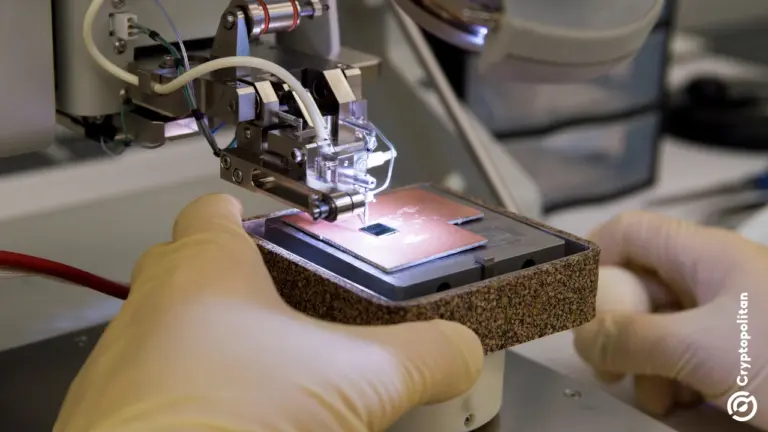
- Meta will start producing its first in-house AI chip, Iris, in September 2026.
- Broadcom is the design partner, and TSMC will handle fabrication.
- The chip is meant to trim Meta’s compute costs and reduce its dependence on Nvidia and AMD.
Meta appears set to start the assembly line for its own in-house chip production by September of this year. News of the AI chip code-named Iris first broke after Reuters reported having reviewed an internal company memo on Thursday.
The same report claimed that it only took six weeks to declare the design bug-free as the chip aced testing without turning up any major faults.
Iris is reportedly the first of four chip generations that the Zuckerberg-led firm has lined up in its Meta Training and Inference Accelerators (MTIA) program. Meta first shared plans for the chip in March.
With that, Meta has played its next hand in justifying the roughly $145 billion it has poured into AI infrastructure this year alone. The firm has not publicly reacted to the news.
Why Meta is building its own chip?
For a company that leans heavily on processors to run AI across its flagship Facebook and Instagram products, Meta needs wiggle room in terms of cost and dependence.
The memo that Reuters reviewed explicitly mentioned the headache of riding the wave with Nvidia (NASDAQ: NVDA) and Advanced Micro Devices (NASDAQ: AMD) when they release new generations of chips.
Rolling out the newest GPUs at Meta’s scale “has been a heavy lift, and it has cost us time,” the memo reportedly read.
The Iris chip will not completely sever the connection between Meta and these firms, though. It just means that if everything else goes to plan, Nvidia and AMD could be losing major business from one of their biggest customers.
Meta, meanwhile, would be moving forward with two new partners in Broadcom (NASDAQ: AVGO), which worked with Meta on the design, and Taiwan Semiconductor Manufacturing Co. (TPE: 2330), which will fabricate the silicon.
A bigger buildout behind the chip
The Iris timeline arrived bundled with the rest of Meta’s hardware roadmap. The memo laid out a compute expansion in two stages, reaching seven gigawatts of capacity in 2026 and doubling to 14 gigawatts in 2027. That growth underpins the company’s projected AI infrastructure bill of up to $145 billion for the year, one of the largest such programs in tech.
The custom-chip work also has a longer arc. Meta formalized its silicon partnership with Broadcom earlier this year, extending the arrangement through 2029 across several MTIA generations and committing to deploy more than one gigawatt of compute as a first step. Separately, Meta struck a multiyear deal with AMD to bring online up to six gigawatts of AMD Instinct GPUs, part of a push to avoid relying on any single vendor.
The spending is landing while investors scrutinize AI returns. Meta recently drew attention for a plan to sell surplus AI compute through a new cloud business that sent its shares to a record close of $796.25 on July 1, according to Cryptopolitan.
The mood has since cooled. Meta (META) closed at $603.12 on July 8 and slipped a further 3.75% to $580.50 in Thursday pre-market trading, per Google Finance data, leaving the stock well below its 52-week high.
Don’t just read crypto news. Understand it. Subscribe to our newsletter. It's free.
FAQs
When will Meta start producing the Iris AI chip?
Meta plans to begin manufacturing Iris in September 2026, after the chip cleared its bug-testing phase in about six weeks without significant problems, according to an internal memo reviewed by Reuters.
Who is manufacturing Meta's Iris chip?
Broadcom served as Meta's design partner on Iris, and Taiwan Semiconductor Manufacturing Co. was tapped to fabricate it.
Why is Meta building its own AI chip instead of only buying from Nvidia and AMD?
Meta wants to cut compute spending and reduce its reliance on outside chip vendors, though the memo said Iris is intended to supplement, not replace, the GPUs it buys from Nvidia and AMD.

Hannah Collymore
Hannah is a writer and editor with nearly a decade of blog writing and event reporting experience in the crypto space. At Cryptopolitan, Hannah contributes to the news page, reporting and analyzing the latest developments in DeFi, RWA, crypto regulation, AI and frontier tech industries. She graduated from Arcadia university with a degree in Business Administration.









