






Japan’s Nikkei Index rides $65B physical AI commitment to close at record levels

- The Nikkei 225 responded to Japan’s government plans to allocate $65.1 billion to physical AI by fiscal 2040 by closing above 72,000 for the first time.
- The session was led by chip and robotics stocks.
- Japan is making a broader commitment of 370 trillion yen across 17 strategic sectors.
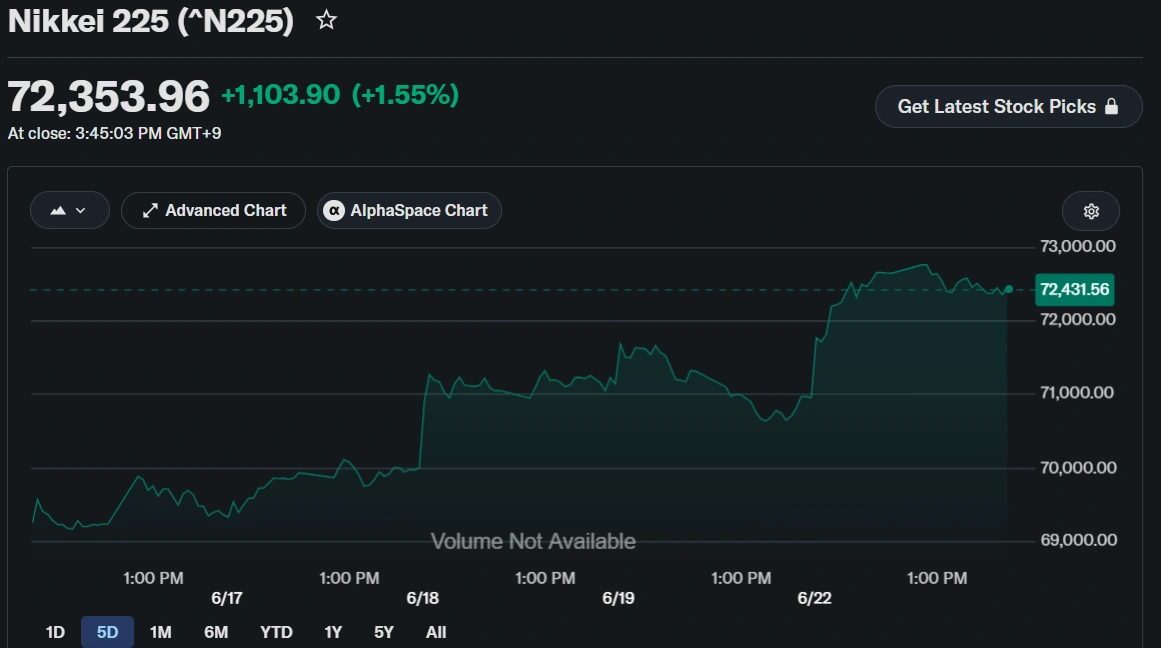
Japan’s Nikkei 225 crossed the 72,000 level for the first time ever today, June 22, riding the high from the 10.5 trillion yen ($65.1 billion) that the Japanese government committed to in a public—private physical AI spending plan expected to spread across 17 strategic sectors by fiscal 2040.
The benchmark index closed at 72,353.96, up 1.55% on the day, according to Yahoo Finance data. It was the seventh consecutive session ending at a record high. The broader Topix index gained 1.29% to 4,097.26, with both gauges setting fresh intraday peaks.
The optimism came from government messaging signaling that it plans to insulate funding for the 17 sectors on its list from normal budget cycle fluctuations, as long as the national debt-to-GDP ratio stays on a declining path.
Japan’s physical AI commitment is part of a $2.3 trillion growth bet
Japan’s Prime Minister Sanae Takaichi’s growth strategy is focusing on figuring out ways to move artificial intelligence technology from software environments into real-world hardware.
The 10.5 trillion yen earmarked for the physical AI strategy will touch everything from robots to industrial machinery.
Also, it is just one layer of the roughly 370 trillion yen ($2.3 trillion) that the Takaichi government has committed to in combined public and private investment through 2040. Semiconductors, drones, LNG shipbuilding, defense, quantum computing, aviation and space, content industries, cybersecurity, nuclear fusion, and marine industries are among the 17 fields and 62 specific products and technologies under consideration.
Another 29 trillion yen is supposed to be funneled into communications infrastructure, spanning next-generation wireless, optical communications, and undersea cables, to support AI deployment at scale.
Chip and robotics stocks led Nikkei’s Monday’s rally
The hope is that corporate investment and growth plans evolve into long-term strategies now that the government has signaled its all-in AI strategy. However, the short-term results are showing up on the big screens already.
Investors piled into technology and manufacturing names tied to the AI buildout. Renesas Electronics jumped 6.49%, while chipmaker Rohm gained 3.14%. Chip-testing equipment maker Advantest rose 1.35%, and Tokyo Electron added 3.24%. SoftBank Group, a major backer of AI rollouts, climbed 1.87%.
Robotics stocks also put up strong contenders for Monday’s biggest winners. Yaskawa Electric surged 9.02%, and Fanuc gained 8.10%. Non-ferrous metals led the Topix sector gains at 7.57%, followed by electric appliances and glass and ceramics products.
Demographics are driving the spending
Japan’s physical AI push is inseparable from its population crisis. The country stands to lose around 15 million working-age people over the next two decades, according to an Acumen Research and Consulting analysis cited by Cryptopolitan. The working-age share of the population currently sits at 59.6%.
Japan already maintains one of the highest robot densities on the planet: 419 robots per 10,000 manufacturing workers, with 435,000 industrial units installed, per the same analysis. The country shipped more than 160,000 industrial robots in 2024, representing 38% of global exports in the sector and roughly $12.5 billion in value.
The policy sequence over the past week underscores how coordinated the push has become. On June 16, the Bank of Japan raised its benchmark rate to 1%. The same day, two ministries began examining a mandatory EV battery collection program.
On June 18, the Japan Bankers Association flagged risks from AI-powered cyberattacks. And on June 19, the AI Strategic Headquarters released a draft proposal for ongoing assessment of AI-related legislation, Cryptopolitan reported.
If you're reading this, you’re already ahead. Stay there with our newsletter.
FAQs
How much is Japan investing in physical AI?
Japan is targeting 10.5 trillion yen ($65.1 billion) in combined public and private investment in physical AI by fiscal 2040.
What level did the Nikkei 225 reach?
The Nikkei 225 closed at 72,648.47 on Monday, June 22, 2026, crossing the 72,000 mark for the first time and setting its seventh consecutive record closing high.
Why is Japan prioritizing physical AI investment?
Japan faces the loss of roughly 15 million working-age people over the next 20 years, and physical AI, including robotics and industrial automation, is positioned as a core solution for labor shortages in manufacturing, logistics, and healthcare.
Disclaimer. The information provided is not trading advice. Cryptopolitan.com holds no liability for any investments made based on the information provided on this page. We strongly recommend independent research and/or consultation with a qualified professional before making any investment decisions.

Hannah Collymore
Hannah is a writer and editor with nearly a decade of blog writing and event reporting experience in the crypto space. At Cryptopolitan, Hannah contributes to the news page, reporting and analyzing the latest developments in DeFi, RWA, crypto regulation, AI and frontier tech industries. She graduated from Arcadia university with a degree in Business Administration.









