







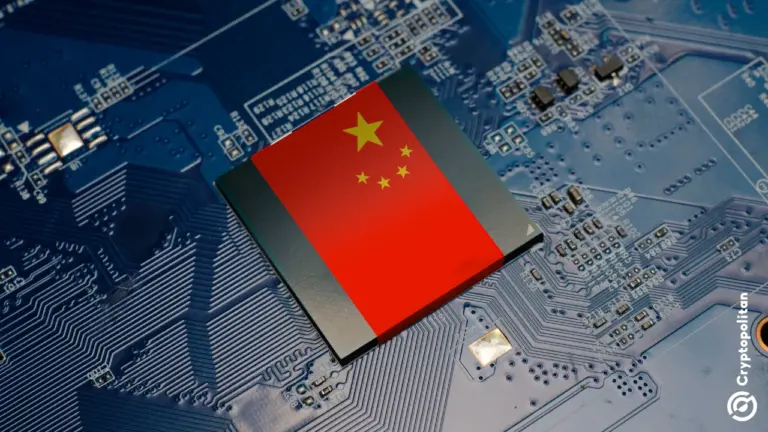
- China is reportedly considering export controls on domestically developed AI models and chips, signaling a shift from technology importer to potential gatekeeper.
- The move would mirror U.S. semiconductor restrictions and strengthen Beijing’s control over its growing AI and chip ecosystem.
- If adopted, the controls could reshape the global AI race by making access to advanced Chinese AI technology subject to government approval.
China is considering new controls on exports of its homegrown AI models and chips. A move that could give Beijing the same kind of technological leverage Washington has exercised through years of semiconductor restrictions.
The proposal is still under deliberation, as Chinese authorities have not yet released any draft regulations. However, studies carried out by the Center for Strategic and International Studies (CSIS), the Mercator Institute for China Studies (MERICS), and the Rhodium Group demonstrate that China has been developing both the industrial capability and the legal scheme to manage the advanced technologies being exported out of the country for many years.
This timing indicates a major transition. China is not just intent on supplanting foreign technology anymore. Moreover, it is now creating AI systems, home-grown chips, and robotics solutions that China perceives as assets of national importance.
Cryptopolitan has reported on the emergence of Moonshot AI’s Kimi K3, the increasing power of DeepSeek, the country’s initiatives in the domain of AI governance, and its explosive growth in the area of humanoid robotics—a sign that indicates that China is becoming an AI exporter rather than its previous role of an AI importer.
From restricted buyer to potential gatekeeper
Washington laid down the groundwork. The Biden administration enacted extensive restrictions on the export of sophisticated AI chips and technology for producing semiconductors in October 2022, and they were followed by the imposition of even stricter limitations.
The results could be seen instantly. According to a March 2026 report by the CSIS which consists of the work of Sujai Shivakumar, Charles Wessner, and Thomas Howell, China’s production of integrated circuits fell by 9.8% in 2022 for the first time in many years, while technological restrictions have still made it impossible for most chip manufacturers to produce chips smaller than around the 7-nanometer node.
Even so, the authors suggested that the measures had unintended consequences: they motivated China to pursue self-reliance in the semiconductor sector. In this regard, rather than delaying development in the sector, export bans actually led to the state investing more money, improving procurement policies, and quickly switching to the use of local chips.
That approach has moved beyond chips. China is now putting money into foundation models, AI infrastructure, and robotics, as part of a wider industrial strategy. In a different report by CSIS from April 2026, the researchers state that after the Trump government lifted restrictions on Nvidia’s H200 chips in late 2025, Chinese customs officials allegedly stopped the products from getting into the country and prompted firms to use local products.
A legal framework already in place
China also spent much of early 2026 strengthening the legal foundation for controlling technology flows.
According to MERICS, two new State Council rules came into force in April: one deals with industrial and supply chain security, while the second is supposed to counter what Beijing describes as improper extraterritorial jurisdiction by foreign governments. Both regulations enhance powers to impose penalties on companies, limit business practice, and include them in the list of “malicious entities.”
According to Zheng Shanjie, the Chairman of the National Development and Reform Commission, in April’s People’s Daily, China is still prone to being “strangled” in key technologies and needs more effective policy instruments to counter foreign de-risking measures. MERICS analyst Jacob Gunter described such a process of securing the economy as “one of the most extreme examples in modern history.”
A licensing system for the export of Chinese AI models and semiconductors would be a natural fit in such a framework.
Why markets should pay attention
China still ranks behind the leaders in terms of cutting-edge semiconductor technology. Rhodium Group reported in May 2026 that cutting-edge chips remain one of the country’s biggest technological shortcomings.
However, Beijing does not have to dominate every part of the AI supply chain in order to get leverage.
Chinese companies have become increasingly competitive in AI models, mature-node chip production, AI infrastructure, and robotics. If Beijing begins licensing exports of its own AI models or domestically designed chips, the global AI industry could face something it has not experienced before: two rival technology powers deciding who gets access to critical AI tools.
This will be a major shift. For the last three years, controls on exports have been mostly one-way, meaning that they have gone from Washington to Beijing. Now, Beijing is signaling that AI governance will be a two-way street in that both superpowers will use their access to the newest technologies as a tool of their economic and geopolitical policies.
Recent years have taught us how hard such limitations can actually be enforced. As of October 2022, it is estimated that over 1 million downgraded chips of Nvidia came to China through gray channels and that Huawei used intermediaries to get more than 2 million chips made by TSMC, as stated in CSIS’s report from November 2025. The same report mentioned the proposed US Chip Security Act that would make it compulsory for advanced AI GPUs to be equipped with mechanisms of geolocation in their place of origin.
If authorities in Beijing finally introduce restrictions to global sales, the AI competition will no longer depend solely on who develops the best technology. Rather, the question will be turning into deciding where the newly developed technologies can go.
The smartest crypto minds already read our newsletter. Want in? Join them.
FAQs
What is China reportedly considering?
According to the Financial Times, China is weighing tighter export controls covering both its domestically produced AI models and its chips, though no draft rules have been published.
Why did China build up its own AI chip industry?
US and allied export controls imposed from October 2022 restricted advanced chips and chipmaking equipment, cutting China's IC output by 9.8% in 2022 and capping its fabs above the 7-nanometer node, which CSIS says accelerated Beijing's drive for self-reliance.

Ashish Kumar
Ashish Kumar is a crypto and financial journalist with eight years of newsroom experience. He covers what’s happening with crypto markets, regulation, DeFi, and exchange ecosystems. He has worked with Coingape, Todayq, and Newsroompost. Ashish holds a PGDP in English Journalism from the IIMC. He has also interviewed industry figures including Arthur Hayes, Yat Siu, Austin Federa, and more.









