






- Google’s Willow chip cut magic-state errors about 40-fold, reaching 99.99% logical fidelity.
- Factoring an RSA-2048 key would need those states about a million times cleaner.
- Willow runs 105 physical qubits, against fewer than 500,000, a Google paper estimated for breaking Bitcoin’s cryptography.
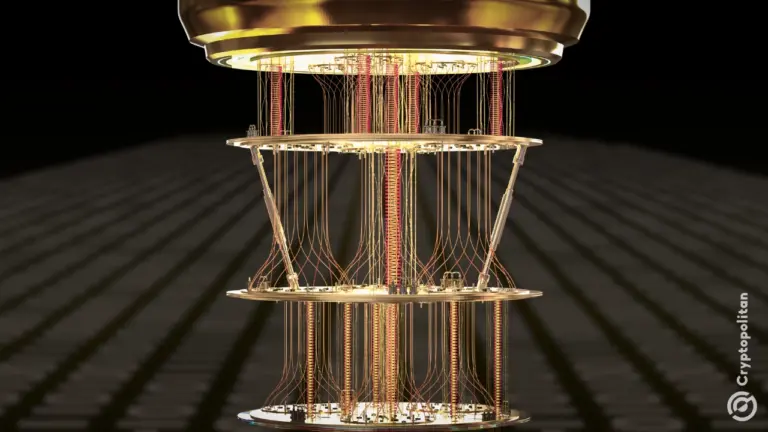
The Quantum AI team at Google said in a paper that appeared Thursday in Science that on its Willow chip, it trimmed errors in “magic states” by about 40 times.
These states still need to become about a million times more accurate before quantum code-breaking is viable.
Willow cuts magic-state errors 40-fold
Google says the method, dubbed magic state cultivation, attained 99.99% logical fidelity on the Willow processor.
Quantum computing is feasible thanks to magic states. Basic operations are handled by error correction, but these states are like fuel for the tougher ones that exceed classical computing.
Google cites estimates that the process of producing them could consume up to 95% of a machine’s capacity, leaving scant room for actual work.
A 40-fold cut makes a dent but doesn’t remove the bottleneck, and Google said cultivation needs to be demonstrated on a far bigger scale before it can be put to practical use.
In 2024, Craig Gidney, Noah Shutty and Cody Jones devised the method at Google by taking a prior theoretical idea and refining it. Cultivation acts like a filter.
A state with noise enters a confined region of the chip, where coordinated measurements hunt for errors. Attempts that don’t work get discarded, and the ones that do are retained.
Research scientist Emma Rosenfeld repeatedly got outcomes that seemed implausible. After digging for months, the team finally found that temperature variations and lab noise from equipment drift had warped their benchmark.
The remedy was to grant the system more control, and the team also conceived the idea of employing cultivation as a fresh way to benchmark itself.
Moving a purified state from a distance-3 color code to a distance-5 surface code, a step called “grafting,” is another thing Google has shown. These are two ways to structure error correction. In the future, machines may need to combine both error correction methods to stay reliable without bloating the hardware.
Factoring RSA-2048 needs errors near one in 10 billion
A 99.99% fidelity rate means there is about one error in every 10,000. To factor an RSA-2048 key, the paper says, you would need magic states with errors of about 1 in 10 billion, which is a million-fold difference.
Craig Gidney estimated in 2025 that RSA-2048 could be broken with less than a million noisy qubits. Cultivation is one of the ingredients in this estimate. On Thursday, Bitcoin traded near $82,165.
Fewer than 500,000 physical qubits would be needed to crack Bitcoin’s 256-bit elliptic-curve cryptography, according to a Google Quantum AI study, a figure ~80% lower than earlier estimates.
According to the study, an adequately powerful machine could reroute a live transaction in about nine minutes, with a 41% success rate.
Per estimates from Coinbase and Project Eleven, wallets with public keys already on the blockchain hold about 7 million BTC. That’s about a third of the entire BTC supply, a pool that swelled with Bitcoin’s Taproot upgrade.
Willow has 105 physical qubits, nowhere near the half million that the math for the attack requires.
Google’s schedule for post-quantum cryptography is in 2029.
Bitcoin, for now, has just one proposal, BIP 360, for quantum-safe addresses, and no plan to move everyone over.
If you're reading this, you’re already ahead. Stay there with our newsletter.
FAQs
What did Google actually demonstrate this week?
Magic state cultivation working on its Willow chip, cutting errors about 40-fold.
Does this mean quantum computers can now break bitcoin?
No. Factoring an RSA-2048 key would need magic states about a million times cleaner than Google's result.
Why does the magic-state bottleneck matter so much?
Google cites estimates that making magic states could eat up to 95% of a quantum computer's capacity.
Disclaimer. The information provided is not trading advice. Cryptopolitan.com holds no liability for any investments made based on the information provided on this page. We strongly recommend independent research and/or consultation with a qualified professional before making any investment decisions.

Randa Moses
Randa Moses is an editor and reporter at Cryptopolitan covering tech, AI, robotics, crypto, scams, and hacks. She has worked in the crypto space since 2017. She held roles at Forward Protocol, AmaZix, and Cryptosomniac. Randa holds a degree in Electrical and Electronics Engineering from the University of Bradford.









