







- Galaxy Digital’s (NASDAQ: GLXY) Alex Thorn warns that the CLARITY Act is the biggest financial surveillance expansion since the Patriot Act.
- Charles Hoskinson argues that the bill will allow future administrations to weaponize the rules against the industry.
- JPMorgan (JPM) and Citadel are lobbying to prevent tokenized assets from trading under new, decentralized rules.
The cryptocurrency sector has been clamoring for regulatory clarity, but concerns about the contents of the CLARITY Act have risen.
Galaxy Digital’s (NASDAQ: GLXY) research head, Alex Thorn, highlighted sanctions data and surveillance concerns, warning that the CLARITY Act may not be all good news as the community is hoping.
Is the CLARITY Act a surveillance bill in disguise?
The U.S. Senate has returned from its recess, and debates regarding the Digital Asset Market CLARITY Act have begun; however, Alex Thorn, head of research at Galaxy Digital (NASDAQ: GLXY), has urged caution.
He warned in a January 2026 client note that while the industry has long wished for regulatory clarity, the current version of the bill contains “fine print” that represents the largest expansion of financial surveillance since the USA PATRIOT Act.
According to an analysis shared by Thorn, the U.S. Treasury’s Office of Foreign Assets Control (OFAC) has historically sanctioned 518 Bitcoin addresses. These addresses have cumulatively received 249,814 BTC, sent 239,708 BTC, and currently hold a net balance of approximately 9,306 BTC, worth roughly $707 million.
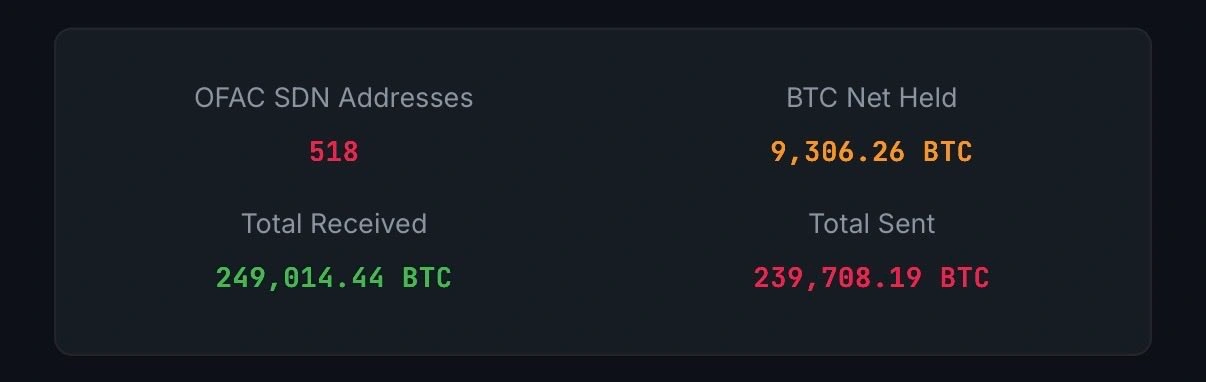
Thorn notes that OFAC’s Specially Designated Nationals (SDN) list is just one tool the Treasury uses today. However, the CLARITY Act would expand these powers significantly, giving the department new tools to intercept illicit assets.
Thorn warned in March that if the CLARITY Act does not pass committee by the end of April 2026, the odds of passage this year become “extremely low.” Reports indicate that negotiators are close to a deal on stablecoin yields, but other hurdles remain.
Supporters on the Senate Banking Committee argue the CLARITY Act is designed to “crack down on illicit finance” while protecting software developers and promoting innovation. The official summary states the bill gives law enforcement “new, targeted tools to combat money laundering, terrorist financing, and sanctions evasion.”
Aside Thorn, Cardano founder Charles Hoskinson argues the language goes too far. Hoskinson has warned that the legislation’s broad provisions could be exploited by future political administrations, regardless of which party is in power.
The fact that the bill automatically classifies new digital tokens as securities with virtually no pathway to reclassification is also an issue, as it stifles competition.
One independent analysis of a previous draft noted that while the bill includes a “Keep Your Coins Act” preventing bans on self-custody, it contains loopholes that still allow for government intervention regarding illicit finance.
The introduction of “Distributed Ledger Application Layers” in the draft could also create compliance obligations for software applications that could force DeFi interfaces to monitor users.
Who benefits from the new rules?
Wall Street giants, including JPMorgan Chase & Co. (JPM) and Citadel LLC, are actively lobbying the SEC to ensure tokenized securities do not receive special treatment.
In a recent letter to the SEC, Thorn argued that “forcing a new architecture to clone the old one” is not technology neutrality. Instead, he suggests that a decentralized automated market maker (AMM) should not be classified as an exchange because it is “autonomous code” and not an organization of persons operating a marketplace.
Thorn argues that liquidity providers (LPs) on AMMs are simply traders using their own balance sheets, not dealers serving customers.
He warns that banks and brokerages are playing a cynical game where they publicly back Bitcoin but use their Washington lobbyists to delay real integration that would threaten their control over market structure.
According to JPMorgan analysts, the legislative disputes have narrowed to two or three core questions, primarily revolving around stablecoin rewards.
The tentative compromise would ban passive “idle yield” on stablecoins, because banks fear it would drain deposits, while allowing activity-based rewards. However, critics like Ryan Adams argue that if banks succeed in killing yield provisions, it proves the Senate is prioritizing bank interests over the public.
The smartest crypto minds already read our newsletter. Want in? Join them.
Disclaimer. The information provided is not trading advice. Cryptopolitan.com holds no liability for any investments made based on the information provided on this page. We strongly recommend independent research and/or consultation with a qualified professional before making any investment decisions.

Hannah Collymore
Hannah is a writer and editor with nearly a decade of blog writing and event reporting experience in the crypto space. At Cryptopolitan, Hannah contributes to the news page, reporting and analyzing the latest developments in DeFi, RWA, crypto regulation, AI and frontier tech industries. She graduated from Arcadia university with a degree in Business Administration.









