






France will miss out on AI agent boom because of outdated tax system, stakeholders warn


- Three French crypto industry figures warned that France’s 2019 tax code penalizes stablecoin-to-bank transfers.
- The current 31.4% tax on these transactions risk pushing capital offshore and costing the government up to 3 billion euros annually.
- The warning comes amid rapid growth in AI agent payments settled in stablecoins.
Jean Meyer, Pierre Morizot, and Damien Patureaux, three people with stakes in the domestic crypto economy in France, have warned that lawmakers have only six months to review the country’s tax code before it is stuck on the outside looking in while other countries reap big tax benefits from properly regulating the fast-growing economy where autonomous AI agents transact in stablecoins.
In the Le Monde op-ed published on May 18, the trio argued that Article 150 VH bis of France’s tax code, written in 2019, penalizes holders who convert crypto gains into regulated euro stablecoins and then move them to a bank account.
The transfer sequence, according to them, triggers a 31.4% tax on unrealized capital gains, even though the European Central Bank classifies regulated stablecoins as electronic money. To avoid those unnecessary tax obligations, many French holders just never convert their stablecoins into fiat euros, costing the national budget an estimated 1 billion to 3 billion euros per year.
The warning packs an extra punch because machine-to-machine payments have taken off, settled mostly in stablecoins. These agentic payments contributed to the $46 trillion in stablecoin transaction volume that Andreessen Horowitz cited in its latest “State of Crypto” report over the past year. According to the firm, those numbers are on par with Visa’s annual throughput and even exceed PayPal’s by a factor of 20.
France is missing out as AI agents spend stablecoins
Coinbase CEO Brian Armstrong posted on May 18 that “the agentic economy will be larger than the human economy,” pointing to Base, the exchange-backed layer-2 network, as its primary venue.
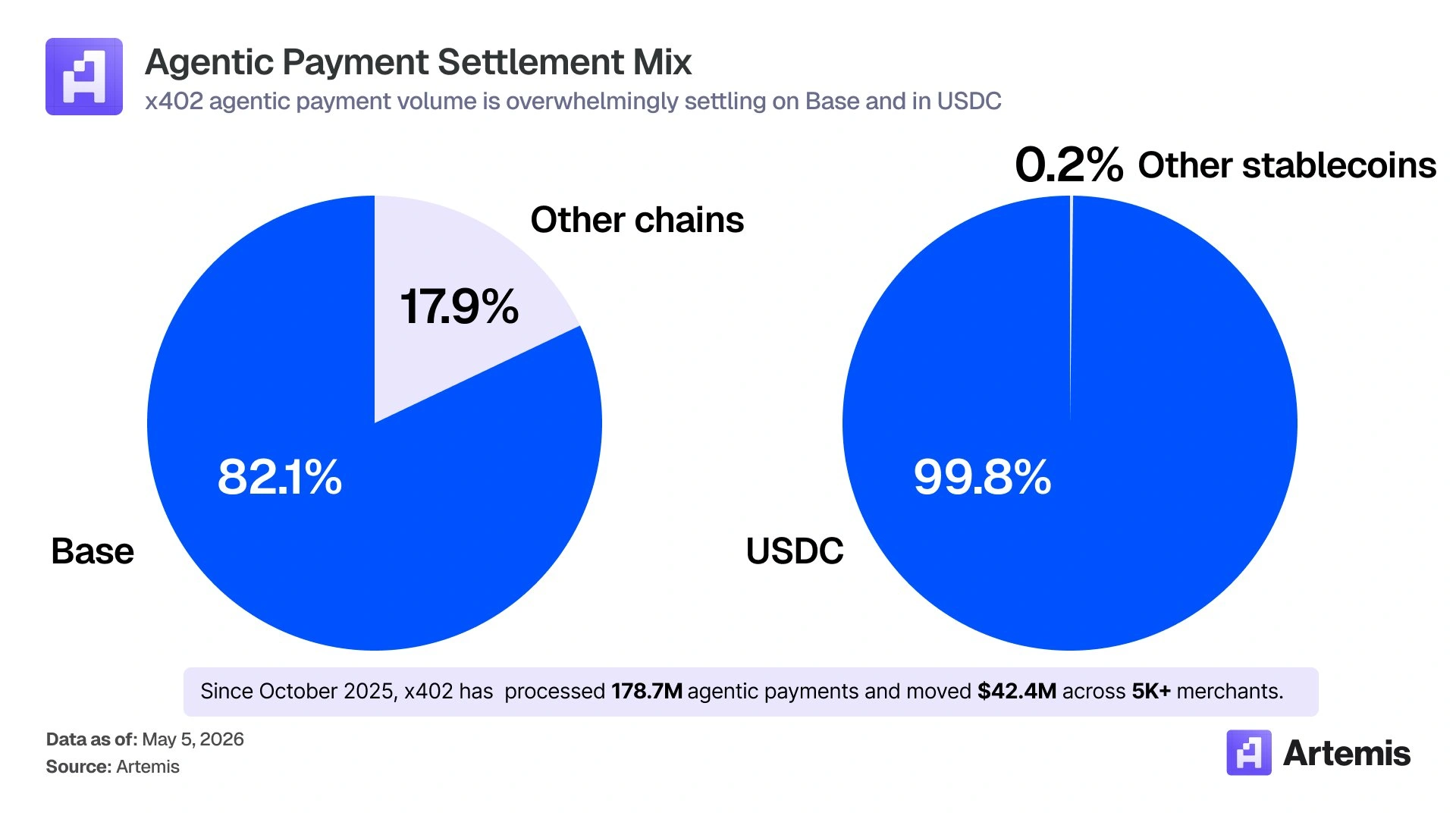
Artemis data cited by Base shows that the x402 payment protocol has processed more than 178.7 million transactions worth over $42 million since October 2025. Base handles 82.1% of all agent payment volume and supports 250,000 daily active AI agents, with infrastructure growing 400% year over year. Of those transactions, 99.8% settled in USDC.
The x402 standard, originally developed by Coinbase, moved under the Linux Foundation in April 2026. Google, Microsoft, Amazon Web Services, Visa, Mastercard, American Express, Stripe, and Circle all signed on as backers.
Cryptopolitan has previously reported that the protocol lets AI agents and web services process payments independently, covering tasks like API access, data purchases, and digital services without human approval on each transaction.
Circle launched its Agent Stack solution in May 2026. Google Cloud and Solana launched a separate marketplace called Pay[.]sh, where AI agents, including Google’s Gemini, discover and pay for APIs using stablecoins.
Capital will escape offshore if France doesn’t resolve tax friction
The French op-ed authors laid out the problem that France will run into as AI agent payments take off:
- A holder who swaps Bitcoin for EURCV, a regulated euro stablecoin, owes nothing.
- The moment those EURCV move to a bank account denominated in the same euro currency, the full capital gains bill comes due.
The authors compared it to taxing every transfer from a PayPal balance to a linked bank account. France’s own Cour des Comptes, the national audit court, has called the framework outdated, the op-ed noted.
Industry estimates cited in the Le Monde piece credit stablecoins for 40% to 75% of digital asset trading volumes. If French holders avoid getting into fiat euros to avoid the tax event it triggers, that capital permanently stays outside the domestic banking system, beyond the reach of both regulators and the tax base.
The stakes extend beyond retail holders. Armstrong said during Coinbase’s May earnings call that he expects billions of AI agents to trade and send money, with blockchain as “the only option” for settling that activity.
The six-month countdown has started
The x402 Foundation already counts the largest American tech and payments companies among its members. Others see the potential, and they are launching competing protocols to grab a piece of the agentic payment pie. Cryptopolitan previously reported that Stripe and blockchain startup Tempo launched the Machine Payments Protocol in April, backed by $500 million in funding at a $5 billion valuation.
According to the op-ed’s authors, France has a tight six-month deadline to modernize its crypto tax treatment or watch the agentic payment layer get built elsewhere.
As they put it, France will have to choose between sticking with a seven-year-old tax article that can’t accommodate an entire category of next-gen economic activity or jump on the train as others in the US and Asia build the rails.
If you're reading this, you’re already ahead. Stay there with our newsletter.
FAQs
What is France's crypto tax problem with stablecoins?
Article 150 VH bis of the French tax code, enacted in 2019, triggers a 31.4% tax on unrealized capital gains when a holder transfers regulated euro stablecoins from a crypto wallet to a euro bank account, even though the ECB classifies those stablecoins as electronic money.
What is the x402 protocol for AI agent payments?
The x402 protocol, originally developed by Coinbase and now housed under the Linux Foundation, lets AI agents and web services process stablecoin payments autonomously for tasks like API access and data purchases. Google, Microsoft, AWS, Visa, Mastercard, and Stripe are among its backers, and it has processed 178.7 million transactions, according to Artemis data cited by Base.
How large is AI agent payment activity right now?
Coinbase's Base network handles 82.1% of all agent payment volume, supporting 250,000 daily active AI agents with 400% year-over-year infrastructure growth, per data from Artemis. 99.8% of agent transactions are settled in the USDC stablecoin.
Disclaimer. The information provided is not trading advice. Cryptopolitan.com holds no liability for any investments made based on the information provided on this page. We strongly recommend independent research and/or consultation with a qualified professional before making any investment decisions.

Hannah Collymore
Hannah is a writer and editor with nearly a decade of blog writing and event reporting experience in the crypto space. At Cryptopolitan, Hannah contributes to the news page, reporting and analyzing the latest developments in DeFi, RWA, crypto regulation, AI and frontier tech industries. She graduated from Arcadia university with a degree in Business Administration.









