





Exclusive: Fahmi Syed says Midnight can fix the problem JP Morgan, Goldman and Citi are creating

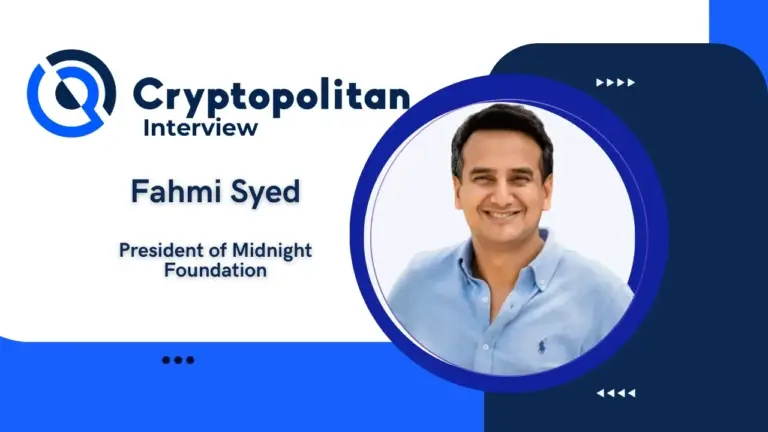
Cryptopolitan sat down for a chat with Fahmi Syed, President of Midnight Foundation, at Consensus Miami, where he told Karnika E. Yashwant, better known as Mr. KEY, founder and CEO of KEY Difference Media, that every bank on Wall Street wants its own lane, but clients still need to deal across the whole road.
Fahmi pointed at JPMorgan Chase (NYSE: JPM), Goldman Sachs (NYSE: GS), and Citigroup (NYSE: C) as examples of major institutions building private blockchain systems that may improve things inside each bank while making life harder across banks.
OpenSea CMO says private bank chains are creating a new access problem for clients
Fahmi said the irony is hard to miss. “Who would have thought five years ago JP Morgan would be at a Web3 convention?” he said.
“So what their JP Morgan coin allows is internally for them, for their clients to utilize that rail. It gives better transparency across departments, better maybe efficiencies across global entities. But actually, it’s… less efficient than the existing TradFi rails.”
A client at Morgan Stanley (NYSE: MS) still cannot simply settle or buy an asset from another bank’s chain, like all these shiny systems magically understand each other. Fahmi said that right there is the part Midnight wants to attack.
Fahmi said the real problem is: when a hedge fund banks with JPMorgan and Goldman Sachs at the same time, but they run separate private chains, then the client has no clean way to use one chain’s asset position inside the other chain’s system.

“How does that same client move an asset from Goldman’s to JP Morgan? They can’t,” Fahmi said. “With Midnight, we could be a privacy layer that can provide proof that that client is the same client.”
He added that Midnight could help with “identity, but access, agency, and much more beyond that.”
Mr. KEY then asked Fahmi: “So you are looking at yourself being integrated with all these other kinds of competing chains?”
Fahmi answered that: “We see ourselves as a unifying layer,” adding that Midnight wants to be “a ubiquitous privacy layer that any other network can use.”
Fahmi said KYC is one simple example. Every chain is trying to build some identity system, which means users could end up repeating the same checks across different networks.
His version is different. One private identity proof could sit on Midnight, and other networks could check it when needed. That could matter for Solana, bank chains, lending apps, and other systems that need proof without exposing the full user file.
Midnight believes users should not have to bridge or hand over assets
Mr. KEY then asked the bridge question because that is where crypto usually starts sweating. “Do you think this causes any situation like bridge challenges?” he asked.
Fahmi said no, because: “Our tokenomics is different. In every other network, it is tribalist. You have to own the token to access the network, and the token that you own for capital ownership is the very token you cannibalize to pay for your transactions. So it creates a tribalist environment.”
With Midnight, Fahmi said the Knight token is meant to separate access from ownership. “In Midnight, you have a Knight token that gives away free gas,” he said. He added that users could lease or delegate gas access instead of buying into the network just to use it. “Technology is consumed, it’s very rarely owned,” Fahmi said.
Mr. KEY asked him, “But are users actually bridging the tokens?”
Fahmi, again, said the answer is no since “they don’t have to bridge.” The asset can stay on the original chain, whether that is a bank’s, Solana’s, Aave’s, or any other, because the user would simply show cryptographic proof that the asset exists and that they own it.

That part caught Mr. KEY’s attention because of his own personal experience. “I’m one of the largest stakers with EtherFi,” he told Fahmi. “I do borrow against it,” but said he is not comfortable putting funds inside a custodian’s setup. “If I could have it at my end and borrow against it, it would be perfect,” Mr. KEY said.
Fahmi said Midnight Foundation is not trying to become the lender, the bank, or the custody provider. “I’m not going to be a bank. I’m not going to be a custodian,” he said. Instead, the plan is to provide rails that others can build on. He said those rails could let someone create “the first decentralized system” for this kind of lending.
Mr. KEY also asked the money question. “And your monetization?” he said. Fahmi said revenue could come from network activity and delegated gas fees as more people use Midnight, which could involve a custodian, a foundation, or even another operator delegating the fee asset.
Mr. KEY then wondered: “Is that going to be a sufficient revenue stream? Because most chains suffer from not having actual revenue.”
Fahmi told Mr. KEY, “Time will tell. If I had a crystal ball, I would not be standing here.”
Disclaimer. The information provided is not trading advice. Cryptopolitan.com holds no liability for any investments made based on the information provided on this page. We strongly recommend independent research and/or consultation with a qualified professional before making any investment decisions.

Jai Hamid
Jai Hamid has been covering crypto, stock markets, technology, the global economy, and the geopolitical events that affect markets for the past 6 years. She has worked with blockchain-focused publications including AMB Crypto, Coin Edition, and CryptoTale on market analyses, major companies, regulation, and macroeconomic trends. She has attended London School of Journalism and thrice shared crypto market insights on one of Africa’s top TV networks.









