






- Drift Foundation opened DFX claims for victims, with each token worth about 0.0104 USDT at launch, roughly one cent per dollar lost.
- Users face years of waiting on Velocity revenue, a capped Tether commitment and recovered funds before the rate climbs.
- The claim window runs until January 1, 2028, and unclaimed tokens will be burned.
Victims of the April 1 exploit that drained about $295.4 million from Drift Foundation, now called Velocity, have called out the repayment rate on the DFX recovery token, which works out to roughly one cent for every lost dollar.
The claims and redemptions window, confirmed in an October 1 release by the project, provides the first working portal for the tens of thousands of Drift users affected by the attack that made headlines more than five months ago.
Why 100 USDT lost in the Drift exploit is worth 1 USDT now
The math behind the DFX recovery token is based on a calculation that converts each verified dollar lost in the Drift hack to one DFX token, a standard SPL token on Solana that can be held, redeemed, or sold on Raydium or other secondary markets.
Notably, the token’s USDT value is not fixed. According to the Drift Foundation’s claims guide, USDT value is calculated by dividing the Recovery Pool balance by the number of DFX still outstanding.
The DFX token was worth around 0.0104 USDT at launch. Hence, a user who lost 100 USDT in April holds 100 DFX now, which they can redeem for about 1.04 USDT at the current exchange rate.
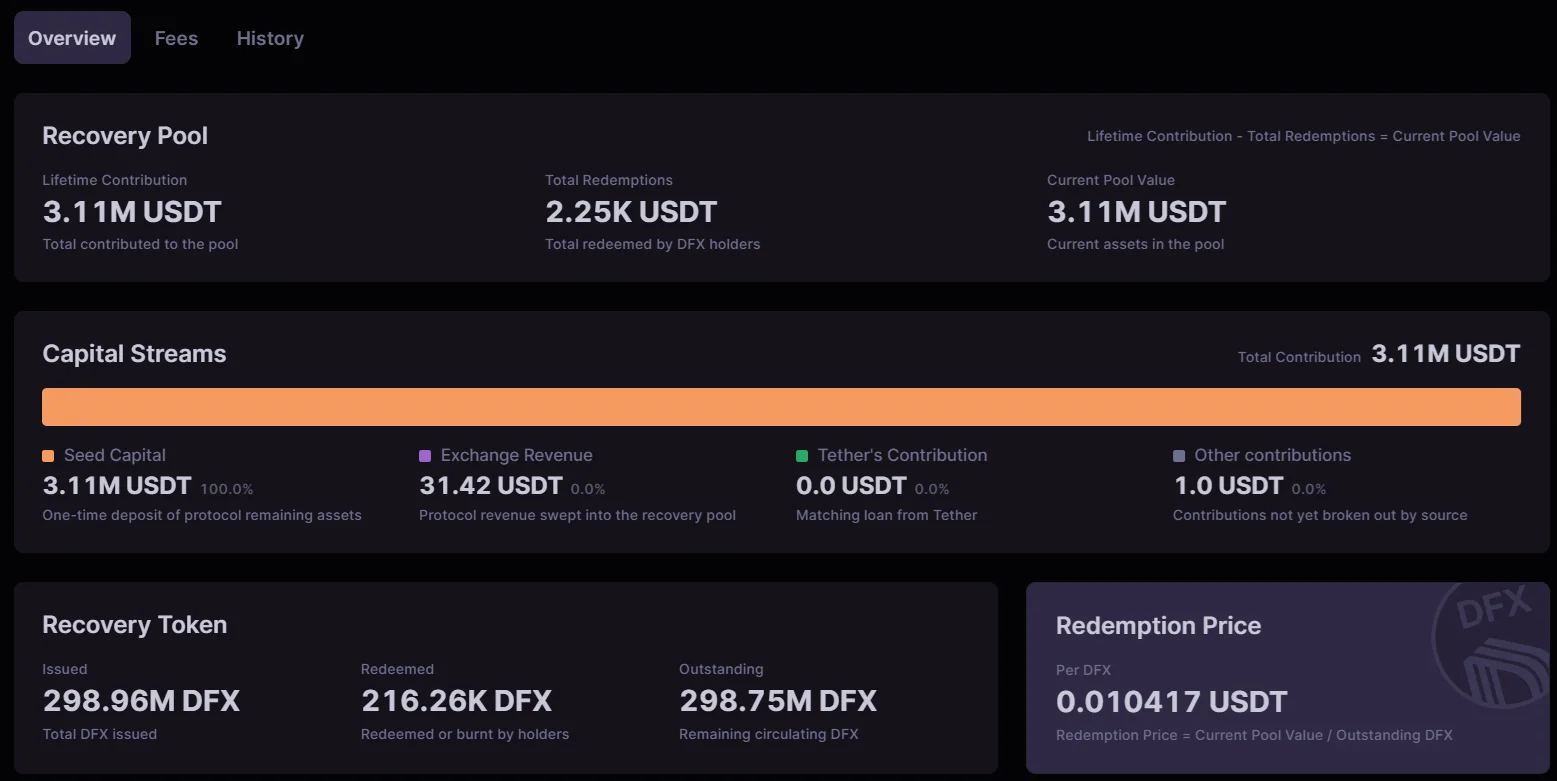
The current value is based on the Recovery Pool currently holding roughly 3.11 million USDT against a fixed supply of 299,500,810.998 DFX.
Speculative trading on DFX has quickly gotten hot, with the token climbing about 210% in 24 hours to about $0.03, although with thin liquidity of around $200,000, which also implies volatility.
Cryptopolitan reported on Drift user frustrations and unfairness accusations in May, when the project’s recovery framework was interpreted as forcing early redeemers to forfeit their remaining claims.
One contributor on the Drift governance forum called the related Insurance Fund vote “effectively an attempt at money laundering.”
Will the redemption rate of the DFX token rise?
The pool to repay victims in the Drift Protocol exploit was designed to only grow; the redemption rate never falls.
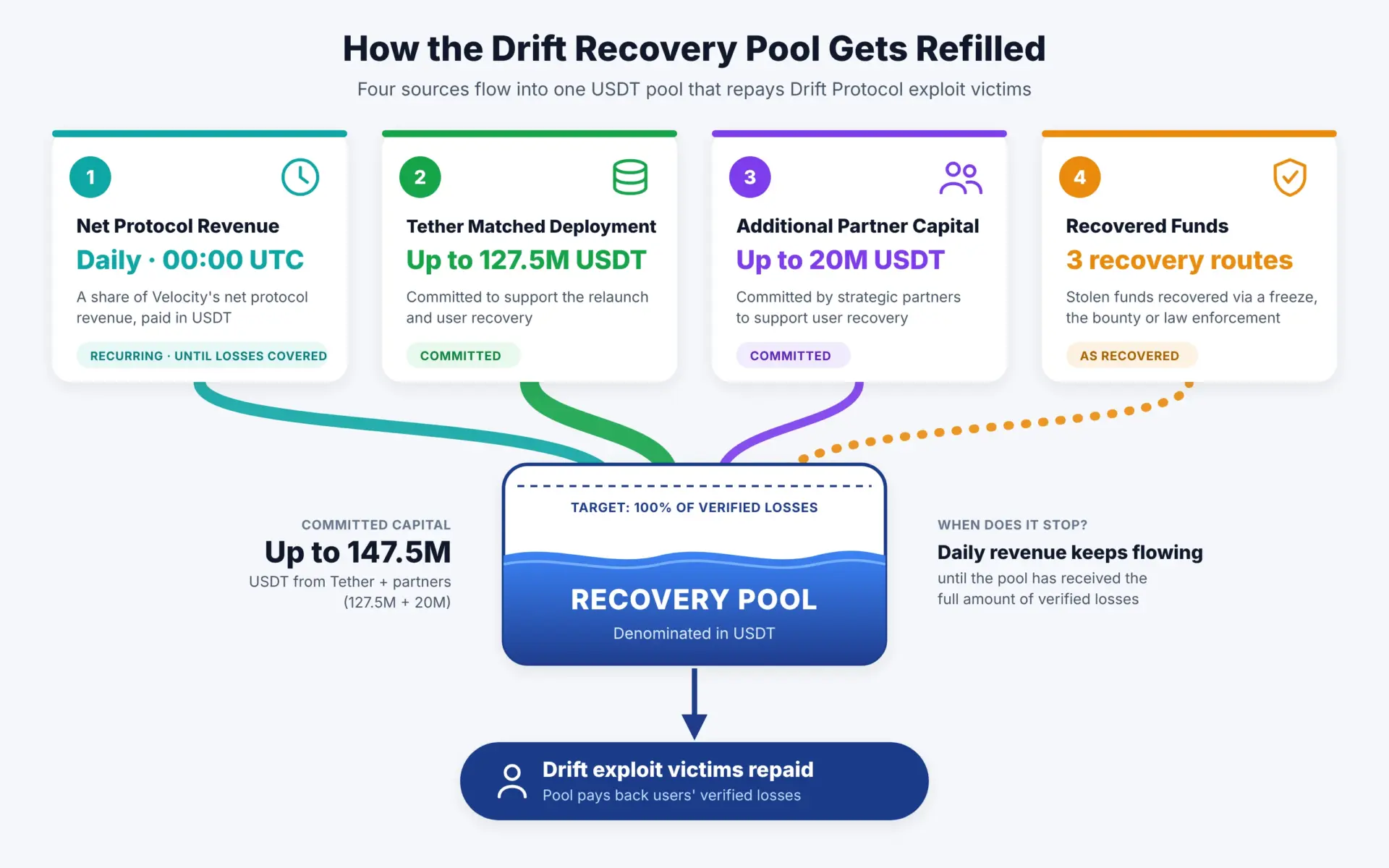
Money enters once a day at 00:00 UTC from the Net Protocol Revenue of Velocity at different rates:
- 60% of the first 30,000 USDT of daily revenue
- 70% up to 100,000 USDT
- 90% of anything above that, until deposits total the full verified loss.
Unclaimed DFX tokens by the time the window closes at 00:00 UTC on January 1, 2028, will be burned.
Tether has pledged up to 127.5 million USDT, while other strategic partners have committed up to 20 million USDT. However, those funds have caps and will only be released in phases, according to a preset schedule.
Any additional funds recovered from the stolen total form the fourth stream, but that is less predictable.
As of Drift’s September 30 update, $9.2 million of the stolen funds were frozen after the attacker routed funds through Tornado Cash in August. Three of the four Ethereum wallets still hold 107,165 ETH of the stolen crypto and have not moved in months.
Don’t just read crypto news. Understand it. Subscribe to our newsletter. It's free.
FAQs
How much do Drift victims get back per dollar lost right now?
At launch each DFX redeems for about 0.0104 USDT, so a user recovers roughly $1 for every $100 lost.
Why is the DFX redemption rate so low at launch?
The Recovery Pool held only about 3.11 million USDT against a fixed supply of 299,500,810.998 DFX, and larger commitments such as Tether's up-to-127.5 million USDT pledge had not been deposited on opening day.
When does the DFX claim window close?
The claim window closes at 00:00 UTC on January 1, 2028, and any DFX still unclaimed at that point will be permanently burned.
Disclaimer. The information provided is not trading advice. Cryptopolitan.com holds no liability for any investments made based on the information provided on this page. We strongly recommend independent research and/or consultation with a qualified professional before making any investment decisions.

Hannah Collymore
Hannah is a writer and editor with nearly a decade of blog writing and event reporting experience in the crypto space. At Cryptopolitan, Hannah contributes to the news page, reporting and analyzing the latest developments in DeFi, RWA, crypto regulation, AI and frontier tech industries. She graduated from Arcadia university with a degree in Business Administration.









