






Bitcoin needs trillions in new capital, but institutions are chasing AI instead


- CryptoQuant’s CEO says Bitcoin needs over $1 trillion in fresh institutional capital for another parabolic run.
- The problem is that money is currently flowing into AI infrastructure instead.
- On-chain data shows Bitcoin sellers growing more aggressive, with the profit/loss ratio underwater for most of the past two months.
Bitcoin will need over $1 trillion in fresh institutional capital to recover to a place where price stays in the green for a sustained period, according to CryptoQuant CEO Ki Young Ju.
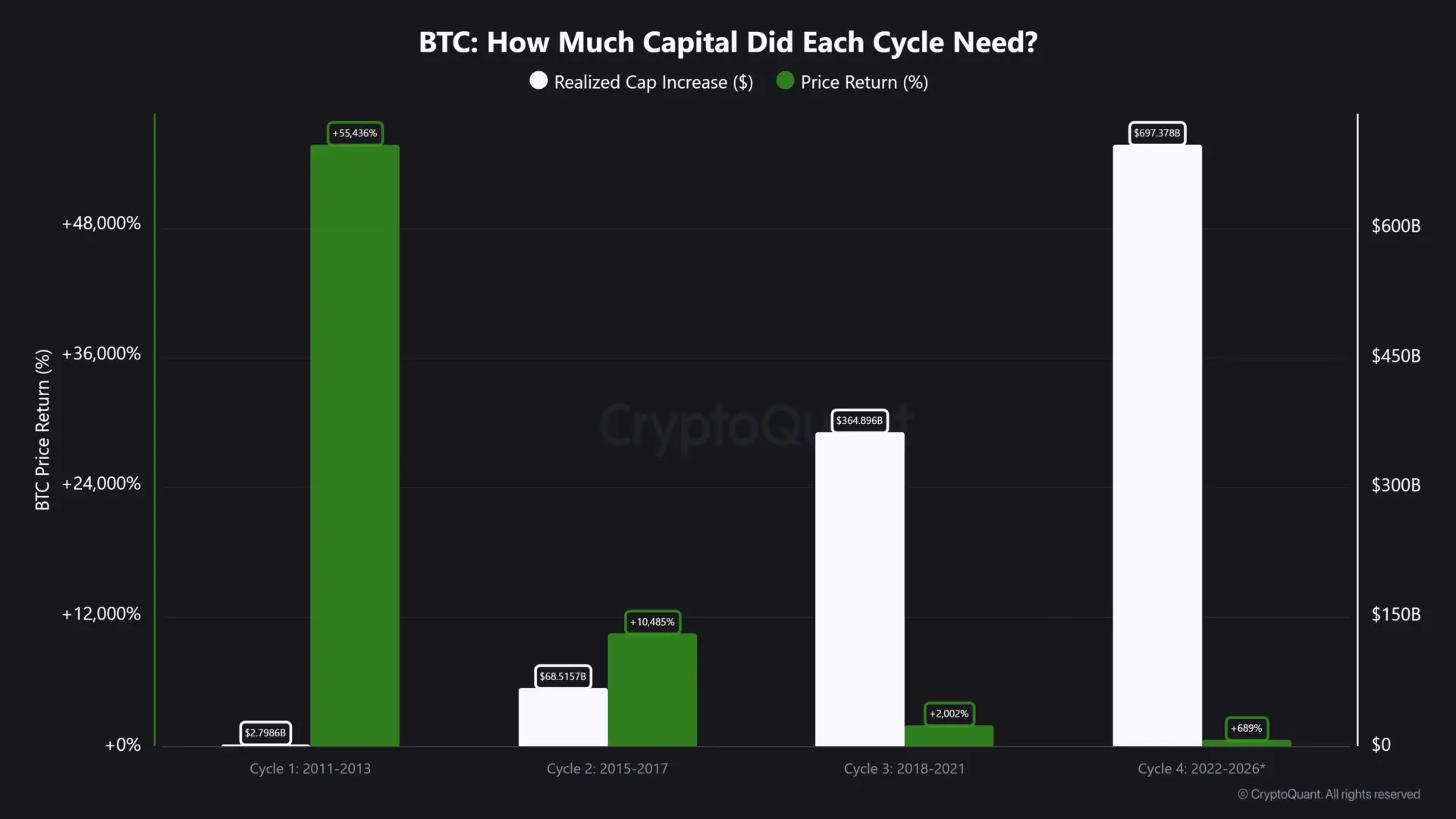
Ju published on-chain data on July 1 showing how much more capital each Bitcoin cycle needs to produce meaningful returns.
While $2.7 billion in net inflows drove a 55,436% price gain in 2011, the current cycle turned $697 billion into a 689% run, as seen on the CryptoQuant dashboard. There has to be around $101 billion in net flows, up from $5 million in 2011, for Bitcoin’s price to double today.
Ju wrote, “The next parabolic bull cycle likely requires deeper institutional portfolio allocation and Bitcoin becoming a core macro asset, not just an ETF trade.” According to him, if Bitcoin can absorb more than $1 trillion in realized capitalization, another parabolic run remains possible, noting gold’s market cap sits at $27 trillion.
Bitcoin chokes as AI steals the oxygen
The institutional capital Ju says Bitcoin needs is, for now, heading in the opposite direction.
When gold, silver, and Bitcoin sold off together in recent weeks as a hedge trade unwound, proceeds moved into AI stocks rather than back into Bitcoin. Some Bitcoin miners have also redirected their computing capacity toward AI hosting, where contracted payments beat the volatility of mining revenue.
Bitcoin currently trades around $58,800, down more than 45% from its October high above $120,000.
U.S. spot Bitcoin ETFs have been taking a beating too, enduring persistent redemptions in recent weeks. SoSoValue recorded that $222.64 million was pulled out yesterday, June 30, with BlackRock’s IBIT alone hemorrhaging $212.45 million.
On-chain data shows sellers growing more aggressive
On-chain analyst Axel Adler Jr. reported on July 1 that Bitcoin exchange inflows, measured by a 30-day moving average, have risen to 122,000 BTC, which is around 52% above the February level of around 80,000 BTC. The yearly baseline is around 82,000 BTC, and the current reading is approaching the upper standard deviation band at 131,000 BTC.
The Spent Output Profit Ratio, which is a metric that tracks whether coins are being moved at a profit or loss, has held below the breakeven level of 1.0 for 37 of the past 61 days.
Adler pointed out that while February showed a similar loss-realization reading, it came with far lower exchange inflows. This time around, the current correction is more severe, as it faces the combined forces of heavier selling volume and persistent loss-taking.
Where will the new buyers likely come from?
According to Grayscale’s head of research, Zach Pandl, beyond the small group of digital asset treasury firms that have driven most institutional demand this cycle, two cohorts will be responsible for driving the surge.
The first cohort will involve the transfer of wealth from baby boomers and the silent generation, who are estimated to hold $110 trillion in assets. That wealth will move to younger, more crypto-open investors over the coming decades. Pandl estimated that if 2% of that wealth entered crypto, it would create $2.2 trillion in new demand.
The second cohort is corporate treasuries outside the crypto-native world. Pandl pointed to SpaceX, which holds 18,712 Bitcoin worth about $1.4 billion, as a potential catalyst once the company goes public.
However, neither of these cohorts is buying at scale today, and with AI infrastructure commanding the largest capital commitments in a generation, the trillions Ju says Bitcoin needs remain, for now, spoken for.
The smartest crypto minds already read our newsletter. Want in? Join them.
FAQs
How much capital does Bitcoin need to double in price today?
According to CryptoQuant CEO Ki Young Ju's on-chain analysis, roughly $101 billion in net capital inflows is now required to double Bitcoin's price, compared to just $5 million in 2011.
Why are Bitcoin exchange inflows concerning right now?
On-chain analyst Axel Adler Jr. reported that 30-day average exchange inflows have reached 122,000 BTC, about 50% above February's level, while coins are being spent at a loss on average, a combination that signals heavier selling pressure than the earlier correction.
What new buyer groups could support Bitcoin's price?
Grayscale's head of research Zach Pandl has identified two potential sources: the $110 trillion generational wealth transfer from Baby Boomers to younger, more crypto-receptive investors, and corporate treasuries outside crypto-native firms such as SpaceX, which holds 18,712 Bitcoin.
Disclaimer. The information provided is not trading advice. Cryptopolitan.com holds no liability for any investments made based on the information provided on this page. We strongly recommend independent research and/or consultation with a qualified professional before making any investment decisions.

Hannah Collymore
Hannah is a writer and editor with nearly a decade of blog writing and event reporting experience in the crypto space. At Cryptopolitan, Hannah contributes to the news page, reporting and analyzing the latest developments in DeFi, RWA, crypto regulation, AI and frontier tech industries. She graduated from Arcadia university with a degree in Business Administration.









