


LATEST NEWS
SELECTED FOR YOU


Best crypto insights delivered straight to your inbox.
Bitcoin and crypto stocks sit out U.S. market rebound as the Dow makes another ATH

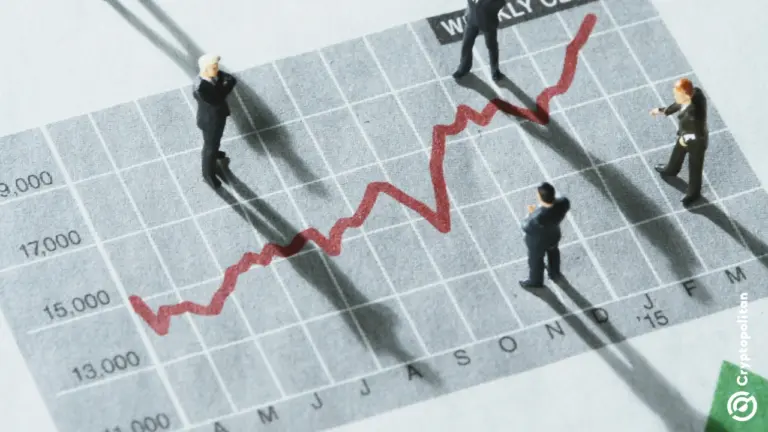

The Dow Jones Industrial Average closed Wednesday at 48,254.82, sealing yet another record high. Futures for the Dow ahead of today’s open ticked slightly lower by around 0.1%.
Meanwhile, the Bitcoin price is hovering in the $102,000 range this morning, having opened around $101,652.80 and before dipping to lows near $100,997.50. Trading volume for Bitcoin spiked more than 100% above its 24‑hour average during a midday breakdown from a session peak above $105,300.
Live Reporting
Bitcoin crashed to $98,072.76 on Thursday, its lowest level since May 8, according to CoinMetrics data, and was last trading slightly higher at $98,215.
This LIVE post has officially ended.
Jerome Powell wasn’t bluffing. After signaling last month that a December rate cut was far from certain, fresh commentary from his Federal Reserve colleagues is now rattling markets, pushing traders to sharply dial back expectations for a third straight policy easing at the Dec. 9–10 meeting.
Just days ago, futures traders were placing better-than 2-to-1 odds on the Fed delivering a 0.25% rate cut. That confidence has evaporated.
According to the CME Group’s FedWatch tool, the probability has now fallen to a near 50-50 split, a total coin flip.
What changed? Behind the scenes, there’s rising concern inside the Fed over whether continued easing might overstimulate the economy, especially with labor markets still tight and inflation not fully conquered. While Powell hasn’t outright shut the door on another cut, he’s made it clear that the bar is getting higher.
And that’s spooked rate-sensitive markets. Treasury yields ticked up on the shift, while traders began repricing everything from growth stocks to high-beta bets that had been riding the rate-cut wave.
The Fed’s messaging now suggests that unless economic data deteriorates sharply, it may pause in December to buy time and avoid oversteering.
This post is updated LIVE.
Fireblocks, one of the most powerful backbones in crypto infrastructure, is getting ready to raise fresh capital, not to expand, but to buy back shares from employees, according to Bloomberg.
The company has tapped Citigroup as an advisor, kicking off early-stage discussions for a tender offer aimed at providing liquidity to insiders, sources said.
The potential raise would give Fireblocks a shot at keeping employees happy without having to jump into the public markets just yet. No word yet on the company’s current valuation, or how much equity it’s aiming to repurchase.
But this move follows a growing playbook among late-stage, VC-backed fintechs like Revolut, which recently repurchased up to 10% of its shares in a similar offer.
Based in New York, Fireblocks is a giant in digital-asset infrastructure, serving massive clients like BNY Mellon, WorldPay, and Revolut. Its tech lets institutions manage wallets, stablecoin payments, and digital asset storage with security-grade tooling trusted by traditional finance.
This year’s pro-crypto position from President Donald Trump has fueled a wave of IPO activity in the space, with Circle, Gemini, and soon BitGo heading to public markets.
But Fireblocks is choosing to stay private, for now, opting instead for a secondary transaction that keeps control tight while giving early employees a chance to cash out.
To date, Fireblocks has pulled in over $1 billion in funding, including a $550 million Series E in January 2022 that valued it at $8 billion, with backers like Sequoia Capital, Coatue, General Atlantic, and BNY in the mix.
This post is updated LIVE.
Wall Street sold off hard on Thursday, wiping out the prior session’s optimism as investors turned sour on both tech valuations and the broader interest rate outlook.
The Dow Jones Industrial Average plunged 716 points, or 1.5%, snapping back from its all-time high and dragging the rest of the market with it.
The S&P 500 slid 1.7%, led by sharp losses in communication services and information technology. Disney was a major weight, falling 7% after its fiscal Q4 earnings came in mixed. But the real damage was once again in big tech.
The Nasdaq Composite nosedived 2.4%, its third straight down day, as investors bailed on AI trades. Names like Nvidia, Broadcom, and Alphabet were hammered as fears around lofty valuations refused to die down. Traders appear to be rethinking the entire growth trade as hopes for rate cuts start to slip.
And in the middle of it all, Bitcoin broke down hard, crashing below $100,000 for the first time in weeks.
After clinging to the $103K range earlier in the day, the slide accelerated into the U.S. close, reflecting not just crypto‑specific pressure but a broader pullback in risk-on sentiment.
This post is updated LIVE.
Tesla shares cratered more than 7% on Thursday after the company disclosed a major recall of over 10,000 Powerwall 2 units, its flagship residential battery system, due to fire and burn hazards.
The news came via a U.S. Consumer Product Safety Commission (CPSC) notice that warned some lithium-ion battery cells in the affected systems could overheat, smoke, or even catch fire, putting users at serious risk.
The CPSC warning was blunt: “The lithium-ion battery cells in certain Powerwall 2 systems can cause the unit to stop functioning during normal use, which can result in overheating, and in some cases, smoke or flame, and can cause death or serious injury due to fire and burn hazards.”
Tesla, led by Elon Musk, pinned the blame on a third-party battery cell defect, but didn’t disclose the supplier’s identity. According to the recall report, Tesla had received 22 overheating complaints, including five fires that caused minor property damage, but no injuries.
The Powerwall 2 is a core product of Tesla Energy, a division that also sells utility-scale battery storage and solar panels.
These Powerwalls are designed to store energy from solar rooftops and provide power during blackouts or peak pricing hours. Tesla said that the Powerwall 3, its newer model, is not affected, and that all recalled units will be replaced free of charge.
This couldn’t come at a worse time. Tesla Energy was actually Tesla’s fastest-growing division in Q3 2025, with revenue surging 44% to $3.42 billion, making up nearly 25% of total company revenue.
The recall undercuts that momentum and raises fresh questions about battery supply-chain quality control, just as Tesla was trying to position its energy business as a stabilizing force amid EV margin pressures.
This post is updated LIVE.
MoonPay is officially jumping into the stablecoin game, and it’s doing it loud.
The New York-based crypto payments firm will now issue and manage stablecoins for clients, rolling out the service across all U.S. states using its existing money transmitter licenses, according to Zach Kwartler, who just took the reins as head of stablecoins.
Zach, who joined in September after building infrastructure at Paxos for big dogs like PayPal, Interactive Brokers, and MercadoLibre, said the move is all about helping clients streamline payments.
He explained that businesses are starting to realize they can move money faster and cheaper by minting their own dollar-pegged tokens, and MoonPay is giving them the tech to make it happen.
The firm will launch this new stablecoin service for enterprise clients across the U.S., Asia, and Latin America, spanning multiple blockchains. No single-chain nonsense here, it’s all about flexibility and global reach.
Why now? Ever since U.S. lawmakers passed stablecoin regulation in July, demand has exploded. Everyone from Stripe to Visa to Citigroup has been racing to integrate stablecoins into their payment stacks.
Stripe even dropped $1.1 billion to scoop up Bridge, a stablecoin infrastructure startup, in a high-stakes bet on this very future.
Zach says the appeal is simple: stablecoins move like cash, settle like code, and cost a fraction of traditional rails. And as fintechs scramble to stay competitive, having your own coin might just be the new flex.
This post is updated LIVE.
Micron (MU) might be headed into a whole new stratosphere. That’s according to Morgan Stanley’s Joseph Moore, who just jacked up his price target to $325 from $220, reaffirming an Overweight rating and naming the chipmaker one of his top stock picks going into 2026.
Micron’s shares have already gone nuclear this year, up 191% year-to-date, but Moore says that’s just the beginning.
His new forecast implies another 33% upside from current levels, fueled by a global shortage of DRAM (dynamic random-access memory) that’s forcing a historic spike in chip prices.
Moore says DRAM spot prices have tripled in the last few weeks alone, a pricing surge not seen since the wild memory cycles of the 1990s.
But this rally is about earnings power. Moore argues that Micron is already operating at record profitability, before the full pricing effects kick in.
Unlike the 2018 shortage, where Micron was barely profitable at the start, today’s setup has the company starting from strength, which could supercharge its bottom line even more.
“We believe that’s going to move us firmly into uncharted territory from an earnings standpoint,” Moore wrote, adding that Wall Street hasn’t fully priced in just how massive this earnings revision cycle could be.
He sees blended DRAM pricing rising 15% to 20% over Q1 and Q2, but warned that late buyers may get hit with 50%+ premiums on new contract rates.
This post is updated LIVE.
JPMorgan just dropped a new round of crypto stock ratings, and the tone is leaning surprisingly bullish, especially for firms branching into institutional trading and HPC infrastructure.
First up, Coinbase (COIN) held onto its Overweight rating, with analyst Kenneth Worthington locking in a $404 price target for December 2026.
That’s a nearly 38% jump from its current levels near $293, and the call rests on Coinbase’s dominant role in U.S. institutional crypto flows and the growing traction of its Base Layer-2 network, which JPMorgan sees as an increasingly important strategic advantage.
Then there’s Riot Platforms (RIOT), which got a rating upgrade to Overweight back in late September, and is still riding that momentum. The company set a new target of $19, up from $15, citing Riot’s move into high-performance computing colocation and cloud services.
JPMorgan analysts noted Riot has the most relative upside among the crypto names they cover, around 14% from here, even after Thursday’s 7.24% drop.
As for MARA Holdings (MARA), JPMorgan kept its Overweight but slightly trimmed the target to $20 from $22, citing valuation tweaks.
Still, the company sees MARA as well-positioned to pivot into HPC monetization, following a surge in institutional positioning: ownership of MARA shares jumped over 300% last quarter, according to Fintel data.
The growing interest reflects broader enthusiasm for firms bridging the gap between crypto infrastructure and AI-grade compute leasing.
This post is updated LIVE.
Circle (CRCL) just got a double upgrade from JPMorgan, with analyst Kenneth Worthington flipping the stock from underweight to overweight, citing stronger fundamentals and a sharp pullback that’s opened up a fresh buying opportunity. The new price target is $100, up from $94, which implies 16% upside from current levels.
Circle stock, which went public in June at $31, has already returned 178% from its IPO price, but it’s also cratered 67% from its highs earlier this year.
The stock got hammered recently, dropping 12% on Wednesday, as higher operating expense guidance spooked investors, even though Q3 results beat expectations on both revenue and earnings.
Worthington called Circle’s quarter “solid” and said the sharp correction into a lockup expiration window had pushed the stock down to “compelling” levels.
He argued the selloff has now brought CRCL below their old 2026 target, and with the fundamentals moving up and more USDC volume staying on-platform, he sees “enough upside in the shares for the stock to outperform our broader coverage universe.”
Circle, which remains the dominant issuer of USDC, is steadily embedding itself deeper into mainstream financial services, according to JPMorgan.
With stablecoin volumes rising, and Circle building out its own native network rails, Worthington sees the firm in strong position to capitalize on institutional demand.
Circle shares were up more than 1% in Thursday trading, snapping back modestly following the bullish note.
This post is updated LIVE.
Meanwhile, crypto-related equities got absolutely torched Thursday across the board, highlighting just how out of sync traditional equity investors are with the digital asset narrative right now.
At the top of the carnage list, Bitdeer Technologies (BTDR) tanked a staggering 20.23% to $11.12, leading a broad rout in crypto mining and infrastructure names.
Bitfarms (BITF) also got slammed, falling 11.36% to $2.81, while Cipher Mining (CIFR) collapsed 9.49% to $15.73. Even bigger names weren’t spared: Riot Platforms (RIOT) dropped 7.24%, CleanSpark (CLSK) fell 6.45%, and Hut 8 (HUT) lost 7.91%.
Coinbase (COIN), the highest-profile U.S. crypto exchange, slipped 3.51% to $293.32, despite relatively tame volumes ($57.2M). Strategy Inc. (MSTR), known for its massive BTC treasury, gave up 2.28%, closing at $219.48.
Payment-focused names also slid: PayPal (PYPL) lost 1.29%, Block (XYZ) fell 2.68%, and Circle Internet Group (CRCL) ticked down 0.63% despite still pushing $2.3B in daily volume.
Even Robinhood (HOOD) cratered nearly 7%, finishing at $123.69, as speculative trading volumes cooled across retail platforms.
One of the few bright spots? Nano Labs, which bucked the trend with a 4.99% gain, and IREN saw huge volume ($109.4M) even as it plunged over 10%. Most of the sector, though, was awash in red as investors rotated out of risk assets tied to the crypto cycle.
This post is updated LIVE.
Bitcoin stayed stubbornly flat on Thursday, trading around $103,663, even as U.S. equities blasted to new all-time highs. While stocks like the Dow and S&P 500 rode momentum from a government funding resolution and rotation into value plays, Bitcoin barely flinched.
The crypto king seems locked in neutral, up just fractions over the last 24 hours.
In contrast, Ethereum (ETH) saw a decent pop. The token jumped over 3% in the past day, hitting $3,541, riding renewed interest in stablecoin infrastructure.
Ethereum remains the dominant chain for dollar-pegged stablecoins, and growing volumes in that corner of the market suggest that demand for digital dollars hasn’t gone anywhere.
But here’s the rub: even though Bitcoin’s correlation to U.S. equities remains high, its behavior is shifting. Jasper De Maere, a strategist at Wintermute, said that BTC’s reaction to market moves has become lopsided.
It still mirrors movements in the Nasdaq, but with a bearish skew, meaning it tumbles more on red days than it climbs on green ones.
According to De Maere, this kind of asymmetric behavior, where downside volatility outweighs upside potential, feels eerily similar to what played out in the 2022 bear market. And that could be a warning sign: “Bitcoin’s performance skew has been structurally negative in 2025… This usually happens near bottoms, not tops.”
This post is updated LIVE.
Wall Street hit the brakes on Thursday after days of rotation into value stocks sent the Dow Jones Industrial Average soaring to record highs.
The Dow dropped 194 points, or 0.4%, snapping its recent hot streak. But the real pain showed up in tech.
The S&P 500 fell 0.9%, dragged lower by sharp drops in communication services and information technology. The Nasdaq Composite, heavy with AI and chip names, sank 1.4%, its third consecutive red session as traders dumped high-growth names over valuation fears.
Names like Nvidia, Broadcom, and Alphabet were under pressure, fueling the retreat in big tech that started earlier in the week. Despite a strong Monday, tech couldn’t hold on. The rotation out of AI trades picked up steam as investors rebalanced into more “defensive” sectors.
Disney didn’t help the mood either, its stock plunged 8% after it posted mixed Q4 results, disappointing investors hoping for a stronger recovery in streaming and parks.
This week has been all about divergence: while growth names fall out of favor, health care and value stocks have stepped into the spotlight.
Even as the Nasdaq drags, the Dow closed above 48,000 on Wednesday for the first time ever, setting it up for its best week since June. But this broadening out could be more than just healthy rotation, it may signal investor caution as markets start to reassess risk appetite.
This post is updated LIVE.
What to know
-
Bitcoin and crypto‑stocks are mostly chilling on the sidelines while the Dow Jones Industrial Average rockets to a new all‑time high. The Dow is catching fire thanks to the federal government funding deal and easing risk from the shutdown.
- At press time, Bitcoin has dipped from the $102k+ zone and briefly flirted with $100,300 before recovering just a tiny bit.
TABLE OF CONTENT
Share this article

MORE … NEWS










DEEP CRYPTO
CRASH COURSE
- Which cryptocurrencies can make you money
- How to boost your security with a wallet (and which ones are actually worth using)
- Little-known investment strategies that the pros use
- How to get started investing in crypto (which exchanges to use, the best crypto to buy etc)