






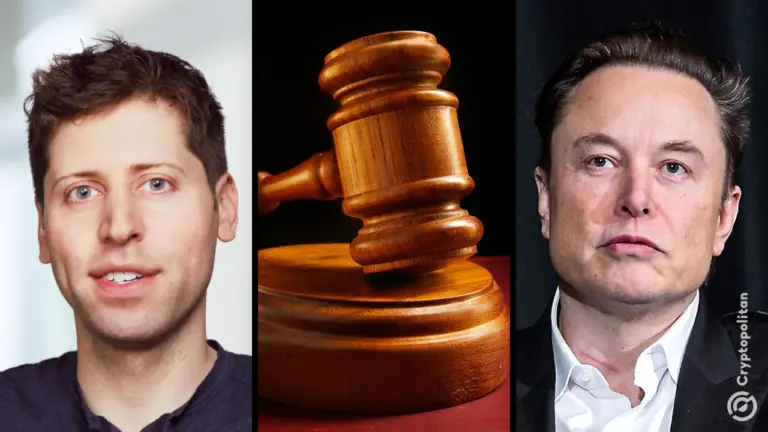
- Altman told jurors, “I believe I am an honest and trustworthy businessperson,” under cross-examination on Tuesday.
- He testified Musk demanded 90% equity in OpenAI and suggested control could pass to his children.
- The trial enters its third week, with OpenAI, Anthropic, and xAI/SpaceX all preparing IPOs.
OpenAI CEO Sam Altman took the witness stand in federal court in Oakland on Tuesday and told jurors he is an “honest and trustworthy businessperson,” rebutting weeks of testimony from former board members and executives who described a pattern of dishonesty.
Musk’s attorney Steven Molo opened cross-examination with a single question: “Are you completely trustworthy?” Under the questioning that followed, Altman told the jury, “I was not trying to deceive the board.”
The testimony came in the third week of Musk’s civil lawsuit accusing Altman, OpenAI president Greg Brockman, and Microsoft of betraying the company’s nonprofit mission.
OpenAI is now valued at $852 billion. As Cryptopolitan reported on Monday, Microsoft CEO Satya Nadella opened the witness sequence with testimony that quantified Microsoft’s $92 billion projected return on its OpenAI investment.
Musk wanted 90% and a succession plan running
Elon Musk initially wanted roughly 90% of the equity in any for-profit OpenAI entity formed in 2017, Altman told jurors, per Yahoo Finance. The figure later changed, but the demand for majority control remained.
In what he described as a “particularly hair-raising moment,” Musk suggested control of OpenAI should pass to his children if he died without a successor.
The OpenAI CEO told jurors he was “extremely uncomfortable” with the prospect of Musk being named CEO of any for-profit OpenAI arm, citing concerns that Tesla, a car company, could not credibly act on OpenAI’s mission to build AI for the benefit of humanity.
The founders believed no single person should control artificial general intelligence, the witness said. When they resisted Musk’s proposals, he eventually left the board in 2018.
Musk had “demotivated” key researchers by ranking their accomplishments, and morale rose after his departure.
What Musk’s attorney pressed on credibility
Molo cited testimony from former OpenAI board members Helen Toner and Tasha McCauley, who described what Toner called “a pattern of behavior related to his honesty and candor, his resistance to board oversight.”
Co-founder Ilya Sutskever testified Monday that he wrote a 2023 memo to the board characterizing Altman as exhibiting “a consistent pattern of lying” that caused a loss of trust and productivity. Sutskever later backtracked and signed a letter supporting Altman’s reinstatement.
A text exchange from the 2023 ouster has become trial fodder for memes: Altman asked then-CTO Mira Murati if events were moving “directionally good or bad.” Murati wrote back, “Sam, this is very bad.”
Altman acknowledged that his outside investments include Helion, Stripe, and Cerebras Systems, all of which have business ties with OpenAI.
The Wall Street Journal reported that the U.S. House Committee on Oversight and Government Reform has requested information related to possible conflicts of interest ahead of OpenAI’s planned IPO.
A verdict on OpenAI’s hybrid structure could reshape three pending IPOs
Altman testified that OpenAI’s nonprofit parent benefits from the current hybrid structure and that its equity stake in the for-profit subsidiary is now worth more than $200 billion.
The hybrid model is not unique. Mozilla Foundation operates a similar structure for Firefox-related operations. Several Blue Cross insurers shifted from nonprofit to for-profit models over decades under close regulatory scrutiny, often after extended legal fights over public accountability.
A ruling forcing OpenAI back into a fully nonprofit model could jeopardize the IPO planned for this year. Anthropic is reportedly raising at a $900 billion valuation, and Musk recently merged xAI with SpaceX in a deal valued at $1.25 trillion.
Altman is expected to continue testifying Wednesday. Closing arguments follow, with an advisory jury verdict expected the week of May 18.
If you're reading this, you’re already ahead. Stay there with our newsletter.
FAQs
What is Elon Musk's lawsuit against Sam Altman about?
Musk accuses Altman and co-founder Greg Brockman of betraying OpenAI's nonprofit mission by converting it into a for-profit company now valued at $852 billion, using $38 million Musk donated to the original nonprofit. Musk wants OpenAI to revert to nonprofit status and seeks unspecified damages.
When will the Musk v. Altman trial verdict come?
An advisory jury is expected to reach its recommendation as early as the week of May 18, 2026, after which Judge Yvonne Gonzalez Rogers will issue the final ruling on liability and remedies.
Does Sam Altman have financial conflicts of interest at OpenAI?
Altman confirmed he holds a nearly $2 billion stake in Helion, a $600 million stake in Stripe, and investments in Reddit and Cerebras, all companies with OpenAI business relationships.
A House oversight committee sent him a letter on May 12 requesting more information about these potential conflicts.
Disclaimer. The information provided is not trading advice. Cryptopolitan.com holds no liability for any investments made based on the information provided on this page. We strongly recommend independent research and/or consultation with a qualified professional before making any investment decisions.

Micah Abiodun
Micah Abiodun makes good use of his Environmental Engineering and Management (MSc) at Tallinn University of Technology (TalTech) to polish content and price prediction news at Cryptopolitan. Now on his 7th year in the crypto media space, he covers major cryptos, altcoins, DeFi, stablecoins, macro trends, and emerging tech.









