







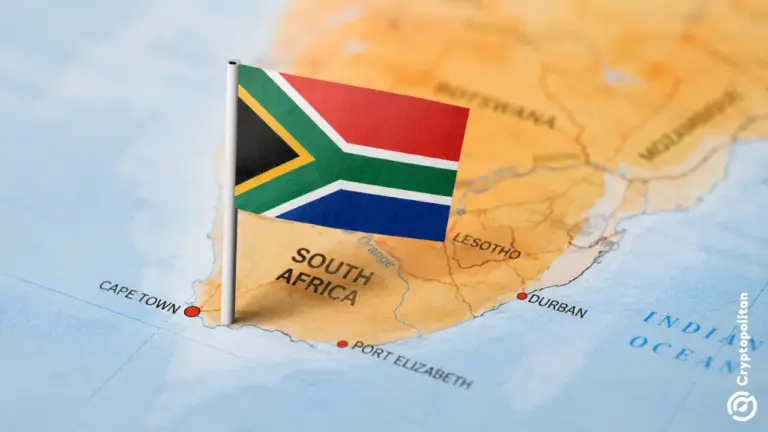
- The World Bank approved a $1.5 billion loan to help South Africa upgrade its electricity, transport, and water infrastructure as part of its economic reform agenda.
- The funding supports structural reforms aimed at improving the power grid, rail, ports, and water systems while encouraging private investment.
- Better infrastructure and investor confidence could indirectly strengthen South Africa’s fintech and crypto ecosystem by improving the business environment.
South Africa has obtained a $1.5 billion loan from the World Bank in order to speed up upgrades to the country’s decades-overdue electricity transmission, rail, ports and water systems. The loan represents the lender’s fourth stand-alone financial assistance to South Africa since 2022, indicating more and more confidence in Pretoria’s ability to implement its plan for economic reform.
The current Development Policy Loan does not just inject more money into the economy, but is anchored in a series of financing packages tied to reform measures in order to help South Africa address its long-standing infrastructure problems that stunted its growth for years.
The World Bank has granted $750 million for COVID recovery in 2022, then a loan of $1 billion for the energy transition process in September 2023, and now the latest package. Each loan has been linked to specific reforms rather than free spending by the government.
Finance Minister Enoch Godongwana said the new financing would deepen reforms already producing results in the energy and transport sectors while extending the government’s reform agenda to the country’s struggling water sector.
The loan comes through the World Bank’s International Bank for Reconstruction and Development (IBRD). World Bank Group Division Director for South Africa Satu Kahkonen said the country’s sustained reform efforts demonstrate that even deeply rooted infrastructure challenges can be reversed. According to World Bank estimates, the reforms supported by the program could help create nearly 600,000 jobs by 2032, with about 280,000 jobs expected by 2027.
What the money is meant to build
The funding enables specified infrastructure and policy reforms in the sectors of energy, transportation, and water.
In the energy sector, the initiative supports the launch of a market for wholesale electricity by making it more competitive, encouraging more investments from private partners in constructing transmission infrastructure, and aiming to wire 300,000 new households by 2027. Earlier estimates from the World Bank also linked the support to a broader reform program to 3,500 MW of renewable energy and the construction of about 200 km of transmission lines and 50,000 smart meters able to allow households to do the reverse selling of their surplus electricity to the grid.
In terms of the transportation sector, the reform strategy includes the opening of South Africa’s freight railway system to new rail operators and the setting up of the first terminal port concession in Durban. As the World Bank has pointed out, constraints in logistics are estimated to have resulted in a 20% fall of the country’s exports in 2023, making it clear that transport reform is necessary.
This new package also includes water and sanitation reforms. In particular, the reforms will strengthen regulation around private water operators, increase participation of private operators in the industry, and provide the National Water Resources Infrastructure Agency with more autonomy in financing its activities, allowing it to raise funding for large-scale water projects. While the Bank does not expect those steps to create much employment, it believes that they will lead to improvement of access to clean water and overall public health, especially for the most disadvantaged segments of the population.
Why now
The loan comes at a time when South Africa is still trying to recover from a long history of poor economic performance. For much of the last ten years, GDP growth has been almost at 1%, and unemployment continues to be higher than 31%. As estimated by the World Bank, power outages alone reduced economic performance by 2% in 2023, while around 500,000 jobs were lost.
The government aims to achieve economic growth higher than three percent within the next three years through Operation Vulindlela, a collaboration by the Presidency and National Treasury that aims to eliminate obstacles to investments.
There are indications of progress. Load shedding almost vanished in the last 18 months, investment in renewable energy from the private sector skyrocketed, and freight movements through ports and rail are almost back to pre-2023 levels. Additionally, the debt relief received by Eskom from the World Bank energy program implemented in 2023 has had a positive impact on electricity availability.
The recent operation has been designed with funding and aid from Germany, Japan, the OPEC Fund and the African Development Bank.
The upcoming test will be practical execution. Investors will be assessing if South Africa will achieve its grid connection objectives, manage to deliver the Durban port concession, and allow the National Water Resources Infrastructure Agency to entice private investors. In spite of the absence of funding directly linked to cryptocurrency or blockchain projects, improved infrastructure and growing investor confidence can boost South Africa’s digital economy indirectly.
With one of the most advanced regulatory frameworks for crypto-assets in Africa, the country is in a good position to benefit as improved transport, energy, and connectivity create a better environment for fintech companies, payment providers, tokenization platforms and blockchain startups
Making South Africa more attractive
Crypto companies are businesses that benefit from lower operating costs and increased investment. The World Bank’s infrastructure financing comes as South Africa already offers one of Africa’s clearest regulatory frameworks for crypto assets. Ripple Chief Legal Officer Stuart Alderoty has said that “institutional adoption and diversified crypto holdings both rely heavily on one crucial factor: regulation.” Analysts say that when regulatory clarity is paired with improvements in electricity, logistics, and investment conditions, it can create a more attractive environment for blockchain companies and digital asset investors.
Although the loan is focused on electricity, transport, and water infrastructure, its longer-term impact may extend beyond traditional sectors. By improving the foundations of the economy and supporting structural reforms, South Africa could further strengthen its position as one of Africa’s leading destinations for regulated crypto businesses, fintech companies, and blockchain innovation.
Don’t just read crypto news. Understand it. Subscribe to our newsletter. It's free.
FAQs
How much is the World Bank loan and who is providing it?
The loan is $1.5 billion, extended through the World Bank's International Bank for Reconstruction and Development (IBRD) as the fourth stand-alone Development Policy Loan to South Africa since 2022.
What projects and reforms will the loan support?
It backs a competitive wholesale electricity market, private investment in transmission, 300,000 new household grid connections by December 2027, greater rail competition, South Africa's first port terminal concession in Durban, and new water and sanitation oversight under the National Water Resources Infrastructure Agency.
How many jobs is the financing expected to create?
World Bank economic modeling estimates the reforms will help create the equivalent of nearly 600,000 jobs by 2032, with the electricity and transport measures accounting for around 280,000 by 2027.
Disclaimer. The information provided is not trading advice. Cryptopolitan.com holds no liability for any investments made based on the information provided on this page. We strongly recommend independent research and/or consultation with a qualified professional before making any investment decisions.

Ashish Kumar
Ashish Kumar is a crypto and financial journalist with eight years of newsroom experience. He covers what’s happening with crypto markets, regulation, DeFi, and exchange ecosystems. He has worked with Coingape, Todayq, and Newsroompost. Ashish holds a PGDP in English Journalism from the IIMC. He has also interviewed industry figures including Arthur Hayes, Yat Siu, Austin Federa, and more.









