






Wall Street thinks China’s yuan is 25% undervalued by a quarter on real‑trade basis

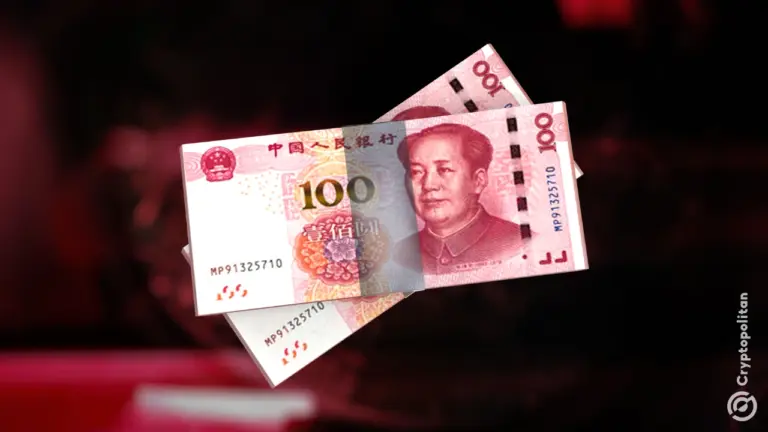
- Goldman says the yuan is about 25% undervalued and should rise far more than 2026 market pricing suggests.
- The yuan is heading for its first annual gain since 2021 due to a weaker dollar, stock inflows, global use, and firmer fixings.
- Goldman rejects the idea that a weak yuan is needed to keep Chinese exports strong despite the $1 trillion trade surplus.
Wall Street’s biggest trendsetter, Goldman Sachs, says the yuan is trading about 25% below its fair value, with the bank expecting stronger gains by 2026 than what forwards currently show.
The bank described the currency as one of its highest-conviction trades, saying its valuation does not match the economic conditions needed to support a steady current-account balance, stable prices, and consistent growth.
Goldman said the yuan is heading for its first annual rise since 2021 in both onshore and offshore markets. The move comes from a weaker dollar, rising equity inflows into mainland China, wider international use of the currency, and firmer daily fixings.
At the same time, the bank said conditions such as a soft economy, visible deflation, possible dollar strength, and weaker exports could still apply downward pressure.
Goldman disputes claims of export-driven weakness
Goldman strategist Teresa Alves wrote in a note dated Dec. 9 that “some argue that CNY undervaluation is a key driver of the competitiveness of Chinese exports,” but “we disagree,” saying the currency is “so deeply undervalued, the strengthening we project would still leave the currency comfortably in inexpensive territory.”
Teresa’s comments came as debate increased over whether Beijing is keeping the yuan weak to manage trade uncertainty.
The International Monetary Fund has linked China’s rising exports and widening surplus to the currency’s real depreciation and urged the country to move toward a freer exchange rate.
The discussion has intensified after China’s goods trade surplus passed $1 trillion in the first eleven months of the year. Governments worried about overcapacity have pushed back on the rising volume of Chinese goods.
Goldman said countries losing market share may respond with their own currency declines, which would lift the yuan’s relative position in China’s trade basket. Teresa also said China’s current-account strength adds upward pressure.
Goldman models point to large mispricing
Goldman’s Dynamic Equilibrium Exchange Rate (GSDEER) model places the yuan’s fair value near 5 per US dollar, with the currency trading around 7.06 on Wednesday. The bank said its Fundamental Effective Exchange Rate (GSFEER) model, which ties values to the current account, shows the yuan 12% undervalued.
The bank said the weighted average of both models places the currency 25% below fair value. Forwards for the fourth quarter of 2026 price the offshore yuan near 6.91, or roughly 2% stronger than its current level.
Across Asia-Pacific markets, traders reviewed China’s inflation numbers while waiting for the Federal Reserve’s decision.
Hong Kong’s Hang Seng Index traded 0.22% higher, while China’s CSI 300 closed 0.14% lower at 4,591.83 as consumer prices rose 0.7% from a year earlier, the highest since February last year, after a 0.2% rise in October. The gain matched a forecast from a Reuters poll.
China’s factory-gate prices fell 2.2% in November from a year earlier, extending the deflation cycle after a 2.1% drop in October.
Australia’s S&P/ASX 200 was little changed at 8,579.40. Japan’s Nikkei 225 slipped 0.1% to 50,602.8, and the Topix rose 0.12% to 3,389.02. South Korea’s Kospi fell 0.21% to 4,135, while the Kosdaq climbed 0.39% to 935.
If you're reading this, you’re already ahead. Stay there with our newsletter.
Disclaimer. The information provided is not trading advice. Cryptopolitan.com holds no liability for any investments made based on the information provided on this page. We strongly recommend independent research and/or consultation with a qualified professional before making any investment decisions.

Jai Hamid
Jai Hamid has been covering crypto, stock markets, technology, the global economy, and the geopolitical events that affect markets for the past 6 years. She has worked with blockchain-focused publications including AMB Crypto, Coin Edition, and CryptoTale on market analyses, major companies, regulation, and macroeconomic trends. She has attended London School of Journalism and thrice shared crypto market insights on one of Africa’s top TV networks.









