

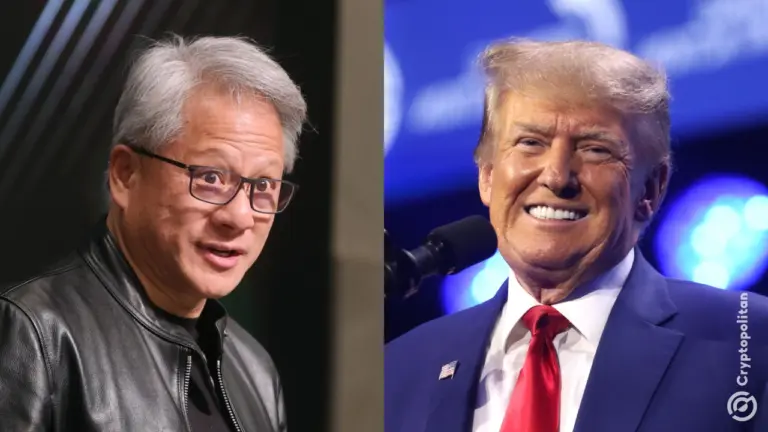
- Trump is considering allowing Nvidia to export H200 chips to China, according to Bloomberg.
- The H200 would be a step above the H20, but still below the banned Blackwell line.
- Beijing is pushing for local chips, but Chinese firms still prefer Nvidia hardware despite restrictions.
Donald Trump is now seriously discussing whether to allow Nvidia to send its H200 artificial intelligence chips to China, despite U.S. restrictions that were put in place three years ago.
According to Bloomberg, conversations inside the White House have already begun. Trump’s aides have been weighing whether to issue export licenses that would allow Nvidia’s chips, used to train massive AI systems, to reach Chinese firms again. Nothing’s been finalized, but the fact that these talks are happening at all is a major reversal from earlier policies.
This debate comes as Trump looks for potential openings with Xi Jinping. Last month, he met with the Chinese leader but didn’t formally bring up Nvidia’s latest chips. That said, people involved in the follow-up say U.S. officials have kept the door open.
Discussions are now centered on what type of processors could be sold, without putting what Trump’s team sees as national security at risk.
Trump officials push H200 over Blackwell
The H200 chip is stronger than the current H20 model allowed in China but is still based on Nvidia’s older Hopper design. The Blackwell line, which is used in the U.S., remains banned.
By letting China buy the H200, the administration could offer a middle option, something more powerful than the current legal ceiling but not America’s top-tier chips.
Trump’s Treasury Secretary Scott Bessent said recently that he could imagine sending Blackwell chips to China, but only once they’re outdated.
“Maybe in a year or two,” Bessent told lawmakers. Five months ago, he had said the administration had “no intent” to expand China’s access to advanced semiconductors and confirmed they had even blocked the weaker H20, something the Biden White House didn’t do.
Then weeks later, the U.S. quietly greenlit shipments of the H20 in return for a 15% cut of revenue, an informal deal with no formal legal agreement behind it. Officials at the time said it was part of a wider trade deal with China for rare-earth minerals.
But six people familiar with the deal in London allegedly said there was no such trade deal. China’s Commerce Ministry said it approved rare-earth exports because the U.S. had lifted other restrictions, and separately acknowledged the H20 license approval.
Howard Lutnick, Trump’s Commerce Secretary, defended the H20 exports by saying, “They’ll get addicted to our tech,” and that it wouldn’t hurt the U.S. because they weren’t selling China the most advanced chips, “not our best stuff, not our second-best stuff, not even our third-best.”
Beijing rejects Nvidia’s limited chips, but still wants access
Despite Washington’s green light, Beijing told its companies not to buy the H20 or another China-specific Nvidia product.
China’s government has been pushing its firms to adopt domestic hardware from players like Huawei, even though most tech companies in the country still want Nvidia’s chips. The local alternatives are weaker and harder to scale.
Nvidia, for its part, has been pushing back on U.S. policy. In a statement, it said the restrictions “leave that massive market to our rapidly growing foreign competitors.”
The company also said, “Our foreclosure from the China data center compute market has no impact on our ability to supply customers in the USA.” CEO Jensen Huang has been meeting with U.S. officials trying to reverse the restrictions.
This internal fight has also reached Congress. A bipartisan group of senators is now writing legislation that would force the Commerce Department to deny all current license applications for advanced chips to China. If that bill passes, the Trump administration’s entire H200 plan would be dead.
The White House and Commerce have refused to comment on whether they support H200 exports. But Trump’s team is still debating the best move. Some aides see the H200 as a reasonable middle ground, better than the watered-down chips already available in China, but far behind Blackwell.
Others inside the administration want no additional chips sold at all. Lawmakers on both sides agree that too many exports could give China an edge in artificial intelligence.
Nvidia shares jumped 2% to $184.29 after the news broke Friday.
The smartest crypto minds already read our newsletter. Want in? Join them.

Jai Hamid
Jai Hamid has been covering crypto, stock markets, technology, the global economy, and the geopolitical events that affect markets for the past 6 years. She has worked with blockchain-focused publications including AMB Crypto, Coin Edition, and CryptoTale on market analyses, major companies, regulation, and macroeconomic trends. She has attended London School of Journalism and thrice shared crypto market insights on one of Africa’s top TV networks.