







- A current Chainalysis report shows that traditional players have joined crypto on-chain to move illegal money.
- July’s Chainalysis report shows that money laundering through crypto has been around for years.
- Decentralized finance, which is far from the reach of governments, has made it harder to track illegal money and impose AML regulations.
Well, crypto criminals are not the only people trying to hide their illegal fund movements across blockchains. Chainalysis, an analytics company, has suggested that traditional money launderers outside the crypto industry may also be transferring their illegal funds on-chain.
Also Read: Abuja High Court schedules Binance’s tax evasion verdict for Oct 11
Chainalysis’s most recent report on crypto money laundering, published this week, shows a thriving space of on-chain money transfers that are not necessarily illegal but exhibit the characteristics of transactions that would peak suspicion from financial institutions.
Crypto becomes a haven for money launderers
Traditional money launderers are beginning to use crypto networks to build “large-scale money laundering infrastructure” to clean cash that did not originate in crypto. Money laundering is the process of hiding the origins of money earned through criminal actions so that the funds can be used without calling attention to their illegal source.
Often, this money obtained through criminal activities such as drug trafficking or terrorist financing appears lawful. Money laundering typically involves three stages: placement, layering, and integration. Placement is the first stage in which illegal money enters the financial system.
Layering entails passing money through a sequence of financial transactions to hide its origin. Finally, integration is the act of returning money to the economy while making it look like it came from a legitimate source.
Chainalysis has gained popularity for detecting blockchain crypto frauds, thefts, and ransomware assaults. According to the firm’s CEO, most on-chain investigators will not be surprised that this type of activity has been a potential source of trouble for years.
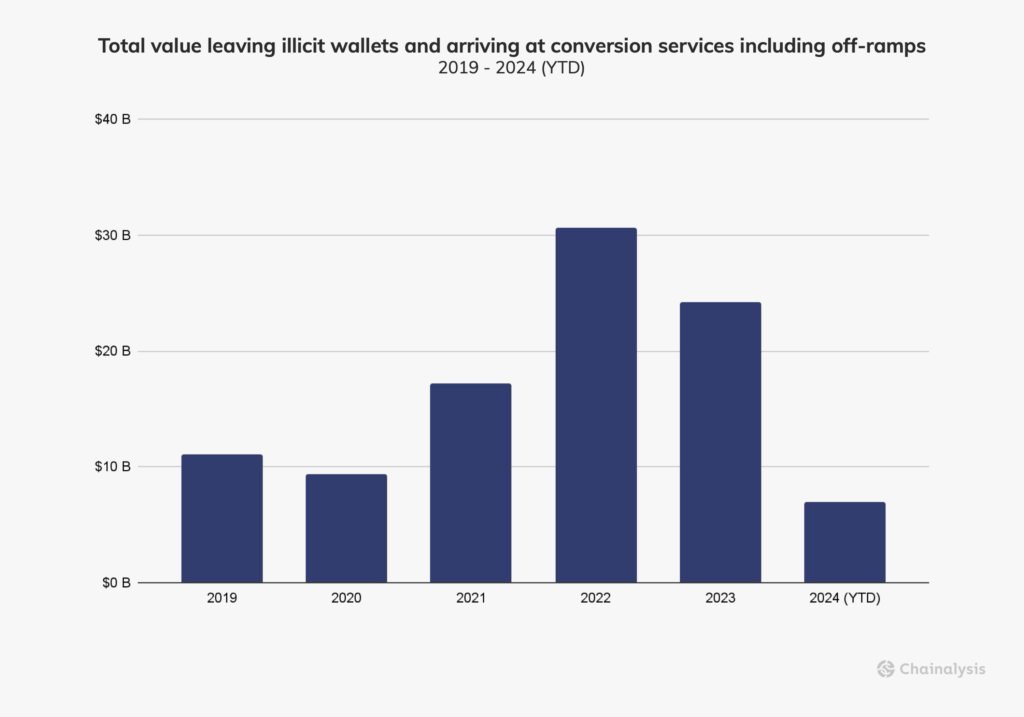
The July research is Chainalysis’ first attempt to demonstrate how widespread the trend is across the blockchain. The company discovered that the orders were larger than the known unlawful transaction base.
When Chainalysis analyzed all transfers submitted to exchanges in 2024, it discovered a flood of transactions priced just below $10,000, at which point further know-your-customer restrictions apply.
Our investigators take many things into consideration when they’re determining whether something is suspicious, and this would be one thing – but definitely not enough […] This is trying to advance the conversation about how we in crypto think about compliance techniques to mirror what was developed in traditional banking.
Kim Grauer
Note that just because a crypto transaction to an exchange is $1 less than the $10,000 threshold does not make it illegal. However, banks and money service businesses in the traditional financial sector have long used similar algorithms to detect illegal activities.
The smartest crypto minds already read our newsletter. Want in? Join them.
Disclaimer. The information provided is not trading advice. Cryptopolitan.com holds no liability for any investments made based on the information provided on this page. We strongly recommend independent research and/or consultation with a qualified professional before making any investment decisions.

Florence Muchai
Florence has been covering for the past 6 years crypto, gaming, tech, and AI news. Her Computer Studies at Meru University of Science and Technology and Disaster Management and International Diplomacy at MMUST amply equip her with language, observation and technical skills. Florence has worked at VAP Group and as an editor for several crypto media houses.









