






Tether CEO Paolo Ardoino unveils QVAC AI assistant built to run on a laptop GPU

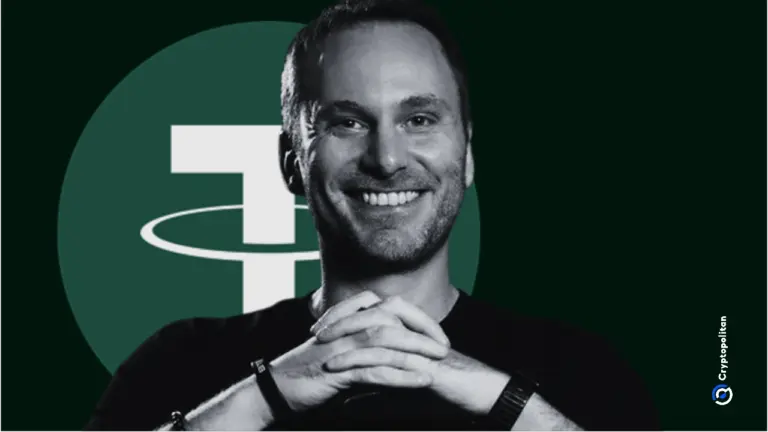
- Tether CEO Paolo Ardoino has unveiled the QVAC AI assistant that uses “100% local inference and reasoning.”
- The assistant uses the Model Context Protocol (MCP) to connect to various tools and services.
- Tether’s USDT continues to dominate with a market capitalization of $184 billion, while USAT, the stablecoin firm’s US-domiciled, has a circulating supply of just $20 million.
Tether CEO Paolo Ardoino has revealed the company’s AI assistant, QVAC. This initiative is Tether’s entry into the decentralized AI space, focusing on privacy and hardware accessibility rather than centralized cloud computing.
Paolo Ardino shared a short demo on his X. He shows the tool running entirely on a local device. The assistant created and assigned tasks in Asana using simple natural language commands.
Testing Tether’s QVAC AI Assistant
many skills already supported via MCP, using Asana in the example below (on a sub-average laptop GPU)
100% local inference/reasoning
soon opensource pic.twitter.com/sYi91QhjVC— Paolo Ardoino 🤖 (@paoloardoino) February 12, 2026
The system uses “100% local inference and reasoning.” The demo ran on a laptop with a below-average GPU. That detail caught attention because most AI tools rely on powerful cloud servers. The assistant runs directly on the user’s device.
It doesn’t send data to cloud servers. This approach fits the crypto philosophy of user control and privacy. Many cloud AI tools collect and store user data. QVAC aims to avoid that issue by keeping everything local. This matters more in finance and crypto, where users value control. The move also puts Tether into the growing AI race.
Tether plans to introduce its first AI applications based on QVAC
The system’s internal thinking process was reflected through the model thinking toggle buttons before the tool call process. The metrics displayed in the terminal for the model’s efficiency included a time of 1062.1 ms to generate the first token and a speed of 34.6 tokens per second.
The assistant uses the Model Context Protocol (MCP). This system allows it to connect to different tools and services. It can add new “skills” without changing the core model.
The company plans to introduce its first AI applications based on QVAC. Tether said it wants to create a decentralized AI ecosystem and usher in an era of unlimited intelligence. The firm’s CEO, Paolo Ardoino, argued that AI will make critical decisions in people’s lives, but the infrastructure is currently fragile, invasive, and opaque.
Previously, the blockchain-enabled platform highlighted that QVAC’s modular architecture allows developers to build and extend applications using small, composable components. Tether added that its peer-to-peer networking facilitates direct device-to-device communication and collaboration without reliance on centralized servers.
This will be possible through a consumer app for local on-device AI processing, called QVAC Workbench. So far, Tether has invested more in telecommunications, energy production, and artificial intelligence infrastructure. Tether first launched QVAC AI in May and further expanded the QVAC Genesis II AI Dataset to 148 billion tokens in December.
The firm stated that its architecture allows the QVAC ecosystem to scale to trillions of AI agents and applications without points of failure while delivering a first-of-its-kind Infinite Intelligence swarm, cryptopolitan reported.
The upcoming open-source release will be the ultimate test of whether this tool can attract interest from the broader developer community and provide a feasible path for decentralized digital assistants.
Tether expands its assets that back USDT
Tether’s USDT continues to dominate with a market capitalization of $184 billion, according to DefiLlama data. USAT, the stablecoin firm’s US-domiciled outfit that launched last month, had a circulating supply of just $20 million.
It has expanded the assets that back its flagship, market-leading stablecoin, USDT. Between September 2024 and November 2025, the share of “high risk” assets, such as gold and Bitcoin, backing USDT rose from 17% to 24%, while the share of US Treasury bills fell from 81% to 75%, according to S&P Global.
According to Bo Hines, CEO of Tether’s US arm, Tether could soon become one of the top 10 buyers of US Treasury bills. USDT now has roughly $185 billion in circulation and serves an estimated 530 million users, adding about 30 million new users each quarter.
To back this supply, Tether holds more than $122 billion in the US Treasury bills, accounting for over 83% of its reserves. At current levels, Tether ranks among the top 20 global holders of U.S. government debt, between major sovereign nations like Germany and Saudi Arabia.
Tether has become one of the world’s largest holders of gold, rivalling countries and multinational banks. Last year, it also became the third-largest shareholder in Adecoagro, Argentina’s largest producer of milk and rice.
The smartest crypto minds already read our newsletter. Want in? Join them.
Disclaimer. The information provided is not trading advice. Cryptopolitan.com holds no liability for any investments made based on the information provided on this page. We strongly recommend independent research and/or consultation with a qualified professional before making any investment decisions.

Florence Muchai
Florence has been covering for the past 6 years crypto, gaming, tech, and AI news. Her Computer Studies at Meru University of Science and Technology and Disaster Management and International Diplomacy at MMUST amply equip her with language, observation and technical skills. Florence has worked at VAP Group and as an editor for several crypto media houses.









