


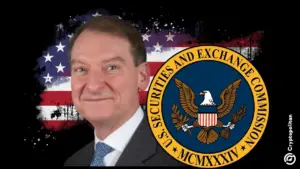



Stablecoin yield standoff could roil crypto markets as French Hill pushes senate


- Lawmakers are stuck over whether stablecoin issuers can offer yield-like rewards.
- The House passed the CLARITY Act with strong bipartisan support, but the Senate has not agreed on final language.
- Despite delays, traders and industry leaders remain hopeful that the bill could become law in 2026.
A breakthrough on the CLARITY Act proved elusive as discussions over stablecoin rewards fell behind the White House’s self-imposed March 1, 2026, deadline. Still, traders on prediction platform Polymarket wager a 73% chance that the landmark legislation will be enacted in 2026.
Speaking at the Milken Institute’s Future of Finance event, House Republican French Hill is urging the Senate to adopt the House-passed CLARITY Act language as a straightforward solution.
In July, the House of Representatives advanced the CLARITY Act (H.R. 3633) by a commanding 294–134 vote, securing strong bipartisan support. Consequently, the strong vote helped raise hope among industry players that the legislation would soon be enacted, increasing pressure on lawmakers to complete the final draft.
Lawmakers have yet to resolve their differences over possible stablecoin yield incentives
Lawmakers in the Senate Banking Committee reached an impasse over whether stablecoin issuers and crypto platforms should be able to offer yield-like benefits to customers. So far, most traditional banks have contended that paying users to hold stablecoins blurs the line with bank deposits and could undermine financial stability, but crypto companies believe participation rewards are key to innovation.
Sharing the concerns voiced by many banks, JPMorgan’s chief financial officer, Jeremy Barnum, addressed the issue on stablecoin yield incentives in January, warning: “The creation of a parallel banking system that sort of has all the features of banking, including something that looks a lot like a deposit that pays interest, without the associated prudential safeguards that have been developed over hundreds of years of bank regulation, is an obviously dangerous and undesirable thing.”
Amid the split between banks, crypto groups, and legislators, White House crypto council executive director Patrick Witt urged lawmakers to resolve their differences by March 1. He warned that any delay beyond the target would only hold back the markup and threaten the bill’s future.
Reportedly, lawmakers have been in constructive discussions over the past few weeks and have tried to craft draft language that would permit modest stablecoin activity-driven incentives while restricting idle yields, but the two sides remain at odds.
Summer Mersinger, CEO of the Blockchain Association, has tried to calm the crypto community over the delays. On X, she emphasized that discussions about the CLARITY Act involve a host of stakeholders and that the legislation, therefore, needs to be deliberated carefully, noting that substantive policy differences take time to resolve.
Senators are still rethinking the markup dates. Nonetheless, if cleared by the committee, the CLARITY Act would proceed to the full Senate.
The crypto community remains optimistic that the bill could be approved in 2026
On prediction platform Kalshi, 41% of traders wagered that the CLARITY Act would be enacted before June, and 15% before May. Overall, 65% believe the legislation will reach the President’s desk before 2027. Meanwhile, 73% of traders on Polymarket are betting that the legislation could be signed into law in 2026.
Additionally, Ripple CEO Brad Garlinghouse told reporters he’s hopeful the CLARITY Act could be approved by April, estimating a 90% probability if talks continue positively. However, some analysts claim the missed March deadline will only add more time to the already stretched legislative schedule, potentially delaying progress until after the November midterms.
The current standstill also follows Coinbase’s withdrawal of support. At the time the exchange pulled its backing, some market observers had cautioned that it could stall any meaningful crypto legislation for the session. Financial policy analyst Jaret Seiberg of TD Cowen had even remarked that the stablecoins’ yield poses risks that could have negative outcomes on the broader crypto market structure bill, “We see this as potentially derailing market structure legislation in this Congress. We view the delay as negative for crypto and positive for banks.”
He added that walking away generally means supporters feel the bill cannot be salvaged through negotiation. Although Coinbase’s Armstrong had justified their decision, saying the draft had “too many issues” for them to back it.
Nevertheless, other crypto players continued their support for the bill even after Coinbase dropped the ball. Ideally, if the bill were approved, oversight of digital assets would be shared by the SEC and CFTC.
In a related development, Wall Street regulators are moving forward with plans to oversee the growing crypto industry and booming prediction markets, with measures that could have long-term effects on broader financial markets.
After months of public statements and political wrangling in Congress, the Securities and Exchange Commission, which supervises the US stock market, and the Commodity Futures Trading Commission, which oversees derivatives, have submitted regulatory proposals to the White House. While details remain limited, the step marks one of the most significant actions yet by the Trump administration’s financial regulators.
Since taking office last year, President Donald Trump has steered US watchdogs toward a more crypto-friendly approach, in contrast to the stricter stance seen during the Biden administration. The new plans could formalize industry guidelines and codify the lighter-touch oversight currently being applied.
Both industries have recently edged closer to mainstream finance, with prediction markets surging into a multi-billion-dollar business and digital asset firms championed by a president who wants to make the US the “crypto capital” of the world. Now the industries are potentially getting some of the clear guidelines they have pushed for in a favorable political environment, with key steps forward from regulators this week.
If you're reading this, you’re already ahead. Stay there with our newsletter.
Disclaimer. The information provided is not trading advice. Cryptopolitan.com holds no liability for any investments made based on the information provided on this page. We strongly recommend independent research and/or consultation with a qualified professional before making any investment decisions.

Nellius Irene
Nellius is a Business Management and IT graduate with five years of experience in the cryptocurrency industry. She is also a graduate of Bitcoin Dada. Nellius has contributed to leading media publications, including BanklessTimes, Cryptobasic, and Riseup Media.









