



- The OCC rejected Wise’s US national trust bank charter over anti-money-laundering deficiencies, sending its shares down 11% in under 24 hours.
- The regulator cited Wise’s 2025 Multi-State Consent Order and lack of fiduciary experience.
- Wise plans to refile under the GENIUS Act, even as the OCC has approved similar charters for crypto firms like Ripple, Circle, and BitGo since late 2025.
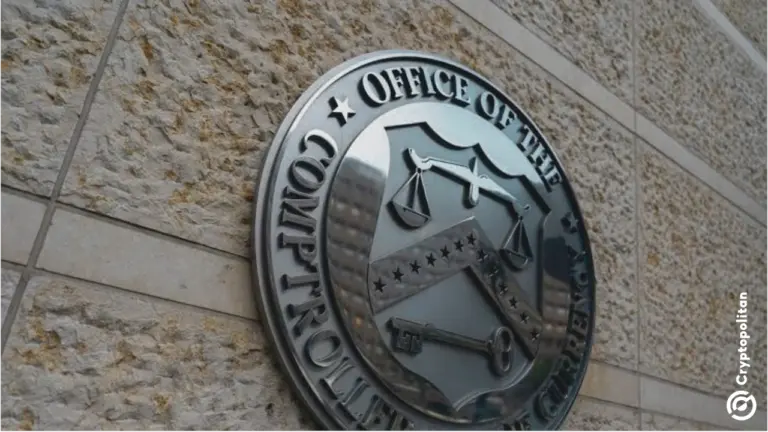
Wise (NASDAQ: WSE) has lost its bid for a US national trust bank charter, and in less than 24 hours, its shares have dropped by 11%. The Office of the Comptroller of the Currency (OCC) rejected the payments firm’s application over anti-money-laundering deficiencies on Thursday, July 23.
Wise has been making moves to expand its footprint in the US, and the bank charter would have been a major step forward in achieving its goal. The fintech, which is headquartered in London, made its debut on Nasdaq in May, relocating its primary listing to New York.
How often does the OCC reject national trust bank charter applications?
The OCC does not usually give outright denials. Reports liken Wise’s case to that of UK digital bank Monzo, which withdrew its own application after the regulator signaled that it was not going to get the approval.
The only difference between both firms is that Wise chose not to withdraw, and the OCC’s decision came as a formal rejection.
Wise filed for the national trust charter over a year ago, and it says that the reasons that the OCC gave for the denial in its letter point back to problems that were tied to that original filing without considerations for where they stand today as a business.
Google Finance data showed the stock trading around 844 pence on the London Stock Exchange on Friday morning, down from a previous close of 905 pence. On Nasdaq, the pre-market data show that it is currently down by 6.51%, trading at $12.08.
What did the OCC actually fault in Wise’s application?
The regulator’s concern was compliance. Wise’s application ran into a public Multi-State Consent Order from July 2025, reached with several US states over weaknesses in the firm’s anti-money-laundering program.
Those failures included being slow to file suspicious activity reports, the alerts banks must send when they spot possible criminal money movement.
Citing the Financial Times, the regulator found that the UK fintech “has no historical experience with fiduciary activities” and that its proposed management failed to show sufficient relevant experience.
Wise says it has since overhauled its controls. “In response to the Consent Order, we have strengthened our local U.S. program, enhanced our investigation and reporting processes, improved the integrity of the data we collect from our customers and increased resourcing for our local compliance program,” the company said in a statement.
Wise added that it works with the UK’s Financial Conduct Authority and the National Bank of Belgium on these controls.
Why Wise says the old plan no longer works
Wise built its original application around getting a master account at the Federal Reserve, the direct line into the US payment system. The Fed proposed changing that access policy in May 2026 and has also paused account access for uninsured trust banks, which Wise now calls a “non-viable” foundation for its first application.
So the firm plans to refile, this time under the GENIUS Act, the new US law that gives stablecoins a clearer footing alongside traditional payment rails. Wise says its infrastructure is positioned to connect those systems as digital assets grow more common.
The company also mentioned that the setback changes nothing for customers now, as it keeps operating under money transmitter licenses across 48 states in the US and four territories, part of more than 80 licenses worldwide.
In fiscal 2026, Wise served around 19 million customers and moved more than $240 billion across borders, per its SEC filing. About 15% of its revenue comes from the US, against nearly $500 million in earnings on $2.5 billion in revenue for the year ending in March.
The contrast with crypto’s charter wave
The OCC has spent the past year waving crypto firms through the same door Wise just walked into and got bounced out. In December 2025, the same regulator conditionally approved national trust charters for Ripple, BitGo, Paxos, Circle, and Fidelity Digital Assets, and in May 2026, it cleared Nomura’s Laser Digital, a first for a Japanese bank subsidiary.
At least 15 digital-asset firms have applied for OCC charters since the start of 2025.
Wise’s denial shows the agency is still willing to say no when it questions an applicant’s compliance record, even as it opens the federal banking system to newer entrants. Rival Revolut filed a fresh US charter application this year after abandoning an earlier attempt, so Wise will not be the only European fintech testing the regulator’s stance.
Don’t just read crypto news. Understand it. Subscribe to our newsletter. It's free.
FAQs
Why did the OCC deny Wise's bank charter application?
The OCC cited anti-money-laundering deficiencies, pointing to a July 2025 Multi-State Consent Order over problems that included Wise being slow to file suspicious activity reports, and found the firm lacked historical experience with fiduciary activities.
Does the denial affect Wise's current US operations?
No. Wise says its normal operations continue under existing money transmitter licenses across 48 states and four territories, backed by more than 80 licenses globally.
What is Wise's next step after the rejection?
Wise plans to submit a new national trust bank charter application under the GENIUS Act framework, after concluding that its original approach, which relied on direct access to a Federal Reserve master account, is now "non-viable."
Disclaimer. The information provided is not trading advice. Cryptopolitan.com holds no liability for any investments made based on the information provided on this page. We strongly recommend independent research and/or consultation with a qualified professional before making any investment decisions.

Hannah Collymore
Hannah is a writer and editor with nearly a decade of blog writing and event reporting experience in the crypto space. At Cryptopolitan, Hannah contributes to the news page, reporting and analyzing the latest developments in DeFi, RWA, crypto regulation, AI and frontier tech industries. She graduated from Arcadia university with a degree in Business Administration.