







- A conflict could occur if Naver Financial becomes a holding company after absorbing Upbit operator Dunamu.
- The Fair Trade Act rules would clash with a proposed cap on major-shareholder ownership of crypto exchanges.
- The pending Digital Asset Basic Act could force Naver into a governance restructuring or a shared-ownership workaround.
Korea’s National Assembly Research Service has pointed out a regulatory contradiction that could force a governance overhaul at Naver Financial if it completes its takeover of Dunamu, the operator of Upbit.
The potential regulatory conflict is between two Fair Trade Act rules. One requires holding companies to maintain minimum subsidiary stakes, while the other proposes a limit on major shareholder ownership in crypto exchanges.
Will Naver Financial complete its acquisition of Dunamu?
In a report handed to Democratic Party lawmaker Park Min-kyu, Korea’s National Assembly Research Service warned that certain requirements of antitrust rules could contradict laws currently under review.
The conflict is centered around an existing law known as the Monopoly Regulation and Fair Trade Act, which requires holding companies to own at least 50% of an unlisted subsidiary and 30% of a listed one. Venture holding companies are legally required to hold a minimum of 20%.
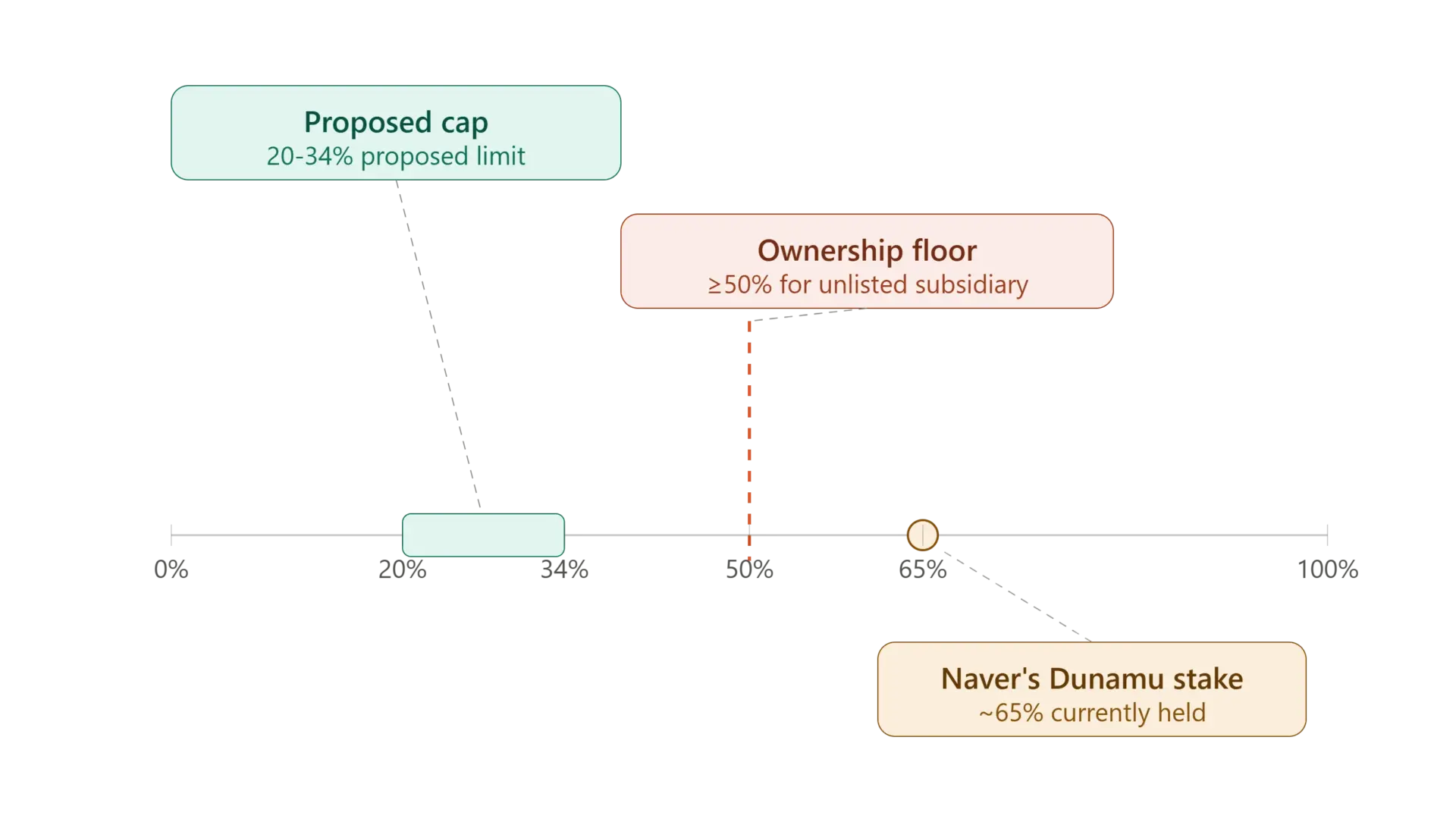
On the other hand is the Framework Act on Digital Assets, which is the second phase of a crypto law that is still under debate in the National Assembly. Lawmakers have spent months considering a provision in the law that would set a limit on the stake a single major shareholder can hold in a virtual asset exchange.
The research office said the two systems do not conflict in every case, but explained that a floor and a ceiling on the same stake “could be seen as a conflicting structure.”
Naver Financial is not a holding company, so the Fair Trade Act’s subsidiary rules do not yet apply.
What are the terms of Naver and Dunamu’s deal?
Naver Financial and Dunamu approved a comprehensive share swap in late November 2025 that puts Dunamu under Naver Financial’s full ownership. The share-swap ratio was set at 1 to 2.54, valuing the combined entity at roughly 20 trillion won. Dunamu’s Chairman Song Chi-hyung is set to become the largest shareholder at 19.5%, with Naver dropping to 17%.
Naver and Dunamu’s deal includes a commitment to invest 10 trillion won ($6.8 billion) into the development of Korea’s AI and blockchain technology over a period of five years.
Notably, Cryptopolitan reported that Dunamu handled about $1.04 billion in daily spot volume in late August, more than its three nearest domestic rivals combined.
If you're reading this, you’re already ahead. Stay there with our newsletter.
FAQs
What is the regulatory conflict facing the Naver-Dunamu merger?
The Fair Trade Act requires a holding company to own at least 50% of an unlisted subsidiary and 30% of a listed one, while the proposed Digital Asset Basic Act may cap how large a stake any single major shareholder can hold in a crypto exchange, creating a floor-versus-ceiling clash.
Does the rule affect Naver Financial right now?
No. The National Assembly Research Service said Naver Financial is not currently a holding company, so the subsidiary-stake obligations do not yet apply, though the issue could become real if the corporate group later meets holding-company requirements.
How large is the Naver-Dunamu deal?
The all-stock share swap sets a 1-to-2.54 ratio and values the combined company at roughly 20 trillion won, with the two firms pledging 10 trillion won (about $6.8 billion) of investment over five years.
Disclaimer. The information provided is not trading advice. Cryptopolitan.com holds no liability for any investments made based on the information provided on this page. We strongly recommend independent research and/or consultation with a qualified professional before making any investment decisions.

Hannah Collymore
Hannah is a writer and editor with nearly a decade of blog writing and event reporting experience in the crypto space. At Cryptopolitan, Hannah contributes to the news page, reporting and analyzing the latest developments in DeFi, RWA, crypto regulation, AI and frontier tech industries. She graduated from Arcadia university with a degree in Business Administration.









