







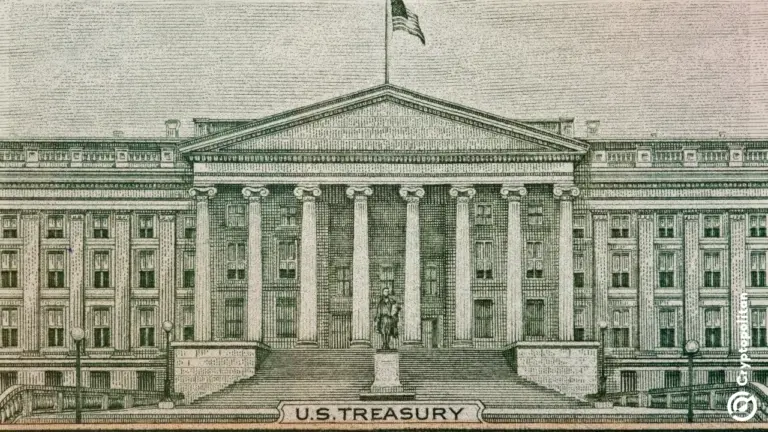
- Long-dated US government debt sold off as Trump moved to remove Federal Reserve governor Lisa Cook, raising concerns over Fed independence.
- The yield curve steepened to near three-year highs, with investors betting on short-term rate cuts but higher long-term inflation risks.
- The dollar weakened as analysts warned of fiscal dominance and political interference threatening central bank credibility.
Long-dated US government debt fell on Tuesday after investors reacted to President Donald Trump’s attempt to dismiss a Federal Reserve governor, which they feel undermines the central bank’s independence.
On Monday night, Trump announced that he was firing Federal Reserve governor Lisa Cook “effective immediately” after the latter was accused of mortgage fraud.
As reported by Cryptopolitan, the decision is expected to be handled by the court and would allow the White House to nominate a replacement likely “more supportive” of the US president’s push for lower interest rates.
Cook has been part of the central bank since 2022 and is one of seven governors on the Fed’s Board. According to legal commentators, the Trump administration would need to prove cause in court to justify her removal.
Liberal Senator and member of the Senate Banking Committee Elizabeth Warren said President Trump was orchestrating an “authoritarian power grab,” warning the public that firing Cook threatens the Fed’s statutory independence.
US market in red after Trump-Fed altercation
The prospect of political intervention at the Federal Reserve rattled American government bond markets. The yield curve steepened after short-term yields fell while long-term yields rose, on the backdrop of investors’ expectations for rate cuts in the September FOMC meeting, and a stubborn inflation rate that is not going down.
Two-year Treasury yields dropped 0.02 percentage points to 3.71%, while 30-year yields rose as much as 0.06 percentage points before easing back to finish up 0.03 percentage points at 4.92%.
This left the gap between two- and 30-year yields at more than 1.2 percentage points, approaching a three-year intraday high first reached during April’s turbulence that preceded Trump’s “liberation day” tariff announcement.
The American dollar weakened by 0.2% against a basket of several currencies, including the euro and pound. The greenback has already lost more than 9% this year, which most economists believe is caused by Trump tariffs.
Economists say government involvement puts central bank at risk
Marieke Blom, chief economist at Dutch bank ING, said Cook’s dismissal would cause “an important dent in central bank independence.” She warned that citizens ultimately pay a high price when governments interfere in monetary policy.
Others like Fraser Lundie, global head of fixed income at Aviva Investors, said markets penalize governments that blur institutional lines.
“Any government exhibiting instability of institutional arrangements and at risk of direct political influence would see a weaker currency, a steeper bond curve, and higher risk premiums on long-dated debt,” he reckoned.
Ed Al-Hussainy, senior rates analyst at Columbia Threadneedle Investments, does not see the White House’s strategy to influence Powell’s decisions as the right way to go.
“I see actions taken by the White House to pressure and intimidate Powell and Cook as part of a strategy to diminish and ultimately eliminate the Federal Reserve’s statutory independence.”
Trump has consistently pressured the Fed to reduce borrowing costs, and his decision raised expectations that the central bank may move to ease policy next month.
Futures markets now imply an 83% probability of a 25 basis point rate cut at the September meeting, up from earlier forecasts. Morgan Stanley joined Deutsche Bank, BNP Paribas and Barclays in predicting that the Fed will lower rates next month after Chair Jerome Powell signaled policy easing at the Jackson Hole economic symposium on Friday.
“We continue to believe that monetary policy must be forward-looking and consider the lags in its effects on the economy,” Powell said.
If you're reading this, you’re already ahead. Stay there with our newsletter.
Disclaimer. The information provided is not trading advice. Cryptopolitan.com holds no liability for any investments made based on the information provided on this page. We strongly recommend independent research and/or consultation with a qualified professional before making any investment decisions.

Florence Muchai
Florence has been covering for the past 6 years crypto, gaming, tech, and AI news. Her Computer Studies at Meru University of Science and Technology and Disaster Management and International Diplomacy at MMUST amply equip her with language, observation and technical skills. Florence has worked at VAP Group and as an editor for several crypto media houses.









