



Shark Tank’s Kevin O’Leary says Ethereum is cracking under pressure

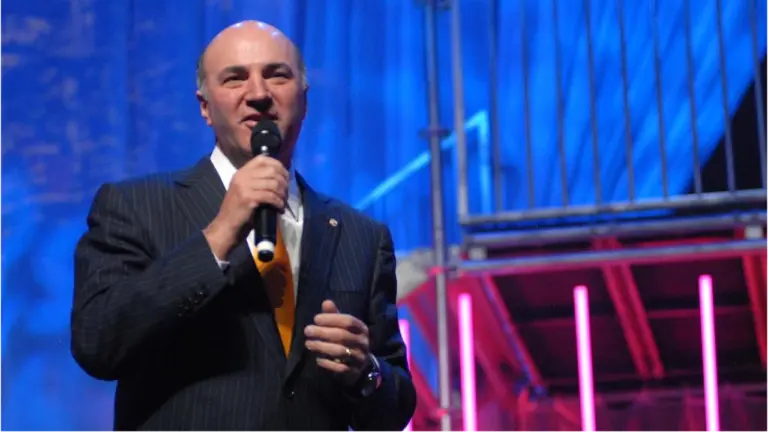
Photo of Kevin O'Leary uploaded by Ontario Chamber of Commerce in December 2009. Source: Flickr.
- Kevin O’Leary warns that Ethereum “cracks under pressure” after network fees surged above $1,000 during heavy blockchain traffic.
- The Shark Tank investor compared Ethereum to a “one-lane highway,” questioning its scalability as real-world adoption rises.
- Ethereum developer Adriano Feria countered, saying Layer 2 networks handle scalability while Ethereum’s main layer prioritizes security and institutional settlement.
Shark Tank member Kevin O’Leary has slandered Ethereum’s ability to handle large-scale blockchain traffic, claiming the network “cracked under pressure” when the crypto market tanked last week due to US-China tariffs standoff.
Canadian businessman and TV personality O’Leary said in a recent interview posted on X that he witnessed congestion, which left Ethereum users paying heavy gas fees just to process small transactions.
“Over the past weekend, I witnessed something every crypto investor should pay attention to. Ethereum, the largest blockchain in the world, got congested, and fees skyrocketed past $1,000 just to process small transactions. That’s like paying a thousand-dollar toll to drive on a one-lane highway,” O’Leary wrote.
What was seen, according to the millionaire, proves Ethereum cracks under pressure when real traffic hits the network.
“Over a decade, we’ve talked about going on-chain, and now with real-world adoption finally happening, the cracks are showing. Innovation is about building infrastructure that can actually handle scale.”
O’Leary talks Genius Act results and real world blockchain adoption
In a video interview posted on his brief explainer on X Thursday, Kevin O’Leary linked the scalability issue to what he coined “growing on-chain adoption fueled by recent legislation.”
“I anticipate that you’re going to be crashing Wall Street with the blockchain with crypto. We’ve been talking about going on-chain for 12 years, but it never happened. But now, with the stimulus of the Genius Act, for the first time ever, people are starting to use it as a digital payment system,” the businessman explained.
According to O’Leary, blockchain-based payments require transactions to move “on-chain,” through networks such as Ethereum and Solana.
“So over the weekend, and the reason I bring it up, a concern that I’ve had for a long time, and I’ve seen before, is that Ethereum, the biggest blockchain, got overloaded, overcrowded.”
O’Leary likened Ethereum’s congestion to a one-lane toll road overwhelmed by heavy traffic. “Ethereum is a single-lane highway and all the cars are transactions on it, but they have to go through the authentication toll booth out in the middle of nowhere. It works fine when there’s not massive volatility or massive volume. But when we had that occur on Saturday, it got stuck.”
He added that users had to pay higher fees to move their transactions to the front of the queue, which drove gas fees to extreme levels.
“That’s how you tell it’s stuck, because you can buy your way to the front of the car line to get through the toll. One of those transactions traded for more than a thousand dollars. Imagine if you’re buying something for a dollar fifty, and you had to pay a thousand to use Ethereum. That’s screwed up.”
Ethereum dev says Layer 1 is not meant for high traffic
Several Ethereum community members responded to O’Leary’s sentiment to defend the blockchain’s long-term scalability plans. One developer, Adriano Feria, said Ethereum’s main Layer 1 is not designed to handle everyday retail transactions.
“Ethereum’s L1 is not meant to handle retail traffic. It is the final settlement layer for the on-chain economy, focused on security, neutrality, and auditability. Scalability happens on L2s, which already process close to 300 transactions per second across rollups and is a couple of months away from scaling another 8x,” Feria remarked.
He also mentioned Ethereum’s broader ecosystem includes several Layer 2 rollups, which handle most retail and high-frequency transactions before settling final results on the Ethereum main chain.
“We have already seen a high level of retail on Coinbase, Visa, BlackRock, Sony, Deutsche Bank, and Ant Digital, who are all building or settling on Ethereum or its rollup ecosystem. Billions in stablecoins, RWAs, and tokenized funds like BlackRock’s BUIDL already rely on Ethereum security.”
Feria also bashed the idea that scalability should be Ethereum’s top priority because large institutions prioritize reliability and security over raw throughput.
“Scalability is not the main priority for all use cases and users,” he said. “Institutional settlement needs maximum security, liveness, and permanence, which is why Ethereum’s L1 is still the ‘default’ network for their operations.”
The smartest crypto minds already read our newsletter. Want in? Join them.
Disclaimer. The information provided is not trading advice. Cryptopolitan.com holds no liability for any investments made based on the information provided on this page. We strongly recommend independent research and/or consultation with a qualified professional before making any investment decisions.

Florence Muchai
Florence has been covering for the past 6 years crypto, gaming, tech, and AI news. Her Computer Studies at Meru University of Science and Technology and Disaster Management and International Diplomacy at MMUST amply equip her with language, observation and technical skills. Florence has worked at VAP Group and as an editor for several crypto media houses.









