






Jensen Huang says Trump–Xi trade deal ensures that Nvidia can access China market

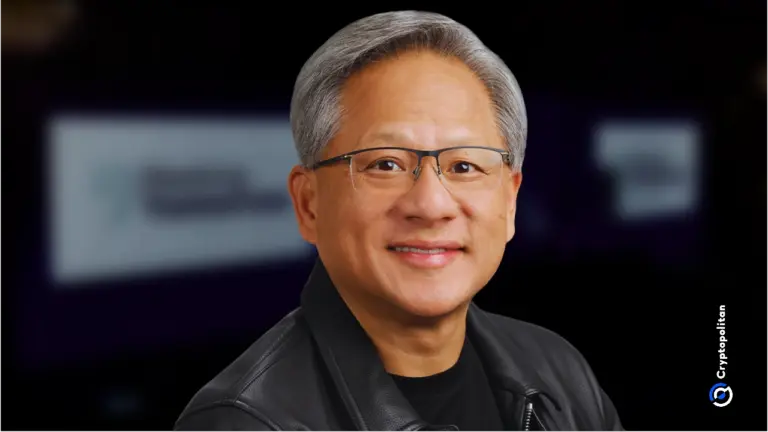
- Jensen Huang said the Trump-Xi trade deal allows Nvidia to keep selling into China while moving advanced chip production to the U.S.
- Nvidia is now manufacturing its most advanced AI chip, Blackwell, in Arizona after a nine‑month push backed by Trump’s directive.
- The company reached a $5 trillion market valuation and announced new partnerships across healthcare, transportation, and government AI systems.
Jensen Huang, speaking on Sunday Morning Futures, said the Trump–Xi trade deal is the reason Nvidia can still sell its technology into China, while the company shifts production of the world’s fastest AI semiconductor chip to Arizona.
The details were discussed during an interview aired this week, according to the broadcast. Jensen made it clear that the deal kept China accessible at a time when the White House demanded that critical chip manufacturing return to the United States.
He said the White House pushed the company from the moment President Donald Trump took office for the second time.
“When President Trump first took office, he wanted us to manufacture these critical technologies on shore. He wanted to re‑industrialize the United States,” Jensen said. He explained that Trump tied U.S. leadership in AI to physical control of the supply chain.
“He wants to have energy growth. He wants to make sure that the United States is a leader in artificial intelligence.” The Trump–Xi agreement, Jensen said, prevented a full commercial cutoff with China while the U.S. began rebuilding advanced semiconductor manufacturing capacity.
Nvidia begins full production of Blackwell chip in Arizona
Jensen described AI as something much larger than a single product line. “AI is an industrial revolution, and this is the most important technology of our time, potentially the most important technology of all time,” he said.
Jensen linked the technology to applications across healthcare, robotics, manufacturing, science, and commercial industries that rely on machine models and computing power.
That is why, he said, Nvidia needed to ensure the capability to manufacture its newest AI chip inside the U.S.
He said Trump wanted the manufacturing shift done “at the speed of light.” Jensen told him Nvidia would do it in nine months. Nvidia partnered with TSMC, Foxconn, Wistron, Amkor, and SPIL to build the production chain necessary in Arizona.
“We’ve been able to manufacture now the most advanced AI chip in the world completely in the United States and Arizona,” Jensen said. He described how mechanical engineers, electricians, plumbers, and construction workers worked without pause to meet the deadline. “Nine months later, we’re now in volume production of the most advanced AI chip in the world.”
Part of the production will supply U.S. military systems. The company confirmed the chip is intended for national defense applications, in addition to commercial use.
Jensen said the cost of producing chips in the U.S. is higher than Taiwan, but that cost is expected to come down as manufacturing efficiency improves. He said the first plants always carry the heaviest expense during the transition.
$5 trillion valuation and expansion across multiple sectors
Last week, Nvidia reached a $5 trillion market valuation, closing at $207.04 per share with a market value of $5.03 trillion.
Jensen said it took the company thirty years to build the technology base now driving AI investment. He described this moment as the beginning of a long infrastructure cycle as organizations build out AI computing capacity.
During Nvidia’s GTC conference in Washington, the company announced a $1 billion investment in Nokia for a 2.9% stake, a partnership with the Department of Energy to build seven new AI supercomputers, and new agreements across healthcare, transportation, and commercial enterprise operations.
Those include Eli Lilly for drug research, Palantir for enterprise‑scale AI systems, and Uber for the development of a robo‑taxi fleet.
Jensen also explained why national security was part of the push to move production to Arizona. “We can’t afford to have the critical manufacturing of things that are so important to national security being manufactured around the world and can’t be manufactured here.”
He tied it to supply chain stability and long‑term employment in high‑skill jobs. He said production of chips and AI systems inside the U.S. will lead to “millions of jobs” over time.
He said Trump’s three priorities guiding this policy are re‑industrialization, energy growth, and leadership in artificial intelligence, and that the Trump–Xi trade deal is what allowed Nvidia to continue operating in China while carrying out that policy inside the U.S.
“These three initiatives are going to transform America’s position in the world completely,” said Jensen. “And so it’s such a great vision, and I’m all behind it. That is very optimistic.”
The smartest crypto minds already read our newsletter. Want in? Join them.

Jai Hamid
Jai Hamid has been covering crypto, stock markets, technology, the global economy, and the geopolitical events that affect markets for the past 6 years. She has worked with blockchain-focused publications including AMB Crypto, Coin Edition, and CryptoTale on market analyses, major companies, regulation, and macroeconomic trends. She has attended London School of Journalism and thrice shared crypto market insights on one of Africa’s top TV networks.









