







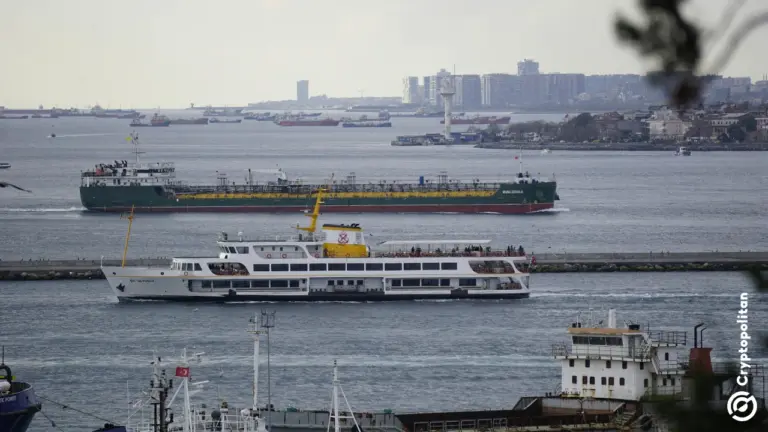
- Iran plans to charge oil tankers about $1 per barrel to cross the Strait of Hormuz, with some supertankers facing fees near $2 million.
- The proposed payment options include Bitcoin and Chinese yuan, as Iran seeks to avoid the U.S. dollar system and sanctions-related freezes on funds.
- Tankers were warned they could be attacked if they crossed without Iranian approval, while Fars said oil tanker passage through the strait had stopped.
Iran wants oil tankers to pay a steep new fee to cross the Strait of Hormuz after last night’s ceasefire announcement, with the bill set at $2 million per fully loaded supertanker.
The Iranians are demanding that the $2 million be paid in Bitcoin, and sometimes Chinese yuan, but mostly it’s going to be crypto.
Hamid Hosseini, a spokesperson for Iran’s Oil, Gas and Petrochemical Products Exporters’ Union, allegedly told the Financial Times that Iran wants to monitor everything entering and leaving the strait during this period.
Iran ceasefire in unclear limbo as many ships keep waiting for approval
Hosseini said vessels would go through a review process in which, first, an email request arrives, Iran finishes its assessment, and then the vessel gets only seconds to make payment in Bitcoin, which, of course, is already a major piece of Iran’s $7.8 billion crypto ecosystem.
“Everything can pass, but the procedure for each vessel will take time, and Iran is in no hurry,” Hosseini added.
On Wednesday, tankers in the Persian Gulf got a radio warning saying they could be hit by military force if they tried to pass without prior permission from Iranian authorities. The warning said, “If any vessels attempt to transit without permission, [they] will be destroyed.”
At the same time, Iran’s Fars News Agency reported that the passage of oil tankers through the Strait of Hormuz had been halted.
Iran also vowed to abandon the ceasefire deal and resume attacks if Israel continues to strike Lebanon, and it is preparing possible responses.
Reacting to the ceasefire talks, Foreign Minister Professor Seyed Abbas Araghchi said on X:
“What we care about are the terms of a conclusive and lasting END to the illegal war that is imposed on us.”
Oil tankers stranded as traders expect slow release amid uncertainty
Meanwhile, in Hungary on Wednesday, Vice President JD Vance called the Iran ceasefire a “fragile truce,” and said Iran’s foreign minister had reacted well, but others inside the country had been “lying” about the deal.
Vance said, “This is why I say this is a fragile truce.” He added, “You have people who clearly want to come to the negotiating table and work with us to find a good deal, and then you have people who are lying about even the fragile truce that we’ve already struck.”
JD also said the U.S. had “clear military, diplomatic and, maybe most importantly, we have extraordinary economic leverage” over Iran. While campaigning for Viktor Orbán’s reelection in Hungary, he said the president had given Iran an ultimatum: “Open up the streets, stop trying to hold the world’s economy hostage, and we’ll engage in a ceasefire.” He then said, “That’s exactly the agreement that we came to last night.”
Out on the water, Kpler said about 175 million barrels of oil and petroleum products are loaded on 187 tankers in the Persian Gulf, with 300 to 400 vessels waiting to leave once it becomes safe, calling the area a “parking lot.”
Cryptopolitan expects the next few days may look like the last two weeks, with only a limited number of Iran-approved vessels allowed through a specific route.
Defense Secretary Pete Hegseth continues to claim that “The strait is open,” and urges countries to simply send their ships through.
Trump’s Joint Chiefs Chairman Dan Caine, when asked if it was open at this moment, also said, “I believe so, based on the diplomatic negotiation.” Then came ship tracking data.
MarineTraffic said on X early Wednesday that two vessels, the Greek-owned NJ Earth and the Liberia-flagged Daytona Beach, passed through overnight.
But both were bulk carriers, not oil tankers, meaning they carry dry cargo, not crude. So those sailings did not prove that tanker traffic had truly restarted after the ceasefire, according to Kpler.
Trump, for his part, said this morning: “A Country supplying Military Weapons to Iran will be immediately tariffed, on any and all goods sold to the United States of America, 50%, effective immediately. There will be no exclusions or exemptions!”
If you're reading this, you’re already ahead. Stay there with our newsletter.
Disclaimer. The information provided is not trading advice. Cryptopolitan.com holds no liability for any investments made based on the information provided on this page. We strongly recommend independent research and/or consultation with a qualified professional before making any investment decisions.

Jai Hamid
Jai Hamid has been covering crypto, stock markets, technology, the global economy, and the geopolitical events that affect markets for the past 6 years. She has worked with blockchain-focused publications including AMB Crypto, Coin Edition, and CryptoTale on market analyses, major companies, regulation, and macroeconomic trends. She has attended London School of Journalism and thrice shared crypto market insights on one of Africa’s top TV networks.









