






Hyperscale pulls a Michigan site off the Bitcoin network for a $1.2 billion AI deal


- Hyperscale Data turned off all bitcoin miners at its Dowagiac, Michigan facility on September 1 as it prepares the site for an AI colocation contract expected to be worth about $1.2 billion.
- The agreement covers 20 MW of AI compute capacity for an unnamed California-based neocloud customer, with expansion rights that could lift total contract value to about $3 billion.
- The shutdown fits a broader mining-sector shift, as weak mining economics and more than $70 billion in announced AI/HPC contracts push listed miners to repurpose powered sites for AI workloads.
Another segment of Bitcoin’s global mining capacity came offline this week. Hyperscale Data (NYSE American: GPUS) turned off its Bitcoin miners at its facility in Dowagiac, Michigan, on September 1 and is now converting the site to an AI co-location cash contract worth over $1.2 billion as detailed by the company’s statement on September 2.
The importance of the shutdown for miners following developments in global hashrate is that it does not take place in a vacuum. Another powered and licensed facility is withdrawing from Bitcoin mining as it readies itself for AI clients.
What Hyperscale actually signed
According to the news release and 8-K filing of the company dated June 24, the deal took place between Alliance Cloud Services, a fully-owned subsidiary of Hyperscale and an unnamed neocloud provider based in California. The contract entails 20 megawatts of AI computing, as stated in the master services contract signed on June 23.
The contract has an initial duration of ten years, with an option to extend it twice for another five years. This would enable the contractor to earn up to $1.2 billion. Furthermore, the contractor has a right to make a first offer for an additional 32 MW of capacity. If the energy is acquired within the first two years and used throughout the extensions, the expected revenues could reach $3 billion. The contract stipulates that the client paid the developer each $5 million upfront charge and $5.6 million security deposit.
The immediate shutdown of the Bitcoin mining operations allows our team to focus the Facility’s power, infrastructure and resources in preparing the Facility for its usage by our Customer.
— William Horne, CEO, Hyperscale Data
Hyperscale intends to profit from the sales of the mining servers. It believes that it can eventually produce an estimated 340 MW of power at the Michigan facility.
Why a working mine gets switched off
The reason for this flip can be attributed to the economic aspect. In a prior report by Cryptopolitan, it was revealed that Hyperscale sold nearly 150.5 BTC amounting to nearly $9.6 million.
The data from CoinShares, mentioned in the same report, revealed that in the 4th quarter of 2025, the average cash cost of producing one Bitcoin would come up to somewhere around $79,995, which is much higher than the BTC rates of $68,000 to $70,000 at that point in time.
As mining margins are squeezed and AI clients provide solid contracts, a mining site that can supply power may be more valuable with GPU operations than its ASIC counterparts.
According to Horne, Hyperscale’s value should increase in line with the business securing more contracted power, which aligns generally with VanEck’s idea of valuing miners as infrastructure for AI.
The capacity draining out of mining
Hyperscale’s agreement is small when compared to big deals that are changing the industry. IREN has $9.7 billion of deals with Microsoft, TeraWulf has signed a deal worth approximately $19 billion with Anthropic, and Core Scientific reported more than $14 billion of expected revenue from contracts. Hashrate Index reports that listed miners have announced a total of more than $70 billion in AI and HPC contracts.
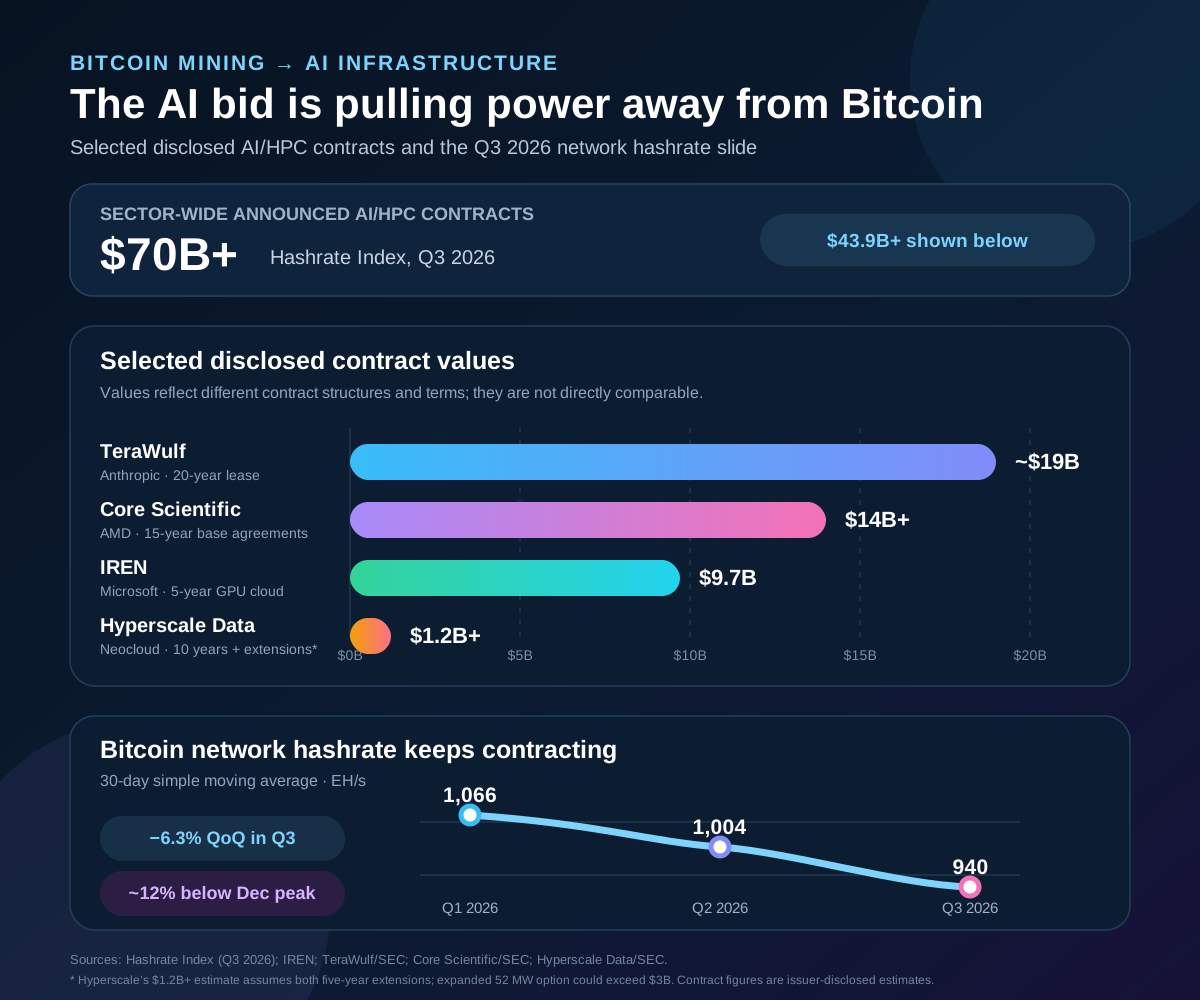
The transition is taking place as the Bitcoin network is weaker. The average monthly hashrate has decreased from approximately 1,066 EH/s in Q1 to 1,004 EH/s in Q2 and 940 EH/s in Q3 2026. This constitutes a quarterly reduction of 6.3%, as well as an overall drop of around 12% compared to the peak observed in December 2025, according to data from Hashrate Index.
This is a structural shift, not just a cyclical low. Miners everywhere are being revalued as energy and AI infrastructure.
— Ethan Vera, COO of Luxor, via Hashrate Index
According to Hashrate Index, the primary factor behind the decrease is the poor mining profitability. Meanwhile, AI and HPC are causing an additional structural pull in the long run.
According to Galaxy Research, the miners who are most suited for AI are those with large facilities and access to cooling water, dark fiber, consistent power, and the necessary permits. Hyperscale plans to continue mining at its facility in Montana.
What to watch next
Hyperscale has not published a new AI launch date for Michigan. The company’s Form 8-K dated June indicated that Phase 1 was expected to be operational by 21st September, although the press release accompanying the 8-K indicated that material revenues could begin at the end of September.
In the broader market, the key message is the trend: faltering economics in the mining industry are prompting the shutdown of high-cost operations at the exact time that AI is creating a better opportunity for the utilization of those power facilities.
Don’t just read crypto news. Understand it. Subscribe to our newsletter. It's free.
FAQs
Why did Hyperscale Data stop mining Bitcoin in Michigan?
The company halted mining on September 1 to prepare the Dowagiac facility for an AI colocation customer, saying the shutdown lets it focus the site's power and infrastructure on the new contract, according to CEO William Horne's statement.
How much is Hyperscale's AI deal worth?
The 20-megawatt master services agreement with a California-based neocloud provider is expected to exceed $1.2 billion if the customer exercises both five-year extensions, and could top $3 billion if it also takes an option for an additional 32 megawatts, per the company's SEC filing.
How does this fit the broader Bitcoin mining trend?
Listed miners have announced more than $70 billion in AI and HPC contracts, and Bitcoin's network hashrate fell about 6.3% quarter over quarter in Q3 2026, according to Hashrate Index, as unprofitable mining and stronger AI economics push operators to repurpose power capacity.
Disclaimer. The information provided is not trading advice. Cryptopolitan.com holds no liability for any investments made based on the information provided on this page. We strongly recommend independent research and/or consultation with a qualified professional before making any investment decisions.

Micah Abiodun
Micah Abiodun makes good use of his Environmental Engineering and Management (MSc) at Tallinn University of Technology (TalTech) to polish content and price prediction news at Cryptopolitan. Now on his 7th year in the crypto media space, he covers major cryptos, altcoins, DeFi, stablecoins, macro trends, and emerging tech.









