






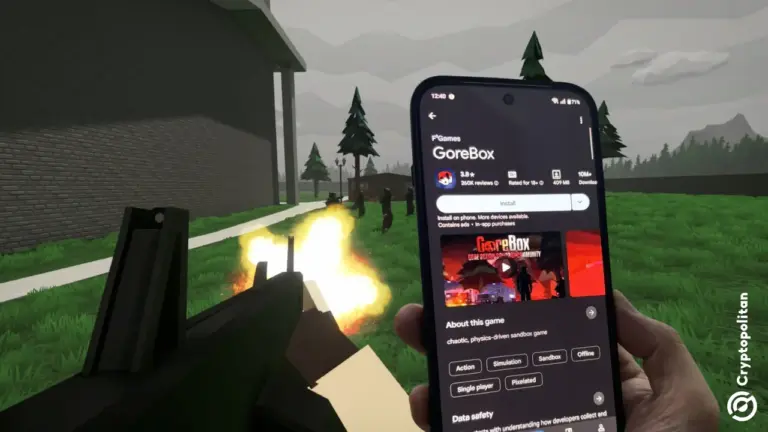
- The Philippines temporarily banned GoreBox after authorities linked one of the suspects in a deadly school shooting in Tacloban to the game.
- The move adds to growing global scrutiny of violent video games, following calls in France and investigations in Turkey after similar incidents.
- Researchers continue to find little evidence that violent games directly cause real-world violence, despite political pressure for stricter regulation.
On June 23, the Philippine government banned the action-packed sandbox video game GoreBox due to its suspected involvement in a school shooting that led to the deaths of three students in Tacloban City, joining other government initiatives around the globe that are poised to regulate violent video games more strictly.
This ban occurred amid the ongoing debate about President Emmanuel Macron’s suggestion in February to potentially ban specific games from being played by minors in France. Game developers and platform providers now have two key markets where the process of regulating violent games is underway, a pattern that could shape distribution rules and age-gating requirements across the industry.
What happened in Tacloban
Two students, aged 14 and 15, opened fire at San Jose National High School on June 22 using a 9mm Glock pistol and a .38-caliber revolver, according to Reuters. Police recovered at least 40 empty shell casings from the scene. The youngest person wounded was 12 years old.
Brigadier General Jason Capoy, Director of the Philippine National Police (PNP) Regional 8 Office, revealed that one of the suspects was an active user of GoreBox, a physics-based sandbox video game launched in 2023, where players have access to weapons, vehicles, and a destructible environment without any storyline.
“We are blocking GoreBox temporarily as a precautionary measure pending the investigation,” Aboy Paraiso, Undersecretary of the Philippine Cybercrime Investigation and Coordinating Center (CICC), explained in an official statement. The Threat Monitoring Center of the agency commenced additional monitoring of the said games in collaboration with the Council for the Welfare of Children.
Increasing pressure from watchdogs
The Philippine action follows a pattern. In February, Macron told French media outlet Brut that games “where you shoot everyone, including Fortnite” could “completely disinhibit” young people and “sometimes make them commit the worst acts.” He tasked experts and the National Digital Council with measuring the effects of games on minors, warning that bans should not be ruled out.
Philippine Senator Risa Hontiveros said that she plans to restart the Senate probe into online platforms and gaming spaces, which are reportedly used to “groom and radicalize children into committing violence.
Turkey was confronted with a similar dilemma following the Onikişubat school shooting on April 15, wherein a 14-year-old school boy murdered 10 people at a secondary school in Kahramanmaraş Province. Turkish authorities imposed a broadcast ban and launched investigations into the shooter’s online activity, including gaming habits.
No direct link between video games and aggression?
Decades of scientific studies have not shown a direct link between the violent content in video games and the manifestation of real-world aggression. For example, a longitudinal study carried out by Paul Adachi and Teena Willoughby and published in the Journal of Youth and Adolescence in 2013, involving 1,492 adolescents being monitored in grades 9 to 12, showed that it is not violent content, but rather competition in video games, that is a better predictor of aggression.
As reported in Le Monde, “hundreds of studies on the subject have found no connection between violence and playing video games.” This report contradicts Macron’s claim.
In addition to that, researchers from SUNY Buffalo and other universities identified another issue with user-generated content games, whereby they may expose minors to sexually and violently explicit content created by other users, according to the 2024 USENIX Security paper.
Is there a player age verification for RPG games like GoreBox?
There is no universal age-verification requirement for RPGs or sandbox games like GoreBox. Whether players must prove their age depends on the platform, the country, and the game’s own policies.
| Mechanism | How it works | Used by GoreBox? |
|---|---|---|
| Age ratings | Advisory labels indicating suitable ages | Yes |
| Self-declared birth date | User enters a date of birth, but it is rarely verified | Common |
| Identity verification | Uploading an ID card or using facial age estimation | No public indication |
| Parental controls | Parents restrict downloads or purchases | Available on some platforms |
Many countries would have different methods of containing violence in their jurisdictions.
| Jurisdiction | Typical Maximum Rating | Ban Threshold |
|---|---|---|
| United Kingdom | 18 | Gratuitous violence, sexual violence, or unlawful content |
| Germany | 18 | Glorification of violence or unconstitutional material |
| Australia | R18+ | Refused Classification if content exceeds legal limits |
| New Zealand | R18 | Material deemed “injurious to the public good” |
| China | No formal age rating system | Games may be denied approval entirely |
| Philippines | No mandatory game-rating law | Government agencies may block apps for public safety reasons |
What the games industry faces next
For studios distributing violent or sandbox-style games in Southeast Asia, the CICC’s move introduces a new variable: a government willing to pull a title from app stores mid-investigation, before any causal link is established. GoreBox remains blocked in the Philippines pending the outcome of the Tacloban probe.
Philippine Education Secretary Sonny Angara told reporters the government wanted to avoid “a situation seen in the United States, where there have been concerns about copycat incidents,” according to Reuters.
The civil defense agency is also expanding its mandate. Senior official Rafaelito Alejandro told Reuters the Philippines needs to “fast-track preparedness, not only for natural disasters but also for human-induced, crime-related incidents,” a shift that could eventually involve restrictions on content deemed to contribute to school violence.
Whether these regulatory moves will produce binding restrictions on game distribution or age-verification requirements remains unclear. What is clear is that politicians in Manila, Paris, and Ankara are reaching for the same lever, and the research base they cite to justify it remains thin.
If you're reading this, you’re already ahead. Stay there with our newsletter.
FAQs
What is GoreBox and why was it banned in the Philippines?
GoreBox is a physics-driven sandbox game launched in 2023 that offers players weapons, vehicles, and destructible environments, with no fixed storyline. The Philippines' Cybercrime Investigation and Coordinating Center temporarily blocked it after police confirmed one of the suspects in the June 22 Tacloban school shooting was a frequent player.
How many people were killed in the Tacloban school shooting?
Three students were killed, and 20 others were injured when two students aged 14 and 15 opened fire at San Jose National High School in Tacloban City on June 22, 2026, according to Reuters and the Philippine Daily Inquirer.
Do violent video games cause real-world violence?
A 2013 longitudinal study of 1,492 adolescents published in the Journal of Youth and Adolescence found that competition in games, not violent content, was the stronger predictor of aggression over time. Le Monde reported that hundreds of studies have established no direct link between playing violent video games and committing violent acts.
Could GoreBox face bans elsewhere in the world?
Unlike games such as Call of Duty or Grand Theft Auto, GoreBox resembles a sandbox where players can stage executions, torture scenes, and mass shootings using customizable weapons and NPCs. That puts it closer to the regulatory concerns that once surrounded Manhunt than mainstream shooters.
Could Sandbox Gore Games become the next target of global age-verification laws?
That question is becoming more relevant as governments move toward mandatory age assurance systems for minors accessing high-risk online content.
Disclaimer. The information provided is not trading advice. Cryptopolitan.com holds no liability for any investments made based on the information provided on this page. We strongly recommend independent research and/or consultation with a qualified professional before making any investment decisions.

Micah Abiodun
Micah Abiodun makes good use of his Environmental Engineering and Management (MSc) at Tallinn University of Technology (TalTech) to polish content and price prediction news at Cryptopolitan. Now on his 7th year in the crypto media space, he covers major cryptos, altcoins, DeFi, stablecoins, macro trends, and emerging tech.









