






- Goldfinch has announced that it will wind down its project.
- An investor has publicly accused the Goldfinch protocol of mismanaging over $50 million.
- The protocol’s native token (GFI) has lost 99.8% of its value since its peak.
An investor in the decentralized credit protocol Goldfinch (backed by Andreessen Horowitz), has publicly come out to claim that the project mismanaged over $50 million in user funds.
The investor claims that the widespread borrower defaults and failed loan restructurings have made it highly unlikely that depositors will ever recover their money.
Just one day after the post, the project announced it would be entering the wind-down process.
How the Goldfinch investor outrage became public
Last Friday, a pseudonymous crypto investor going by the name of Edward Morra posted “These idiots mismanaged over $50M of our money,” revealing that out of eight borrowers in the protocol’s loan book, two had defaulted and six were undergoing restructuring.
“Basically money is gone,” he said. The post drew more than 800 likes and 165 replies, suggesting broad frustration among depositors who locked capital into the protocol as early as September 2021.
Goldfinch confirmed those fears barely one day later as the project announced that it would “begin an orderly wind-down of Goldfinch Prime and to move Goldfinch into ‘maintenance mode’” after “reviewing the current status of Goldfinch Prime.”
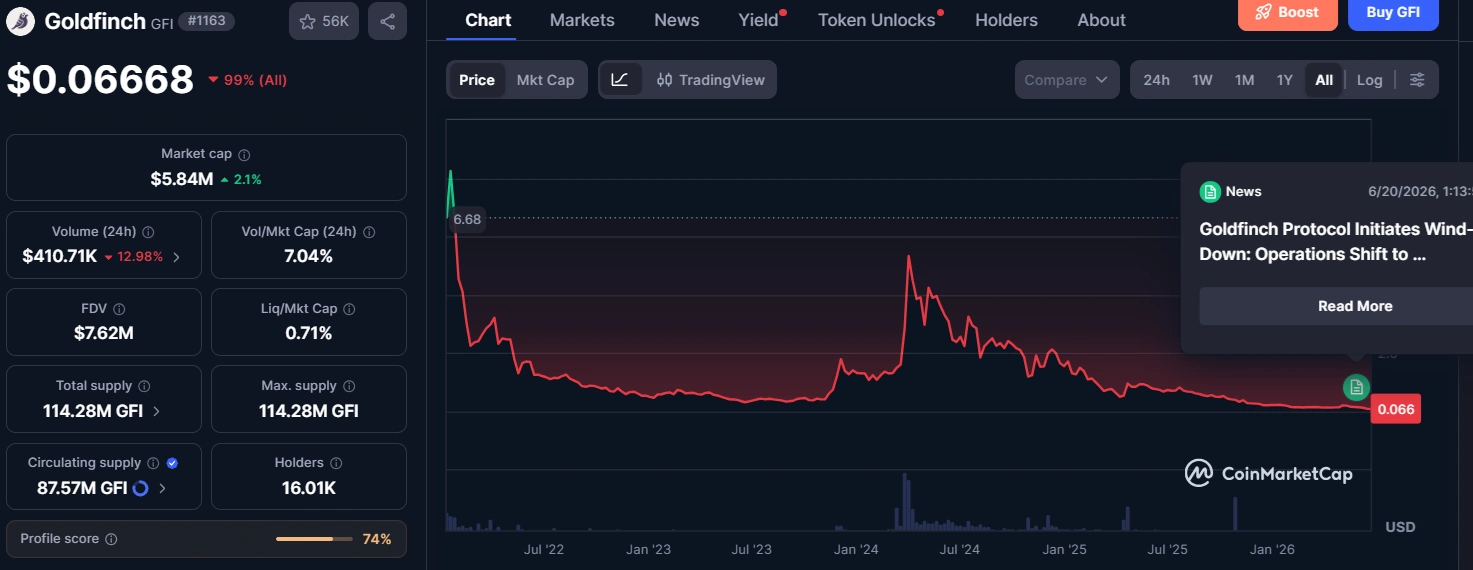
GFI, the protocol’s native token, traded at $32.94 at its January 2022 peak. It now sits below $0.07, a decline of 99.8%, according to CoinMarketCap. The project’s market capitalization, which exceeded $390 million as recently as April 2024, has also collapsed to less than $6 million.
How everything fell apart
Goldfinch launched in 2021 with the mission of trying to bring emerging markets together by connecting crypto capital to creditworthy businesses that traditional banks overlooked.
Founded by former Coinbase employees Mike Sall and Blake West, the protocol established credit lines for various lending enterprises across 18 countries, facilitating everything from financing for motorcycle taxis in Kenya to paycheck advances in Nigeria.
Andreessen Horowitz led a $25 million funding round in January 2022. In a blog post announcing the investment, a16z general partner Arianna Simpson pointed to $38 million in outstanding loans and “a huge global need for access to capital.” Coinbase Ventures, SV Angel, BlockTower, and hedge fund manager Bill Ackman also participated.
The problems started surfacing within months of that fund raise. In October 2021, Goldfinch had lent $5 million to Tugende Kenya, a motorcycle taxi financing company. The borrower diverted $1.9 million to its parent company in Uganda, breaching the loan terms, according to Protos. The facility was eventually written down before partial recovery.
A $20 million facility extended to U.S.-based credit fund Stratos produced its own losses. Stratos co-founder Mike Sall and co-founder Blake West disclosed in an October 2023 governance forum post that two of Stratos’s three underlying positions, in real estate tech company REZI and blockchain project POKT, would likely be written down to zero.
Warbler Labs, the company behind the Goldfinch protocol, pledged to backstop those losses for senior pool investors and backers.
Then came Lend East. The Singapore-based borrower informed Warbler Labs in April 2024 that it could repay only $4.25 million of its $10.15 million loan, a 58% loss of principal.
Sall described the shortfall in a governance forum update as “inconsistent with, and much higher than, all prior communications” from the borrower. One community member on the forum called the situation “borderline fraud from LendEast” and urged the protocol to use its treasury to make depositors whole.
From Africa to institutional credit
As the loan book deteriorated, Goldfinch pivoted. The protocol shifted its focus away from emerging-market borrowers toward institutional credit funds run by firms like Ares and Apollo. References to African borrowers and projects like clean water for schoolchildren also disappeared from the protocol’s marketing.
The trajectory mirrors a pattern among crypto projects that have promised to transform financial access on the continent.
Akon’s $6 billion blockchain city in Senegal was scrapped in 2025 after Akoin fell by 99%. Cardano’s pilot to register Ethiopian students on blockchain technology stalled after enrolling only tens of thousands at its peak, far below the 5 million target.
What depositors are watching
Warbler Labs has not publicly commented on Morra’s June 19 post. The protocol’s governance forum shows ongoing recovery discussions around Stratos and Lend East, but depositors who entered the senior pool in 2021 and 2022 face a loan book where nearly every facility is either impaired or being restructured.
GFI’s decline in value is now a major concern for holders, with the token’s market capitalization plummeting from $390 million to under $6 million. The situation now hinges on whether any significant capital can be recovered from the remaining borrowers, or if Goldfinch will ultimately be categorized as another failed experiment in the crypto lending space.
If you're reading this, you’re already ahead. Stay there with our newsletter.
FAQs
Who backed Goldfinch and how much did they raise?
Andreessen Horowitz led Goldfinch's $25 million funding round in January 2022, with additional backing from Coinbase Ventures, SV Angel, BlockTower, and hedge fund manager Bill Ackman.
What happened to Goldfinch's borrowers?
Of eight borrowers in the protocol's loan book, two are in default and six are undergoing restructuring, according to depositor Edward Morra. Specific losses include a $1.9 million diversion by Tugende Kenya, approximately $7 million impaired in the Stratos pool, and a 58% principal loss on a $10.15 million Lend East facility.
How much has the GFI token fallen?
GFI traded at its all-time high of $32.94 on January 11, 2022, and now trades below $0.07, a decline of 99.8%. The project's market capitalization dropped from over $390 million in April 2024 to less than $6 million.
Disclaimer. The information provided is not trading advice. Cryptopolitan.com holds no liability for any investments made based on the information provided on this page. We strongly recommend independent research and/or consultation with a qualified professional before making any investment decisions.

Hannah Collymore
Hannah is a writer and editor with nearly a decade of blog writing and event reporting experience in the crypto space. At Cryptopolitan, Hannah contributes to the news page, reporting and analyzing the latest developments in DeFi, RWA, crypto regulation, AI and frontier tech industries. She graduated from Arcadia university with a degree in Business Administration.









