




- The Eurozone faces economic risks in 2025, with Trump’s tariff threats and political instability driving projections of just 0.9%- 1.1% % growth.
- Germany’s political uncertainty and Europe’s stagnation weigh on markets, as European equities underperform compared to US stocks.
- Economists urge trade talks with Trump to avoid a trade war, but opinions differ on strategy.
The Eurozone is bracing for a strenuous 2025 as economists highlight mounting risks from a potential global trade war and regional political instability. A Financial Times poll of 72 economists identifies these factors as the most significant threats to the region’s economic health, with consensus forecasts projecting a mere 1.1% growth for the year.
US President-elect Donald Trump’s promise to impose tariffs of up to 20% on US imports, with a potential escalation to 60% on Chinese goods, has raised fears of heightened protectionism. If enacted, these measures would represent the most significant increase in US tariffs since the Great Depression, likely triggering retaliatory actions from affected countries.
The Eurozone, which maintains a significant trade surplus with the US, faces heightened exposure to these tariffs. Economists also warn of potential disruptions from China, which might flood global markets with cheap goods in response to Trump’s policies.
Trade wars loom large: Should the Eurozone brace for impact?
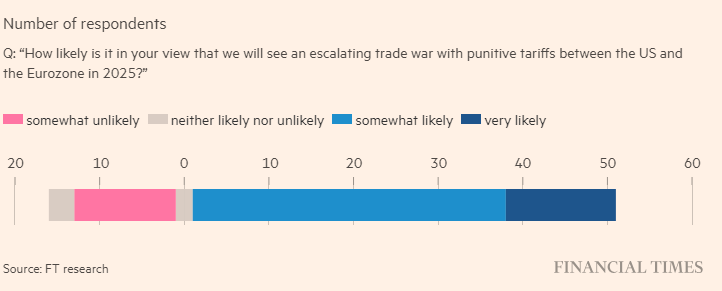
Nearly 69% of FT poll respondents anticipate a US-EU trade conflict, while 81% expect Trump’s return to weigh heavily on Eurozone growth. “Trump’s second presidency is now the single biggest political and economic risk,” said Mujtaba Rahman, managing director for Europe at Eurasia Group.
Economists expect the Eurozone to expand by just 0.9% in 2025, marking a third consecutive year of below-average growth. This outlook aligns with a recent European Central Bank (ECB) survey of independent economists, which showcased several downside risks.
The mere anticipation of tariffs will likely prompt businesses to delay investments as fear of the “unknown” creeps into business sectors.
John Llewellyn, a former senior economist at the OECD, predicted an even gloomier scenario, suggesting the Eurozone economy could shrink by 1% over the year. “Economic stability is far more fragile than the modern generation recognizes,” he warned.
Political ‘paralysis’ could create domestic challenges
Across Europe, analysts are forecasting political fragmentation that could further complicate the economic landscape. Most of them believe Germany is unlikely to achieve a stable government until after snap elections in February, while France remains politically stagnant until President Emmanuel Macron’s term ends in 2027.
Economist Ulrich Kater of Germany’s Deka Bank likened Europe’s struggles to those of the “late Habsburg empire,” citing bureaucratic inefficiencies and a lack of technological innovation. “Europe is bogged down by melancholic remembrance of its former greatness,” he added.
⚠️EUROZONE MANUFACTURING IS IN DISMAL PLACE⚠️
— Global Markets Investor (@GlobalMktObserv) December 27, 2024
Manufacturing activity in the Euro-Area has been SHRINKING for 29 months straight.
This is the longest streak since the 2011-2012 European Debt Crisis.
Services also fell to contraction in November..👇https://t.co/OlSrKmUzsH
European equities have underperformed against their US counterparts, with the Euro Stoxx 600 index trading at a record 40% discount to the S&P 500 based on next year’s forecast earnings. Despite near-record highs in European stock markets, global fund managers remain underweight on European equities, according to a Bank of America survey.
While some analysts hold out hope for a German rebound after February’s elections, others aren’t convinced there’s hope. Marcel Fratzscher, president of DIW, cautioned against expecting a new German government to provide a significant boost to confidence.
Trade negotiations to re-ignite optimism
The majority of economists in FT’s poll, 61%, support ECB President Christine Lagarde’s call for EU policymakers to engage in trade talks with Trump to stave off an all-out trade war. However, opinions are divided on the best approach.
“[The EU] may want to use the threat of retaliation as part of the negotiation. But ultimately, tariffs are a self-inflicted harm, and the EU would be better off not using them,” said Isabelle Mateos y Lago, chief economist at BNP Paribas.
Others are less optimistic about a conciliatory approach. “Trump has the mentality of a playground bully,” remarked Kamil Kovar, senior economist at Moody’s, warning that concessions could encourage more aggressive policies from the US.
Some economists see reasons for hope, backing their optimistic views with declining interest rates and a potential rise in consumer demand could offer modest relief. Additionally, reforms stemming from Germany’s elections could ease fiscal constraints, potentially lifting the country’s constitutional debt brake and spurring investment.
“The psychological depression in Germany could be turned around if a new coalition presents a coherent reform program,” said Moritz Kraemer of LBBW.
Nonetheless, significant challenges remain, with economists calling for coordinated efforts to address both external and internal risks to the Eurozone’s “fragile” recovery.
The smartest crypto minds already read our newsletter. Want in? Join them.
Disclaimer. The information provided is not trading advice. Cryptopolitan.com holds no liability for any investments made based on the information provided on this page. We strongly recommend independent research and/or consultation with a qualified professional before making any investment decisions.

Florence Muchai
Florence has been covering for the past 6 years crypto, gaming, tech, and AI news. Her Computer Studies at Meru University of Science and Technology and Disaster Management and International Diplomacy at MMUST amply equip her with language, observation and technical skills. Florence has worked at VAP Group and as an editor for several crypto media houses.