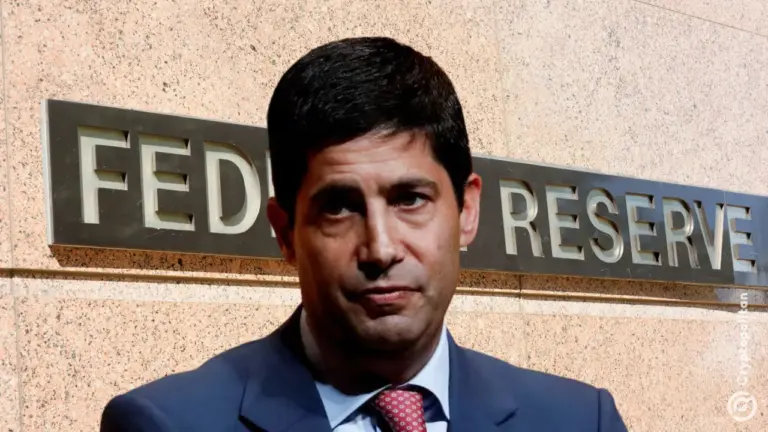
A growing number of market watchers say a potential shift to Kevin Warsh at the Federal Reserve could do more than tweak policy. It could change how money moves through the system.
At the center of the discussion is the Fed’s balance sheet. Warsh has been clear; he wants it smaller. After years of heavy stimulus, he argues the central bank has taken on too large a role in markets.
“Run the printing press a little bit less. Let the balance sheet come down. Let Secretary Bessent handle the fiscal accounts, and in so doing, you can have materially lower interest rates.”
— Kevin Warsh, Fox Business
That puts him on a different path from current Chair Jerome Powell, who, as Cryptopolitan reported, has prioritized keeping liquidity abundant to avoid market disruptions.
How the mechanics would work
The impact starts with the Fed shrinking its balance sheet. When the Fed lets bonds mature without replacing them, cash is effectively pulled out of the system.
That reduction shows up in two main places: the reverse repo facility and bank reserves.
Money market funds currently park excess cash at the Fed through the RRP. As overall liquidity declines, there is simply less cash to park.
That means RRP balances fall.
In practice, funds move out of the Fed and into Treasury bills or private markets offering higher yields. This is usually the first adjustment layer and the least disruptive.
Once RRP balances shrink toward lower levels, further balance sheet reduction begins to hit reserves held by banks.
That’s where things become more sensitive.
Banks rely on reserves to meet liquidity requirements and for daily funding. If reserves fall too far, funding costs rise, and lending tightens.
That’s also when stress can emerge in short-term funding markets, as seen in past episodes.
“If Kevin cuts too fast, banks could run into trouble trying to borrow short-term.”
— Joseph Abate, SMBC Nikko
Stablecoins sit downstream of this process
As bank-based liquidity tightens, market participants often look for alternative dollar access. Stablecoins fill that role. They are typically backed by short-term Treasuries and repo instruments.
So when yields rise under tighter liquidity, their underlying assets become more attractive. At the same time, reduced bank balance sheet capacity can push activity toward on-chain dollars.
That can increase stablecoin usage in trading, settlement, and collateral.
“The price of money is like the Snickers bars and sugar goo I consume to get a quick glucose boost. The quantity of money is like the slow, long, burning ‘real food.’”
— Arthur Hayes, Sugar High
A feedback loop into crypto markets
For crypto markets, the implications are indirect but significant. Lower RRP balances mean fewer low-risk yield outlets in traditional finance.
That can push capital to search for returns elsewhere, including DeFi. Falling bank reserves, meanwhile, tighten credit conditions.
That often leads to short-term pressure on risk assets, including crypto. But it can also increase reliance on stablecoins as a parallel liquidity layer. At the same time, markets tend to price these shifts early.
The bottom line
The sequence is straightforward, even if the outcomes are not:
- Balance sheet shrinks
- Reverse repo balances decline
- Bank reserves come under pressure
- Liquidity tightens across the system
- Stablecoins gain relevance as alternative dollar rails
A Warsh-led Fed would likely mean less excess cash in the system.
And more sensitivity to shocks.
For investors, that points to a more unpredictable environment. One where liquidity matters more, and where it comes from may start to change.