




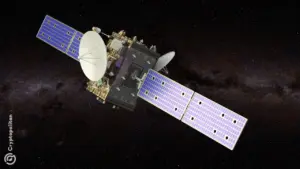



- A Hong Kong university team built a 100-kilogram humanoid rover with four wheels for China’s Chang’e-8 lunar mission in 2029.
- The robot’s job is to haul instruments to the moon’s south pole, deploy them, and collect surface samples.
- China installed over 80 percent of the world’s humanoid robots last year and committed ~1 trillion yuan to robotics and AI.
A team out of Hong Kong University of Science and Technology built a 100-kilogram rover with a humanoid torso and four wheels. It’s headed to the moon’s south pole in 2029 on China’s Chang’e-8 mission.
The job is simple. Move gear. Once the Chang’e-8 probe lands, the rover hauls instruments and sensors to their spots, deploys them, and grabs surface samples.
Hong Kong Space Robotics and Energy Center led the build, working with 30 universities and space groups across Hong Kong, mainland China, and a few international partners.
“This will be a novel demonstration of humanoid robotics on the moon and by China. We are very proud of this design,” Gao Yang, the HKUST professor who runs the center, said on April 29.
Chang’e-8 targets a different slice of the lunar south pole than Chang’e-7, which is supposed to land its own humanoid robot in the same general area.
“We have heard that Chang’e-7 is probably going to see the first humanoid robot landing on the south pole. But our robot will go to a different part of the south pole,” Gao told SCMP reporters.
The south pole is huge and scientifically interesting, so China’s covering multiple zones across both missions.
China’s broader robotics push
Chinese lawmakers passed the country’s 15th Five-Year Plan (2026-2030) earlier this year.
Embodied artificial intelligence made the top priority list for the next half-decade, Cryptopolitan previously reported.
China put in more than 80% of the humanoid robots installed worldwide last year.
That dominance comes mostly from government policies that favor domestic manufacturers.
The National Development and Reform Commission announced plans to deploy ~1 trillion yuan, or $138 billion, to support robotics, AI, and related innovation.
At the Beijing E-Town half-marathon in April 2026, a robot built by smartphone maker Honor finished the course in 50 minutes and 26 seconds.
Faster than the human world record of roughly 57 minutes set by Uganda’s Jacob Kiplimo.
Of 102 robot teams entered, 47 crossed the finish line, up from just 6 out of 20 teams the year before, Cryptopolitan reported.
Washington is concerned over Chinese robotics technology
China’s robotics expansion caught Washington’s attention.
In March 2026, Senators Tom Cotton and Chuck Schumer introduced the American Security Robotics Act, bipartisan legislation that would ban the federal government from buying or operating unmanned ground vehicles made by foreign adversaries.
The bill’s sponsors pointed to risks of data exfiltration and remote hijacking through backdoors in Chinese-made robotic systems, according to a press release from Senator Cotton’s office.
U.S. robotics executives met with lawmakers on Capitol Hill in March 2025 to push for a national robotics strategy.
Leaders from Tesla, Boston Dynamics, and Agility Robotics all showed up.
Jeff Cardenas, Apptronik CEO, told lawmakers, “We’re leading in AI, and I think we’re building some of the best robots in the world.” He continued, “But we need a national strategy if we’re going to continue to build and stay ahead.”
The smartest crypto minds already read our newsletter. Want in? Join them.
FAQs
What is China's Chang'e-8 moon mission?
Chang'e-8 is a Chinese lunar mission set for 2029. It will send a probe to the moon's south pole carrying a 100kg AI-powered rover to move and install scientific instruments.
Who built the Chang'e-8 lunar rover?
The rover was developed by the Hong Kong Space Robotics and Energy Centre at the Hong Kong University of Science and Technology. Professor Gao Yang led the project, working with 30 universities and space organizations in Hong Kong, mainland China, and overseas.
How does this relate to the U.S.-China robotics competition?
China accounted for +80% of humanoid robots installed globally last year. The country has committed ~1 trillion yuan to robotics and AI investment. That pace prompted U.S. lawmakers to introduce the American Security Robotics Act, which bans federal procurement of Chinese-made robotic systems.
Disclaimer. The information provided is not trading advice. Cryptopolitan.com holds no liability for any investments made based on the information provided on this page. We strongly recommend independent research and/or consultation with a qualified professional before making any investment decisions.

Randa Moses
Randa Moses is an editor and reporter at Cryptopolitan covering tech, AI, robotics, crypto, scams, and hacks. She has worked in the crypto space since 2017. She held roles at Forward Protocol, AmaZix, and Cryptosomniac. Randa holds a degree in Electrical and Electronics Engineering from the University of Bradford.









