







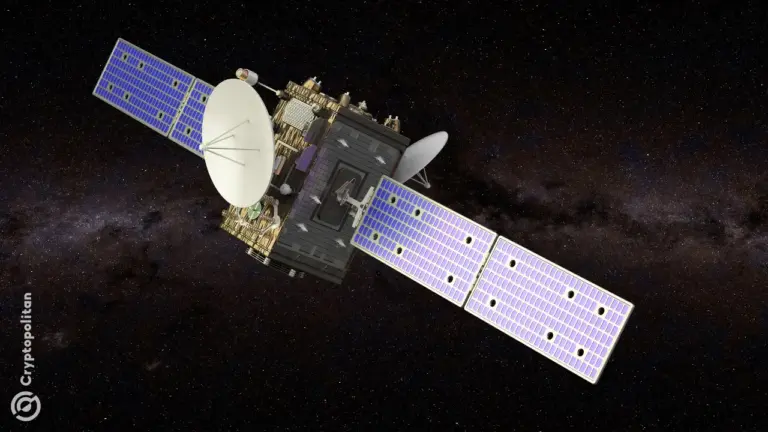
- China applied to ITU for over 200,000 satellites in December 2025—the largest constellation request ever.
- The Radio Innovation Institute, formed on December 30, 2025, filed for 190,000+ satellites, including two networks of 96,714 each.
- This is China’s strategic move to challenge SpaceX, though actual deployment will take years and massive resources.
In a daring move that puts it in direct rivalry with businesses like SpaceX’s Starlink for control of internet access from space, China has submitted papers to the International Telecommunication Union requesting space for over 200,000 satellites.
Shanghai Securities News reports that the documents were submitted to the ITU last month. For what would be one of the biggest satellite projects ever attempted, radio frequencies and orbital locations are covered by the request. The scale of this application, according to space industry experts, indicates that China is making space-based internet a significant national priority.
The request does not guarantee that every one of these satellites will launch. Everything must be reviewed by the ITU, and nations must cooperate on these matters. However, China’s goals are obvious: it wants a sizable portion of the low-Earth orbit satellite market.
New institute leading the charge
A new group called the Radio Innovation Institute is leading the charge. The institute was officially established on December 30, 2025, in Xiong’an New Area. It is backed by the government and focuses on radio technology.
Seven groups came together to create this institute. The State Radio Monitoring Center is one of the founders. China Satellite Network Group Co., Ltd., which runs the country’s main satellite internet operations, is another. The list also includes Hebei Xiong’an New Area Management Committee, Hebei Provincial Department of Industry and Information Technology, Nanjing University of Aeronautics and Astronautics, Beijing Jiaotong University, and China Electronics Technology Group Corporation.
The institute’s objectives are to maximize the available radio frequencies and promote the expansion of the satellite internet industry. It is the center of what officials refer to as the “national team” approach.
Several constellations are in the works
The applications ask for permission for more than twelve different satellite groups. Some are small, with just dozens of satellites, while others are huge. The two biggest proposals are called CTC-1 and CTC-2. The Radio Innovation Institute filed both, and each one includes 96,714 satellites.
Smaller requests were submitted by other groups. Under the moniker CHINAMOBILE-L1, China Mobile intends to launch 2,520 satellites. For its SAILSPACE-1 network, Yuanxin Satellite requested 1,296 satellites. Guodian Gaoke proposed plans for 1,132 satellites in the TIANQI-3G system. The variety of companies involved suggests that the government is working with both more modern commercial companies and well-established state-run institutions.
Experts warn that filing with the ITU is just the first step. China does not necessarily have the factories, launchers, or money required to launch the satellites just because it has frequency licenses. Building and launching hundreds of thousands of satellites requires years and enormous financial resources.
Still, industry watchers think the Radio Innovation Institute could help speed things up. By bringing together resources from across the industry and using China’s large home market and strong manufacturing base, the institute might help Chinese companies move faster. This could let them catch up to SpaceX, which already has thousands of Starlink satellites in space, providing internet service to customers worldwide.
Whether China can pull this off depends on many factors. The country will need to continue spending money on the project for many years. Scientists and engineers will need to solve tough technical problems. Chinese officials will need to work with other countries through the ITU to settle disputes about who gets to use which frequencies and orbital locations.
The satellite internet race is heating up. China’s massive filing shows the country plans to be a major player in this market. The coming years will reveal whether these ambitious plans become reality.
Don’t just read crypto news. Understand it. Subscribe to our newsletter. It's free.

Hania Humayun
Hania joined Cryptopolitan with a long history of analyzing finance, economic trends, and prediction markets. She covered topics in emerging technology, AI, and fintech. Hania’s experiences as a licensed architect have added verve and precision to newswriting. She graduated from the National College of Arts in Lahore with an Architecture degree,









