






Bain & Company backs $320B stablecoin sector to rewire wholesale banking


- Bain advises institutions to prioritize compliance and operational integration with a focus on foreign exchange settlement
- The stablecoin sector is now worth $320.6 billion, with projections suggesting it could grow up to 12-fold by 2030.
- The CLARITY Act faces delays in the Senate due to disagreements over stablecoin yield.
A new report from the global consulting firm Bain & Company, one-third of the big three consulting firms with McKinsey & Company and Boston Consulting Group (BCG), has named stablecoins as central to the future of wholesale banking.
Bain & Company published the report on April 29, arguing that stablecoins and tokenized deposits are no longer seen as speculative crypto instruments but rather as strategic tools for moving money across wholesale banking.
Big three consulting firm Bain & Company backs stablecoins
Bain & Company recently released a report titled “From Hype to Hard Value: Stablecoin and the Great Rewiring of Wholesale Banking.” The report was authored by a six-person team including Ricardo Correia, Karim Ahmad, and Philipp Grimmig.
In the report, Bain defines the current market trend as the “great rewiring of wholesale banking.” The firm argues that traditional banking has a “friction problem” due to the slow nature of cross-border payments.
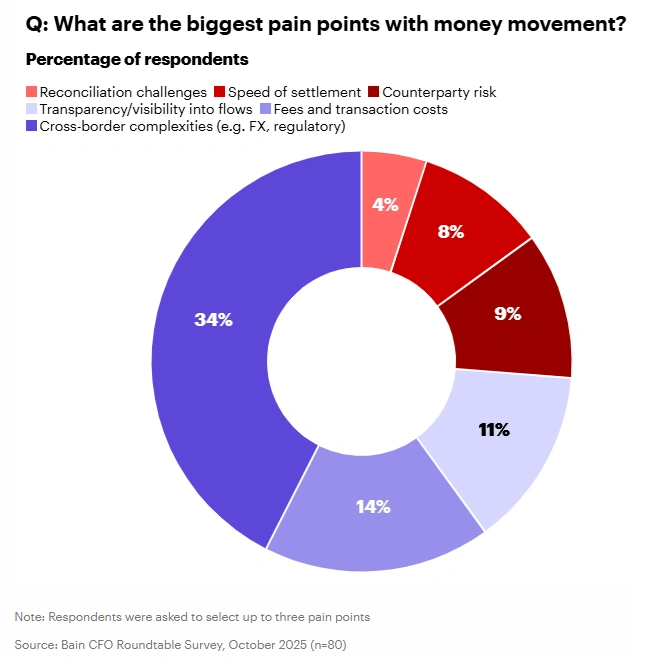
Beyond that, collateral management ties up billions in idle capital, and treasury operations are fragmented. Stablecoins, on the other hand, are “always-on” and programmable. Transactions are settled instantly instead of in days, and without the involvement of multiple intermediaries.
Bain argued that stablecoins and tokenized deposits have become key parts of the “future architecture of money movement” and should be treated as a priority by wholesale banks and global corporations.
Bain advises institutions to prioritize compliance and operational integration with a focus on foreign exchange settlement, derivatives collateral management, and corporate treasury liquidity.
Why is the CLARITY Act stalled?
The stablecoin sector currently has a total market capitalization of $320 billion, according to data from DefiLlama. For banks and issuers to be capable of moving that money safely, they need the CLARITY Act, which is currently stalled. The bill focuses on clearly classifying which digital assets are securities and which are commodities.
Senator Thom Tillis (R-NC) confirmed to Crypto in America host Eleanor Terrett that he is pushing for a committee vote on the CLARITY Act in May, but negotiations have been delayed. The GENIUS Act, which focuses on stablecoins specifically, has also been advancing through committee.
Cryptopolitan has reported that lobbyists for traditional banks are unable to accept any rules that would allow crypto platforms to offer interest on stablecoins, arguing it could pull trillions of dollars out of the traditional banking system.
Notably, the Trump admin has downplayed that scenario in an April paper, as Cryptopolitan reported.
Senator Tillis is reportedly still working on finalizing the legislative text. He stated that he hopes to release the text 4-5 days before the vote to allow stakeholders to preview it.
If the committee does not approve the bill by mid-May, the odds of it passing this year drop significantly due to the election calendar. Without these laws, the rewiring that Bain described cannot happen on a large scale.
The smartest crypto minds already read our newsletter. Want in? Join them.
FAQs
What did Bain & Company's stablecoin report say?
Bain argued that stablecoins and tokenized deposits have become essential to the future of money movement in wholesale banking, with the best opportunities in foreign exchange, collateral, and treasury use cases. The firm said compliance and operational integration, not transaction speed, will determine which institutions scale most effectively.
How large is the stablecoin market in 2026?
As of April 29, 2026, total stablecoin market capitalization was $320.655 billion, according to DefiLlama, with Tether's USDT holding a 59.14% market share.
What is the Clarity Act and how does it relate to stablecoins?
The Clarity Act is US legislation aimed at defining whether digital assets qualify as securities or commodities. Senator Thom Tillis said on April 29 that he will push for a committee markup, and broader regulatory clarity could accelerate institutional adoption of stablecoin infrastructure.
Disclaimer. The information provided is not trading advice. Cryptopolitan.com holds no liability for any investments made based on the information provided on this page. We strongly recommend independent research and/or consultation with a qualified professional before making any investment decisions.

Hannah Collymore
Hannah is a writer and editor with nearly a decade of blog writing and event reporting experience in the crypto space. At Cryptopolitan, Hannah contributes to the news page, reporting and analyzing the latest developments in DeFi, RWA, crypto regulation, AI and frontier tech industries. She graduated from Arcadia university with a degree in Business Administration.









